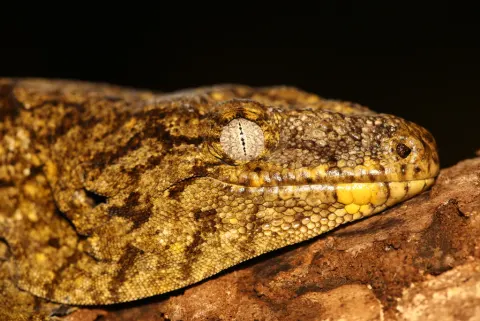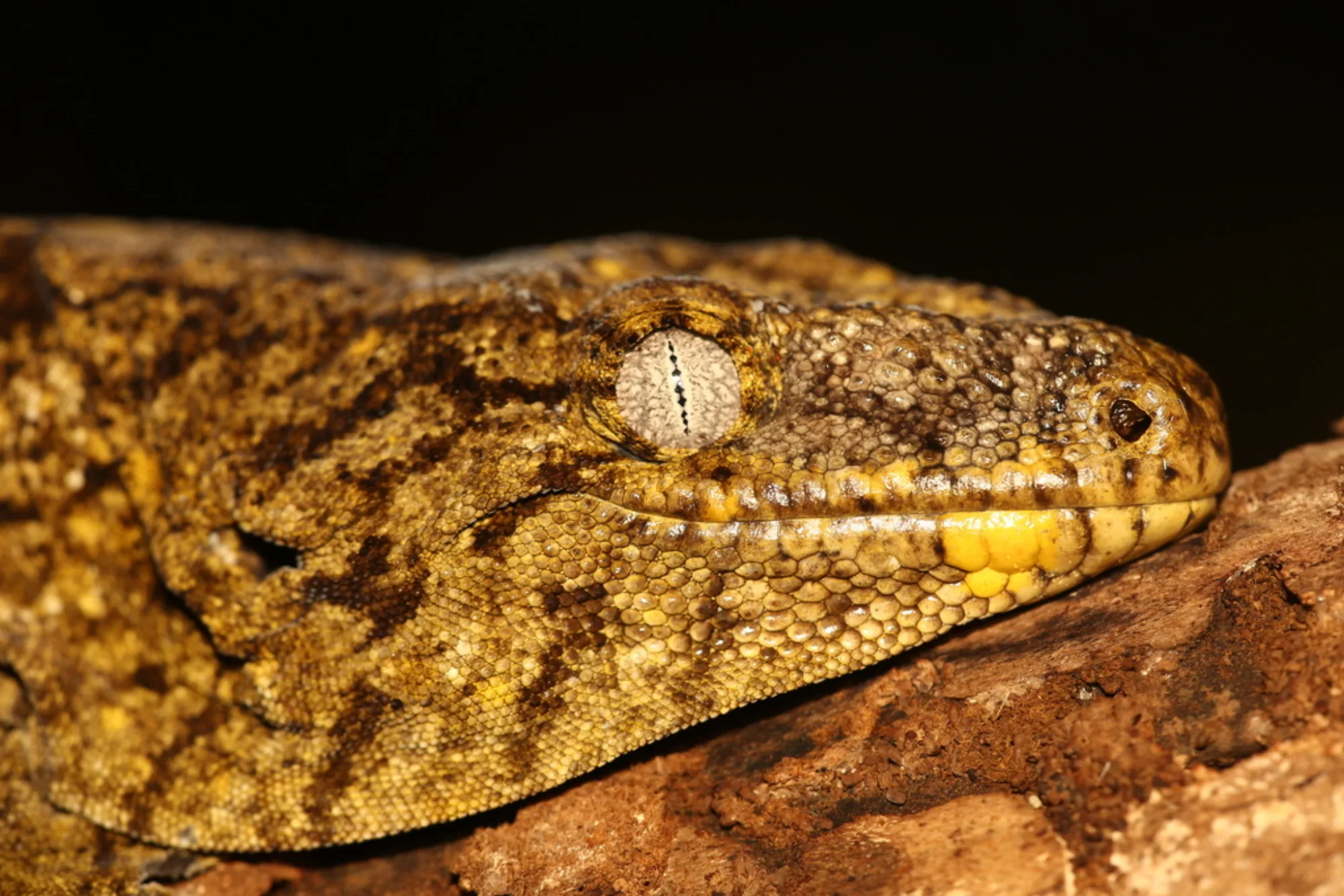
New Caledonia Giant Gecko
Rhacodactylus leachianus
Heavy-bodied and wrapped in loose skin, the New Caledonia Giant Gecko has a small, stumpy tail and a mottled coat of green, grey or brown, sometimes highlighted with white, orange or pink. It is the largest living gecko, although its size varies between locations: animals from Grande Terre can reach 360 to 430 mm in length, while those from smaller islands can reach 23 to 30 cm. Native to New Caledonia, it occurs across the southern and eastern parts of the main island and on several smaller islands. It lives in trees, hiding in hollows by day and becoming active mainly at night.
Fruit from Cassine curtipendula is its most common food, but it also eats spiders, insects and small vertebrates, as well as nectar and sap. The gecko can climb vertical glass, using adhesive pads on its feet and large claws to help it climb. It can also shed its tail and grow it back. In the wild, a male and female commonly share a tree hollow and defend it with territorial behaviour, including calls. A loud growl may warn off a predator or rival, while clucking is often heard at night and associated with calling to a mate. Females usually lay two eggs at a time and can produce up to 10 clutches a year.
Habitat destruction and degradation have likely reduced populations and remain a threat. Introduced cats and rodents prey on the gecko, which is also poached and can be electrocuted while travelling along power lines. The species is protected and lives in several nature reserves.
Written from the English Wikipedia article Rhacodactylus leachianus (CC BY-SA 4.0).
- Records
- 17
- Countries
- 1
No atlas park has a record of the New Caledonia Giant Gecko in or around it yet.
These are open occurrence records, so they show where people looked for and recorded the New Caledonia Giant Gecko as much as where it lives. Cells are up to 25 km across, and every location is generalised to its cell.
Generalised encounter areas, not exact locations. Each shape is a grid cell coloured by how likely the species is there.
- Very likelyNew Caledonia25 km zone · medium confidence · 17 records · updated 80 days ago
Conservation status not assessed here yet, so every location is generalised to its grid cell.