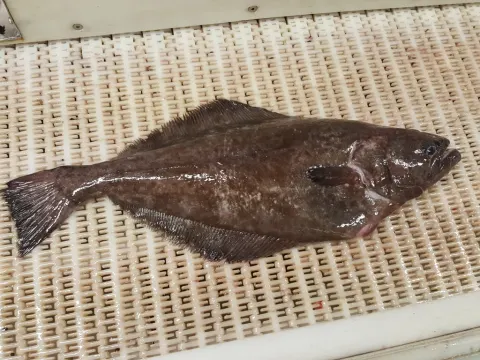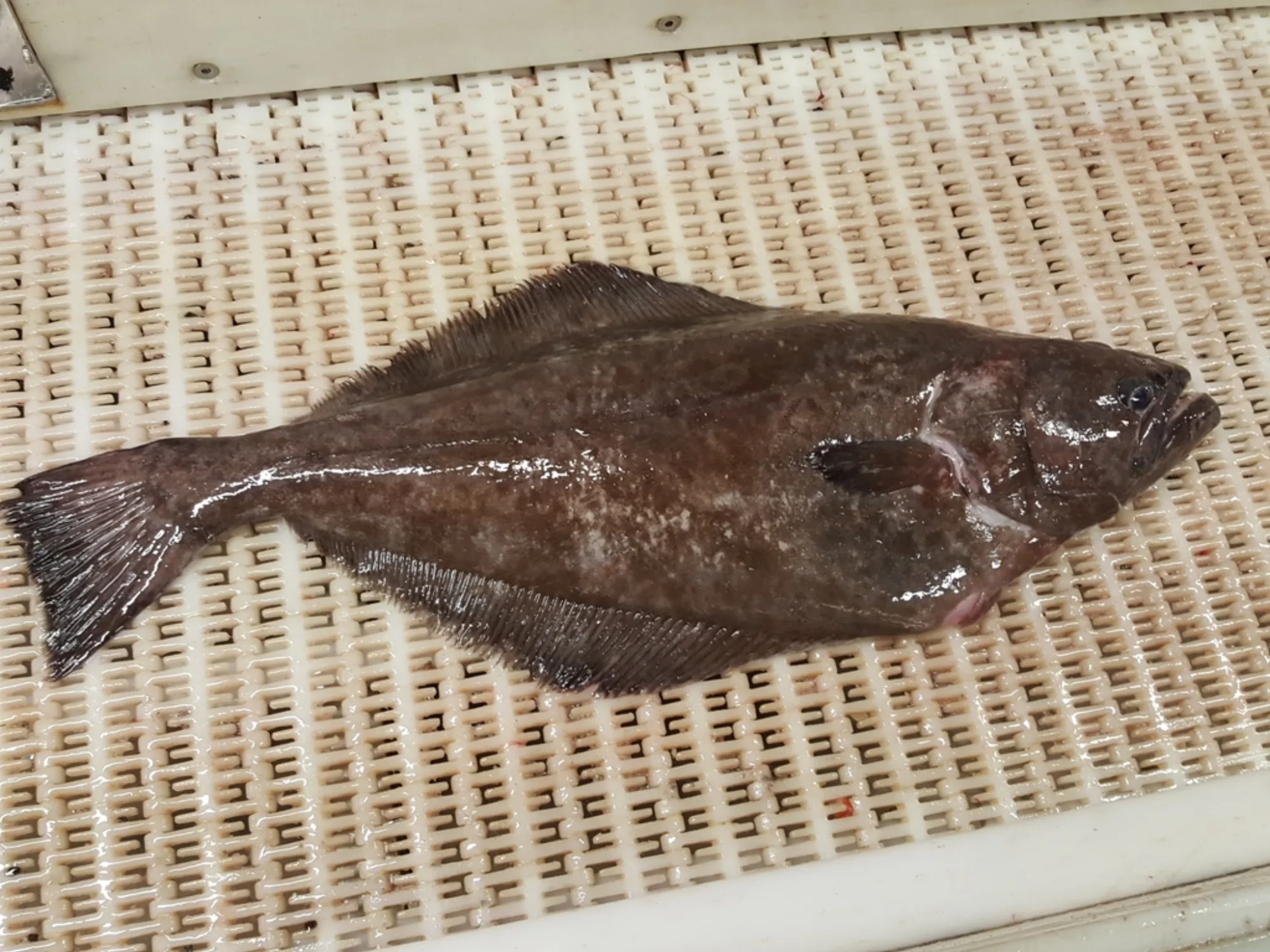
Greenland Halibut
Reinhardtius hippoglossoides
A long, flattened predator of cold northern seas, the Greenland Halibut has a speckled brown body, paler on its left side than on its right. Its left eye sits high on the head, giving the fish a one-eyed appearance when viewed from the front. Adults are normally 80 to 100 cm long and weigh 11 to 25 kg, although larger individuals occur. It can swim upright, and may be able to see forwards.
This flatfish ranges across the northern Atlantic, northern Pacific and Arctic Oceans, from the British Isles and Norway to Greenland, and from waters near Japan through the Aleutian Islands to northern Baja California. It lives from near the surface down to 2,200 m, most often between 500 and 1,000 m, in water mainly between 1 and 4 °C. Tagging shows that it spends time close to the seabed and makes frequent trips into the water above, probably to feed. Young fish under 20 cm eat small crustaceans; as they grow, they begin to take shrimp and fish. Larger fish mainly eat other fish, while the prey available varies between regions. Spawning takes place from January to March, with eggs and larvae drifting in the water column as they develop.
Overfishing is the main threat, and some local populations have continued to decline despite a slight overall increase since the 1980s. Some deep-water spawning grounds lie in areas of oil and gas extraction. Others are near shore, where the ecosystem depends on nutrients from gradually disappearing glacial meltwater. Bottom trawling for the fish can also cause significant environmental damage.
Written from the English Wikipedia article Greenland halibut (CC BY-SA 4.0).
- Records
- 19,273
- Countries
- 5
- Atlas places
- 1
These are open occurrence records, so they show where people looked for and recorded the Greenland Halibut as much as where it lives. Cells are up to 25 km across, and every location is generalised to its cell.
Generalised encounter areas, not exact locations. Each shape is a grid cell coloured by how likely the species is there.
- Very likelyCanada25 km zone · high confidence · 13784 records · updated 80 days ago
- Very likelySvalbard & Jan Mayen25 km zone · medium confidence · 2417 records · updated 80 days ago
- Very likelyNorway25 km zone · high confidence · 1539 records · updated 80 days ago
- Very likelyUnited States25 km zone · medium confidence · 972 records · updated 80 days ago
- Very likelyUnnamed area25 km zone · medium confidence · 496 records · updated 80 days ago
- Very likelyGreenland25 km zone · high confidence · 65 records · updated 80 days ago
Conservation status not assessed here yet, so every location is generalised to its grid cell.