Goldcrest
Regulus regulus
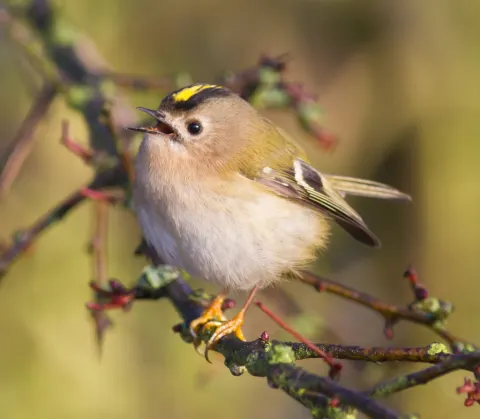
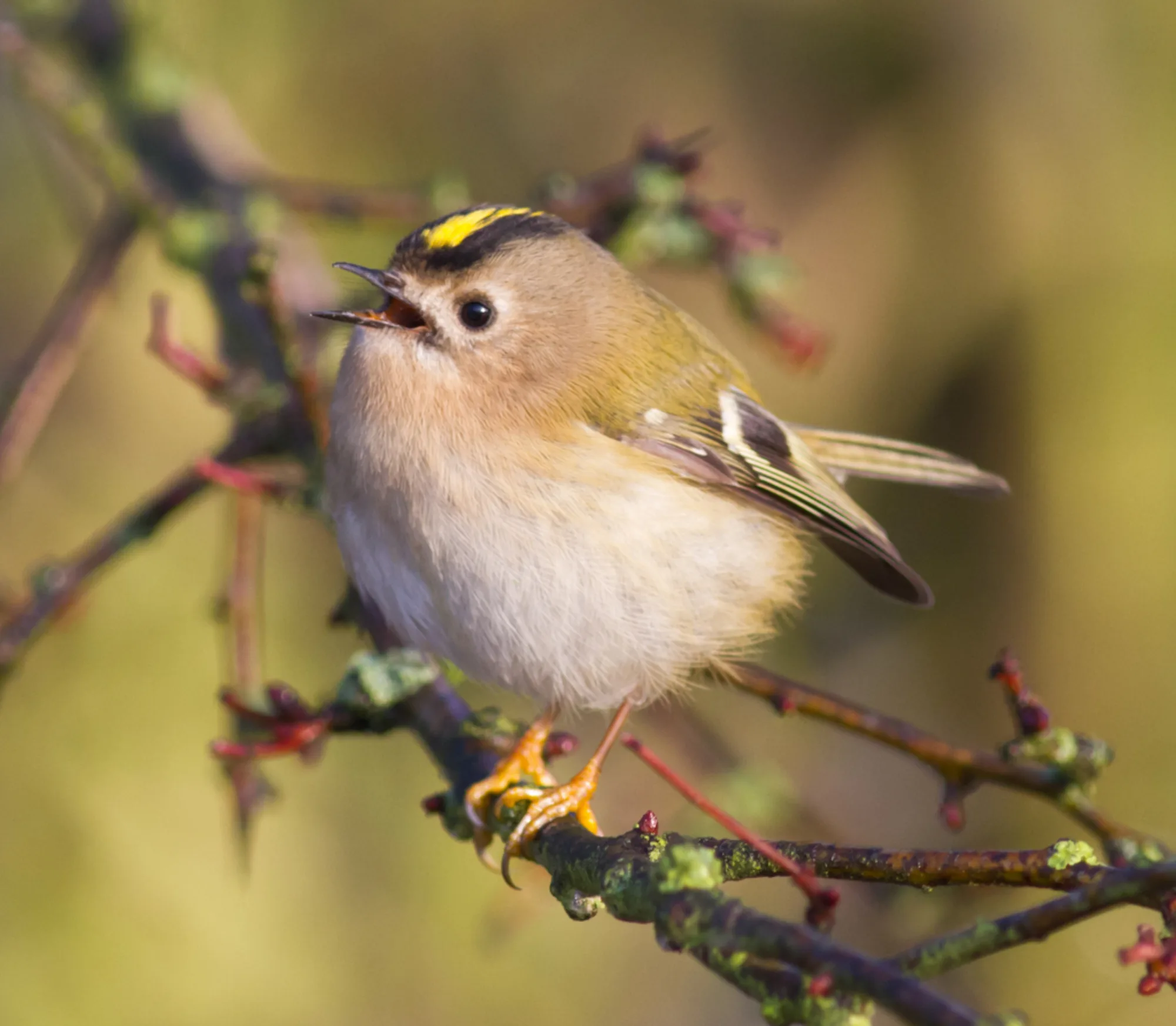
Europe's smallest bird, the Goldcrest measures 8.5 to 9.5 cm long. Look for an olive-green back, a pale belly, a pair of white wing markings and an unmarked face with conspicuous black eyes. The male has a yellow crest with an orange centre, while the female's crest is entirely yellow. A repeated series of high, thin notes can reveal its presence, often while the male searches for food. Watch for whirring flight with sudden changes of direction, or for a bird fluttering and hovering among the foliage.
Goldcrests breed across a vast range from Macaronesia to Japan, including much of Europe, and are also found in Iceland. Their breeding habitat includes mature conifer woods in lowlands and mountains, as well as gardens with suitable trees. After breeding, they also move into deciduous trees, shrubs and more open country such as heathland. Northern birds leave their breeding areas for winter, travelling south into Europe and Asia.
Restlessly searching through trees, Goldcrests often feed beneath branches and leaves, taking spiders, caterpillars, springtails and flies. In winter they frequently join loose flocks with tits and other birds, and may visit bird tables for fat. Both parents build a cup-shaped nest on a branch, using moss, twigs, cobwebs and lichen, with feathers and hair inside. The female incubates the eggs, both parents feed the chicks, and second broods are common. Sparrowhawks and other birds of prey hunt Goldcrests, while hard winters can bring heavy losses, especially when food is scarce. Migration is hazardous too, with the lighter spring passage suggesting that many birds die along the way.
Written from the English Wikipedia article Goldcrest (CC BY-SA 4.0).
- Records
- 1,564,789
- Countries
- 76
- Atlas places
- 3
These are open occurrence records, so they show where people looked for and recorded the Goldcrest as much as where it lives. Cells are up to 25 km across, and every location is generalised to its cell.
Generalised encounter areas, not exact locations. Each shape is a grid cell coloured by how likely the species is there.
- Very likelySweden25 km zone · high confidence · 665183 records · updated 86 days ago
- Very likelyFinland25 km zone · high confidence · 426590 records · updated 86 days ago
- Very likelyUnited Kingdom25 km zone · high confidence · 195382 records · updated 86 days ago
- Very likelyNorway25 km zone · high confidence · 92399 records · updated 86 days ago
- Very likelyBelgium25 km zone · high confidence · 54587 records · updated 86 days ago
- Very likelyÅland Islands25 km zone · high confidence · 34220 records · updated 86 days ago
- Very likelyNetherlands25 km zone · high confidence · 11356 records · updated 86 days ago
- Very likelyFrance25 km zone · high confidence · 10997 records · updated 86 days ago
- Very likelyIreland25 km zone · high confidence · 8875 records · updated 86 days ago
- Very likelyPortugal25 km zone · high confidence · 8089 records · updated 86 days ago
Conservation status not assessed here yet, so every location is generalised to its grid cell.