Firecrest
Regulus ignicapilla
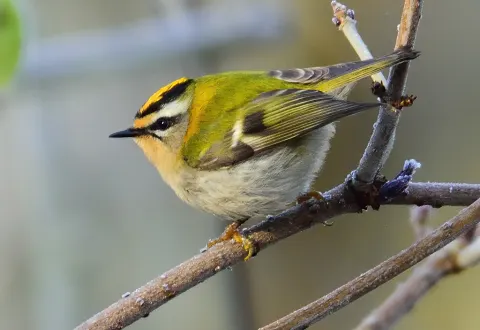
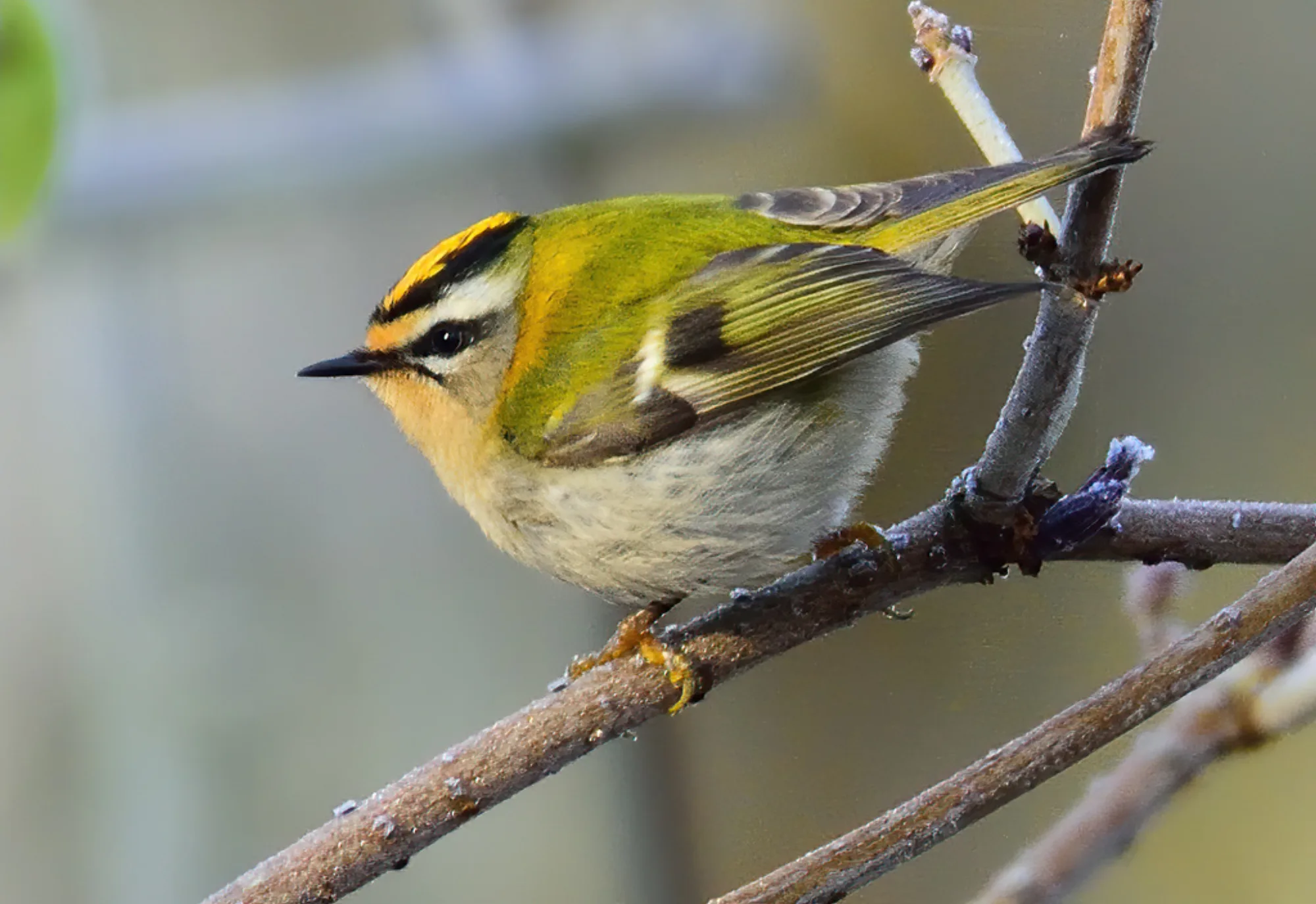
Small and plump, the Firecrest is a kinglet just 9 cm long. Look for olive-green upperparts, pale underparts, bronze shoulders and two white bars on each wing. A black stripe through the eye and a long white stripe above it give the face a bold pattern. The male has a mainly orange crest, while the female's is yellow; young birds lack the coloured crown. Its song is a repeated series of thin, high notes.
Firecrests breed across much of temperate Europe and northwestern Africa, in broadleaved and coniferous woods as well as gardens. They use mixed woodland and, in drier Mediterranean areas, can be found among conifers and evergreen oaks up to 2,800 m. They also live in urban areas where parks or large gardens provide suitable habitat. Southern birds mostly stay year-round, while northern and eastern populations migrate, wintering mainly around the Mediterranean and in the far west of Europe. In winter, birds move from forest into its fringes and scrub, sometimes joining loose flocks of tits and warblers.
Usually alone or in pairs, a Firecrest spends much of its time in the canopy but also visits bushes and lower vegetation. It is constantly moving as it searches for small insects and spiders, and often hovers to catch flying insects. The female builds a compact nest on a branch and incubates the eggs; both parents feed the young. Birds of prey hunt firecrests, while squirrels, jays and woodpeckers can take eggs and chicks. Habitat loss may cause local declines, and invasive Argentine ants reduce the small animals available as food, especially in the canopy.
Written from the English Wikipedia article Common firecrest (CC BY-SA 4.0).
- Records
- 212,862
- Countries
- 19
No atlas park has a record of the Firecrest in or around it yet.
These are open occurrence records, so they show where people looked for and recorded the Firecrest as much as where it lives. Cells are up to 25 km across, and every location is generalised to its cell.
Generalised encounter areas, not exact locations. Each shape is a grid cell coloured by how likely the species is there.
- Very likelySpain25 km zone · high confidence · 83533 records · updated 80 days ago
- Very likelyFrance25 km zone · high confidence · 53506 records · updated 80 days ago
- Very likelyPortugal25 km zone · high confidence · 29561 records · updated 80 days ago
- Very likelyBelgium25 km zone · high confidence · 15959 records · updated 80 days ago
- Very likelyUnited Kingdom25 km zone · high confidence · 13894 records · updated 80 days ago
- Very likelySwitzerland25 km zone · high confidence · 4540 records · updated 80 days ago
- Very likelyMonaco25 km zone · high confidence · 2114 records · updated 80 days ago
- Very likelyItaly25 km zone · high confidence · 2020 records · updated 80 days ago
- Very likelyLuxembourg25 km zone · high confidence · 1711 records · updated 80 days ago
- Very likelyCzechia25 km zone · high confidence · 1315 records · updated 80 days ago
Conservation status not assessed here yet, so every location is generalised to its grid cell.