Oarfish
Regalecus glesne
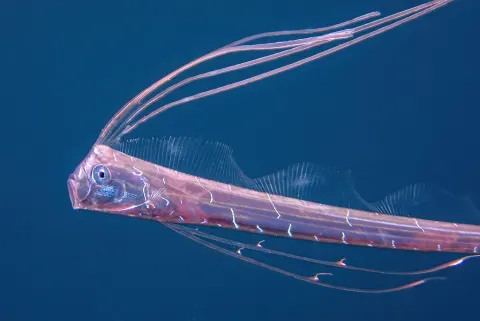
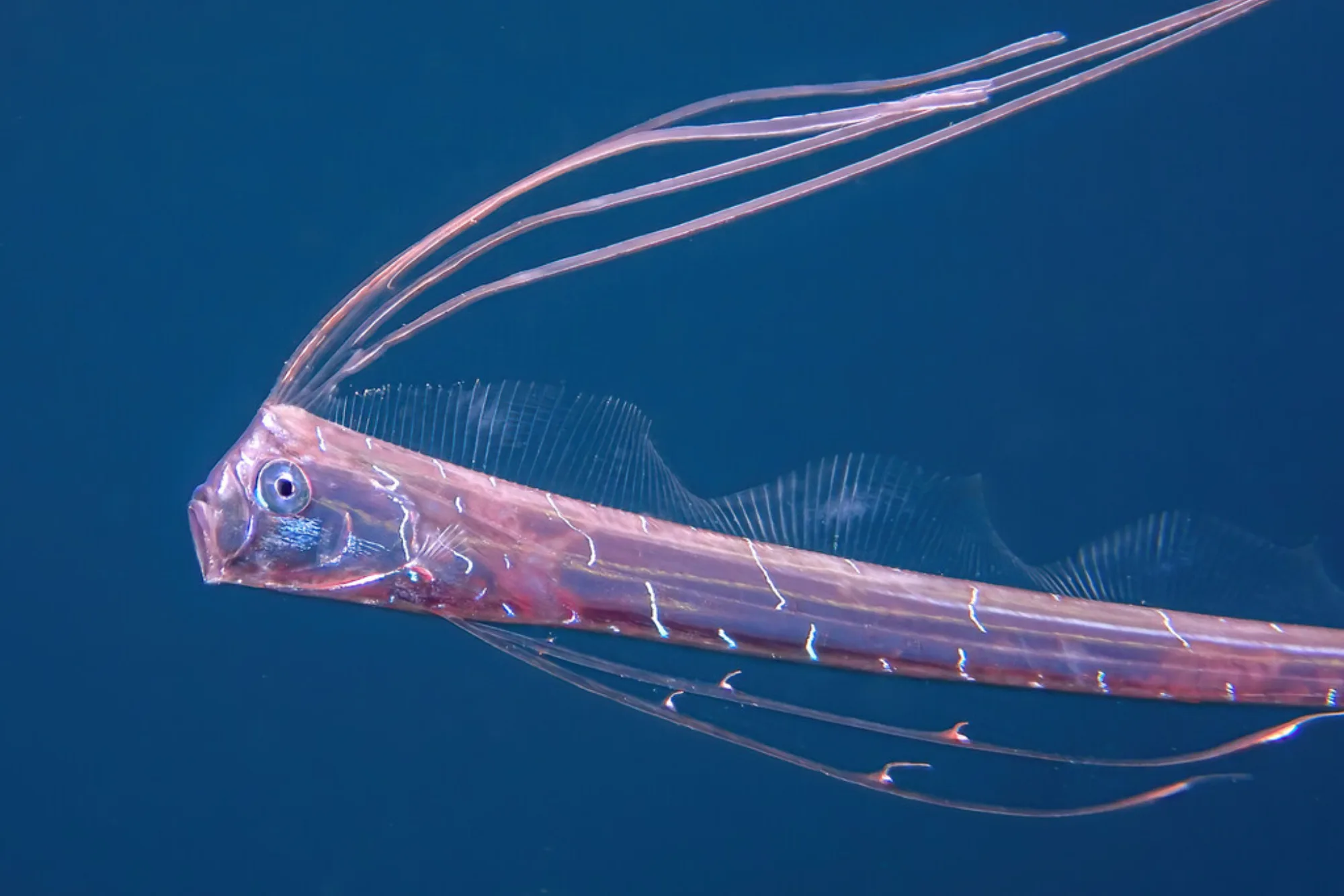
A long silver ribbon moving through the water, the Oarfish (Regalecus glesne) can be recognised by its narrow body, dark markings and red fins. A red crest rises from its head, while a fin runs the length of its body and its long pelvic fins resemble oars. Commonly measured at 3 m, it has reached a recorded length of about 7 to 8 metres. Its shape and rippling movements may have inspired some accounts of sea serpents.
Oarfish live across the world's oceans outside the polar regions, most often from the tropics to the middle latitudes. They occur in both the Atlantic and Pacific, with a wider distribution in the Atlantic. They are thought to inhabit waters from the sunlit upper ocean to the dimmer depths below. Healthy fish are unusual to see in their natural habitat, although they may be fairly common. Off the coast of France, divers filmed two likely giant oarfish near a buoy in deep Mediterranean water. The fish swam vertically and horizontally, and appeared to use the buoy's chain as a reference point.
Little is known about their behaviour or feeding habits. They can propel themselves by rippling the long fin along their back, and have also been seen swimming vertically with their tails down. Krill have been found in their stomachs and guts, although many examined fish had empty stomachs and guts. Eggs have been found near New Zealand and the West Mariana ridge, and an isolated reproductive population lives in the Mediterranean. Oarfish are occasionally caught in commercial nets, though they are not commercially fished. No natural predators have been documented, and there have been no documented attempts to measure their population size.
Written from the English Wikipedia article Giant oarfish (CC BY-SA 4.0).
- Records
- 44
- Countries
- 6
No atlas park has a record of the Oarfish in or around it yet.
These are open occurrence records, so they show where people looked for and recorded the Oarfish as much as where it lives. Cells are up to 25 km across, and every location is generalised to its cell.
Generalised encounter areas, not exact locations. Each shape is a grid cell coloured by how likely the species is there.
- Very likelyBelize25 km zone · medium confidence · 12 records · updated 80 days ago
- Very likelyUnited States25 km zone · medium confidence · 8 records · updated 80 days ago
- LikelyMexico25 km zone · medium confidence · 12 records · updated 80 days ago
- PossibleAustralia25 km zone · medium confidence · 12 records · updated 80 days ago
- UncommonItaly25 km zone · low confidence · 0 records · updated 80 days ago
- RareChina25 km zone · low confidence · 0 records · updated 80 days ago
Conservation status not assessed here yet, so every location is generalised to its grid cell.