Indian Giant Squirrel
Ratufa indica
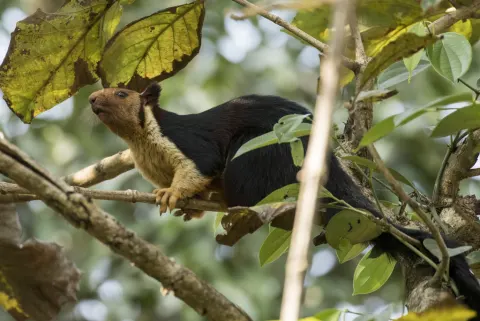
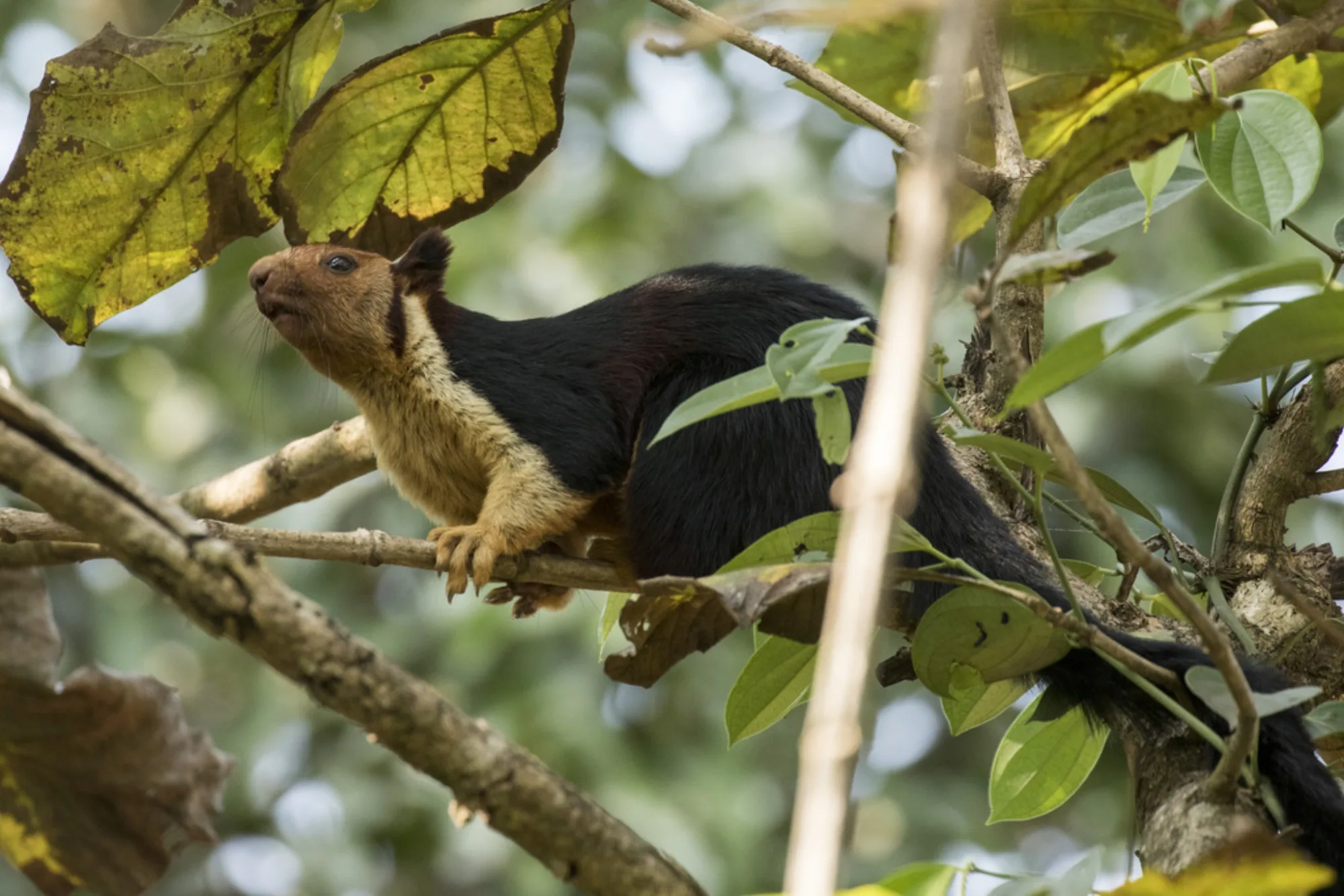
High in India's forest canopy, the Indian Giant Squirrel moves through the trees with jumps of up to 6 m. One of the largest squirrels, it has a head and body measuring 25 to 50 cm, with a tail about as long or longer. Its coat may combine one, two or three colours, ranging from cream and rust to reddish-maroon, brown or black. Look for the usually cream-coloured underside and front legs, and a white spot between the ears.
Found only in India, it ranges through parts of the Western and Eastern Ghats as well as the Satpura Range, reaching north to Madhya Pradesh. It lives at elevations of 180 to 2,300 m in tropical deciduous, semi-deciduous and moist evergreen forests and woodlands. In semi-deciduous forest, it often uses denser growth along waterways. Its range is fragmented, in part because it cannot tolerate degraded habitat.
The squirrel rarely comes down from the trees and is most active in the early morning and evening, resting at midday. When threatened, it often holds still or presses flat against a trunk; owls and leopards are among its predators. It eats fruit, flowers, nuts and bark, and may also take insects and bird eggs. Usually solitary, it sometimes lives in pairs and generally comes together with others to breed. It builds large, round nests from twigs and leaves on slender branches beyond the reach of large predators. One squirrel may make several nests close together, using them for sleep and reserving one as a nursery. In deciduous forest, these nests are easier to spot during the dry season.
Written from the English Wikipedia article Indian giant squirrel (CC BY-SA 4.0).
- Records
- 402
- Countries
- 1
- Atlas places
- 4
These are open occurrence records, so they show where people looked for and recorded the Indian Giant Squirrel as much as where it lives. Cells are up to 25 km across, and every location is generalised to its cell.
Generalised encounter areas, not exact locations. Each shape is a grid cell coloured by how likely the species is there.
- Very likelyIndia25 km zone · medium confidence · 402 records · updated 80 days ago
Conservation status not assessed here yet, so every location is generalised to its grid cell.