Black Giant Squirrel
Ratufa bicolor
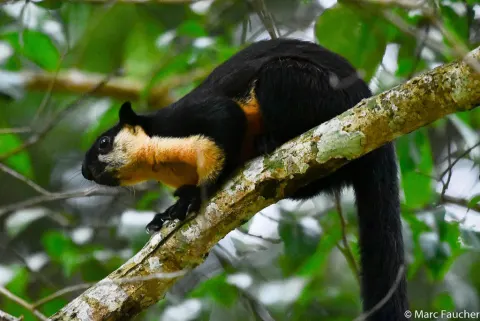
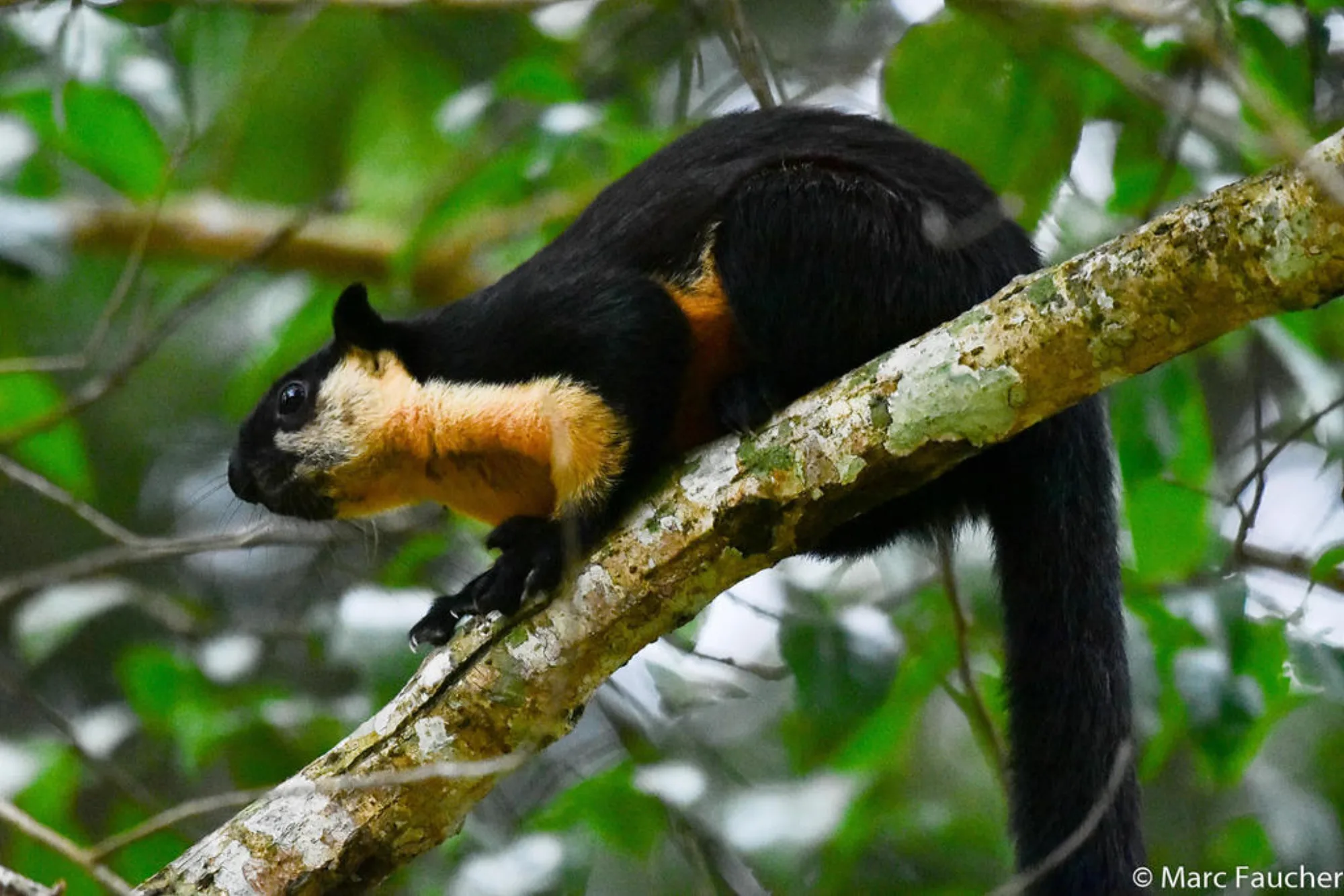
High in the forest canopy, the Black Giant Squirrel cuts a distinctive figure: its dark back, head, ears and bushy tail contrast with pale buff underparts. One of the world's largest squirrels, it has an average adult head and body length of 34 to 37 cm, with a tail measuring 41 to 42 cm. Colour varies across its range: on Sumatra, Java and Bali, light-tipped hairs make the back and tail look paler. Its underparts can be orange to reddish yellow on islands in the Strait of Malacca and on small islands near Myanmar.
This tree squirrel occurs in forests across parts of South and Southeast Asia, from eastern Nepal and northern Bangladesh to southern China and western Indonesia. Its range extends from sea level to at least 2,500 m, and records in India reach 2,700 m. In South Asia it occupies coniferous and broadleaf forests in tropical and subtropical areas; farther southeast, it lives in tropical evergreen and semi-evergreen broadleaf forests. Kaziranga National Park in Assam, India, is among the better places to look for it, while several populations occur in the lower range of Neora Valley National Park.
Active during the day and primarily solitary, it usually lives in the trees but sometimes descends to feed on the ground. It eats seeds, pine cones, fruits and leaves, and rarely enters plantations or settlements, favouring wild forest. A litter has 1 to 2 young, raised in a nest often situated in a tree hollow. Human settlement, timber harvesting and agriculture have steadily encroached on its habitat, while overhunting has also affected it in parts of its range. Research has predicted that climate change could cause the loss of more than 97% of its currently suitable habitat in India by 2050.
Written from the English Wikipedia article Black giant squirrel (CC BY-SA 4.0).
- Records
- 139
- Countries
- 8
- Atlas places
- 6
These are open occurrence records, so they show where people looked for and recorded the Black Giant Squirrel as much as where it lives. Cells are up to 25 km across, and every location is generalised to its cell.
Generalised encounter areas, not exact locations. Each shape is a grid cell coloured by how likely the species is there.
- Very likelyThailand25 km zone · medium confidence · 68 records · updated 80 days ago
- Very likelyMalaysia25 km zone · medium confidence · 36 records · updated 80 days ago
- Very likelyIndia25 km zone · medium confidence · 24 records · updated 80 days ago
- LikelyIndonesia25 km zone · medium confidence · 5 records · updated 80 days ago
- LikelyChina25 km zone · medium confidence · 3 records · updated 80 days ago
- LikelyVietnam25 km zone · medium confidence · 3 records · updated 80 days ago
Conservation status not assessed here yet, so every location is generalised to its grid cell.