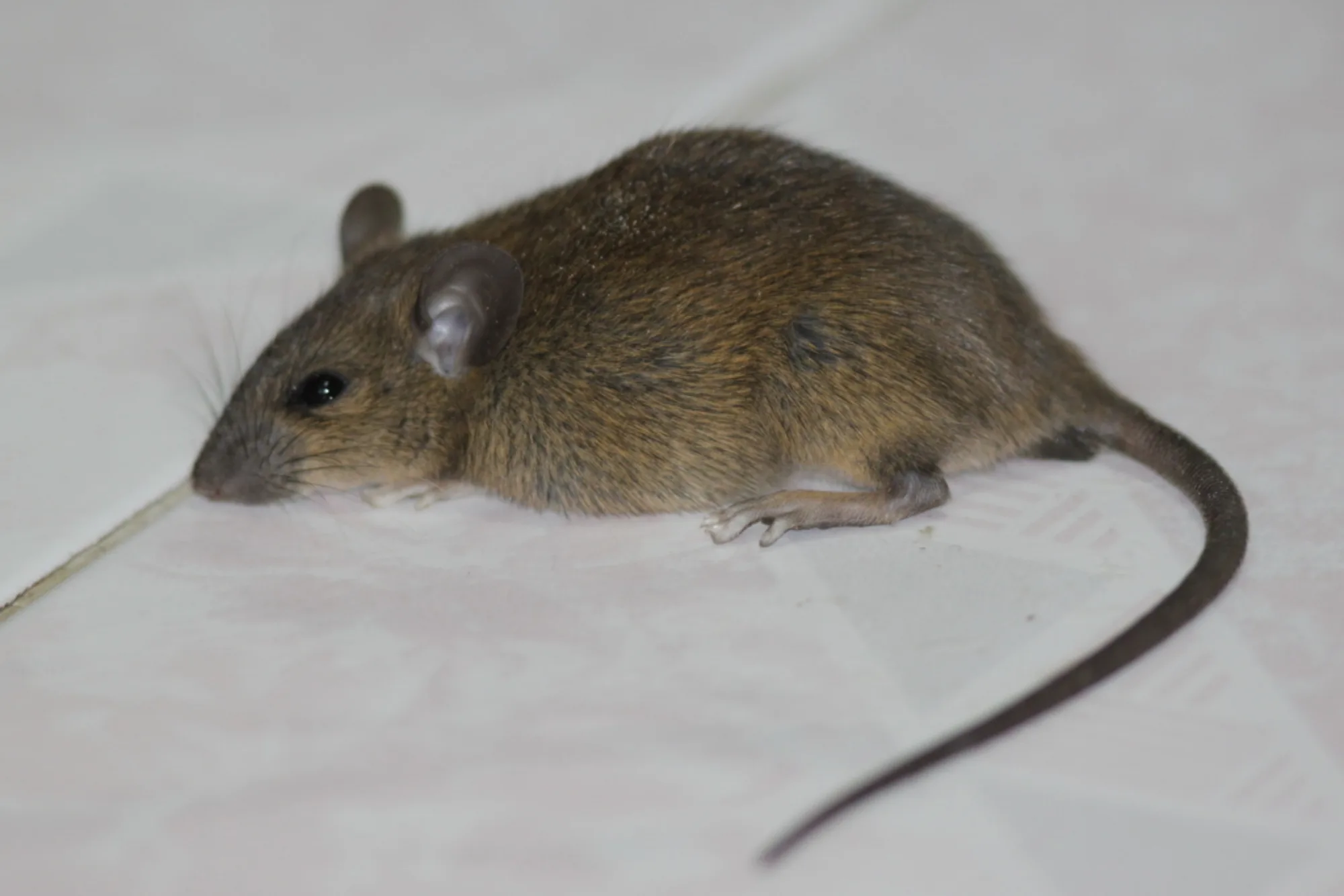
Polynesian Rat
Rattus exulans
Large, round ears and a pointed snout help distinguish the Polynesian Rat, also known as kiore. Its coat is black and brown, with a lighter belly, and its feet are comparatively small. Look for a dark mark near the ankle on top of each hind foot, while the rest of the foot is pale. Its slender body can reach 15 cm from nose to tail base, although rats on smaller islands tend to be smaller, at 11.5 cm.
The species originated in Southeast Asia and is now widespread across that region and the Pacific, reaching Hawaii, Easter Island and New Zealand. It occupies habitats ranging from grasslands to forests and often lives close to people, who provide access to food. Active at night, it climbs well and frequently nests in trees. Its varied diet includes seeds, fruit, leaves, insects, earthworms, spiders, lizards, bird eggs and hatchlings. When winter food is scarce, it eats plant stems and strips bark. Rats often carry food to sheltered places for preparation, including spots among tree roots, in trunk crevices and in upper branches. In New Zealand, such feeding places can also be found beneath rock piles and fallen nīkau palm fronds.
Breeding takes place in spring and summer, with litters of 6 to 11 pups and weaning at around 28 days. Predators pose a threat, and the rats' habit of preparing food under cover offers some protection. People also target them in eradication programmes intended to protect native wildlife, although Mauitaha and Araara, in the Hen and Chickens group, have been set aside as rat sanctuaries.
Written from the English Wikipedia article Polynesian rat (CC BY-SA 4.0).
- Records
- 956
- Countries
- 17
- Atlas places
- 1
These are open occurrence records, so they show where people looked for and recorded the Polynesian Rat as much as where it lives. Cells are up to 25 km across, and every location is generalised to its cell.
Generalised encounter areas, not exact locations. Each shape is a grid cell coloured by how likely the species is there.
- Very likelyPhilippines25 km zone · medium confidence · 333 records · updated 80 days ago
- Very likelyPapua New Guinea25 km zone · medium confidence · 277 records · updated 80 days ago
- Very likelyLaos25 km zone · medium confidence · 87 records · updated 80 days ago
- Very likelyIndonesia25 km zone · medium confidence · 67 records · updated 80 days ago
- Very likelySolomon Islands25 km zone · medium confidence · 54 records · updated 80 days ago
- Very likelyFrench Polynesia25 km zone · medium confidence · 37 records · updated 80 days ago
- LikelyCambodia25 km zone · medium confidence · 34 records · updated 80 days ago
- LikelyNew Zealand25 km zone · medium confidence · 24 records · updated 80 days ago
- LikelyMyanmar (Burma)25 km zone · medium confidence · 19 records · updated 80 days ago
- PossibleBangladesh25 km zone · medium confidence · 8 records · updated 80 days ago
Conservation status not assessed here yet, so every location is generalised to its grid cell.