Reindeer
Rangifer tarandus
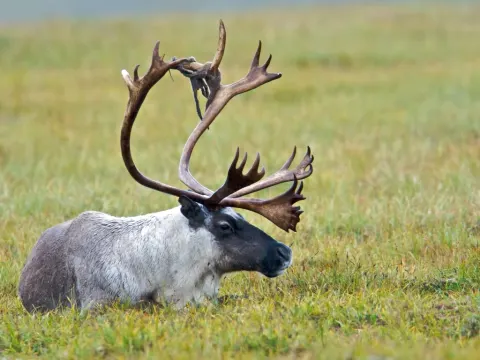
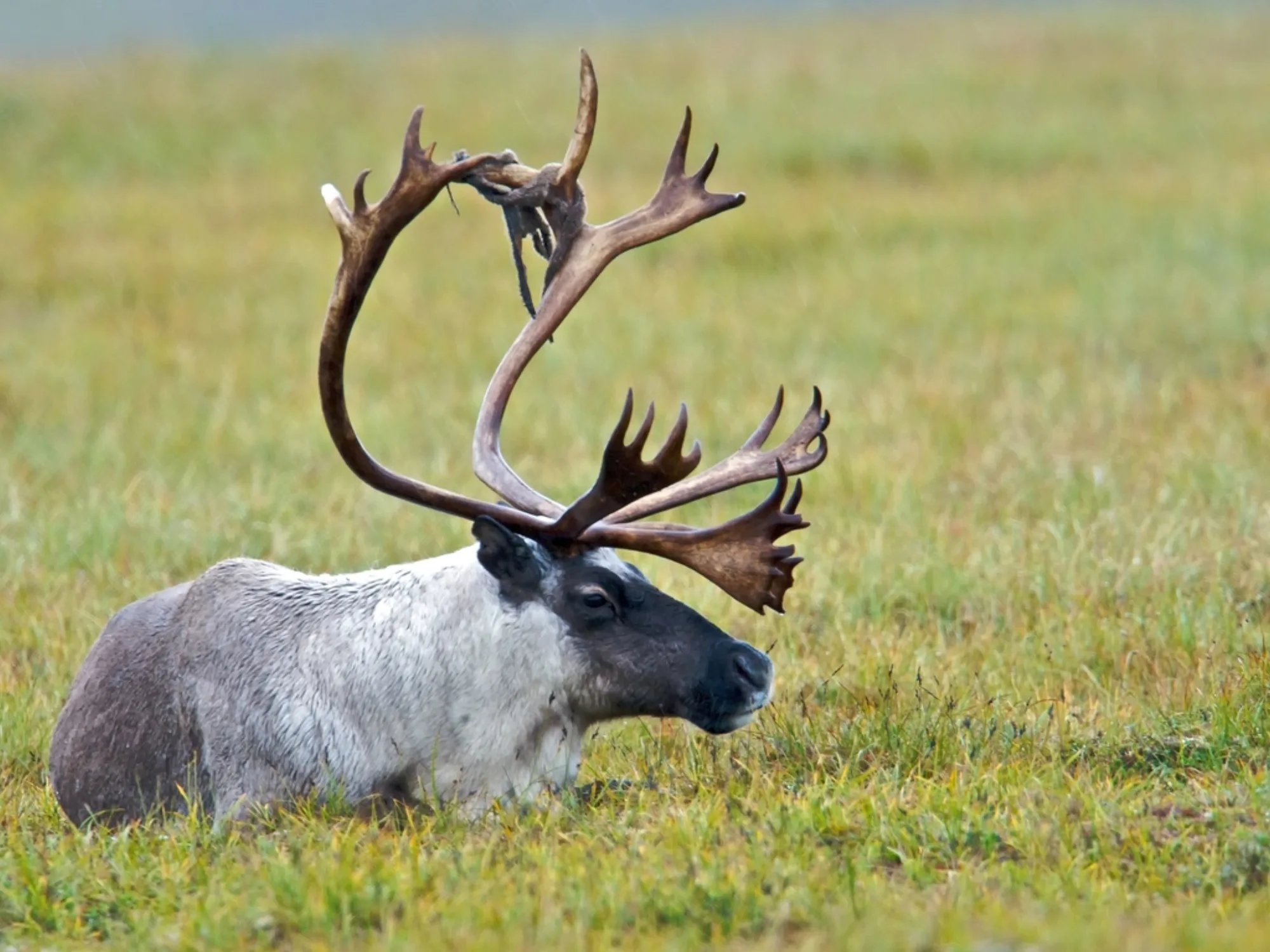
Across northern tundra, forests and mountains, the Reindeer (Rangifer tarandus) lives as both a wild and a domesticated deer. It is also known as caribou, particularly in North America, and varies widely in size, coat colour and the shape of its antlers. Both males and females can grow antlers each year, though females do not do so in every population; those of males are typically larger. Its range stretches across Northern Europe, Siberia and North America, with populations on islands as well as on the mainland. In Eurasia, wild and domestic animals occupy tundra and taiga, while Finnish forest reindeer live patchily in coniferous forests. In North America, caribou occur from Alaska across northern Canada and south through the Canadian Rocky Mountains.
Some populations stay in one area, while others migrate, and herd sizes differ greatly between regions. Migratory barren-ground caribou in Arctic Alaska and northern Canada spend summer on tundra and winter in taiga. Reindeer paw through snow to find food, and tundra caribou use their antlers to dig into hard-packed snow for forage. In some tundra populations, calves are born at roughly the same time, and animals gather after calving. Females keep their antlers until they give birth, while males shed theirs after the autumn mating season. Humans hunt reindeer and are their main predator in many areas. Some populations have declined sharply: Canada's migratory George River herd fell from 800,000 to 900,000 animals in the 1990s to fewer than 9,000 estimated in January 2018.
Written from the English Wikipedia article Reindeer (CC BY-SA 4.0).
- Records
- 34,356
- Countries
- 10
- Atlas places
- 1
These are open occurrence records, so they show where people looked for and recorded the Reindeer as much as where it lives. Cells are up to 25 km across, and every location is generalised to its cell.
Generalised encounter areas, not exact locations. Each shape is a grid cell coloured by how likely the species is there.
- Very likelyNorway25 km zone · high confidence · 31120 records · updated 80 days ago
- Very likelyUnited States25 km zone · high confidence · 2623 records · updated 80 days ago
- Very likelyFrench Southern Territories25 km zone · high confidence · 202 records · updated 80 days ago
- Very likelySvalbard & Jan Mayen25 km zone · medium confidence · 125 records · updated 80 days ago
- LikelyCanada25 km zone · medium confidence · 125 records · updated 80 days ago
- LikelyFinland25 km zone · medium confidence · 114 records · updated 80 days ago
- LikelyIceland25 km zone · medium confidence · 18 records · updated 80 days ago
- LikelyGreenland25 km zone · medium confidence · 11 records · updated 80 days ago
- LikelyNetherlands25 km zone · medium confidence · 9 records · updated 80 days ago
- LikelyUnited Kingdom25 km zone · medium confidence · 9 records · updated 80 days ago
Conservation status not assessed here yet, so every location is generalised to its grid cell.