Common Frog
Rana temporaria
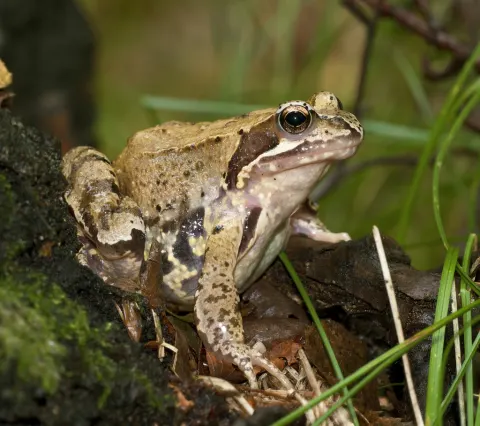
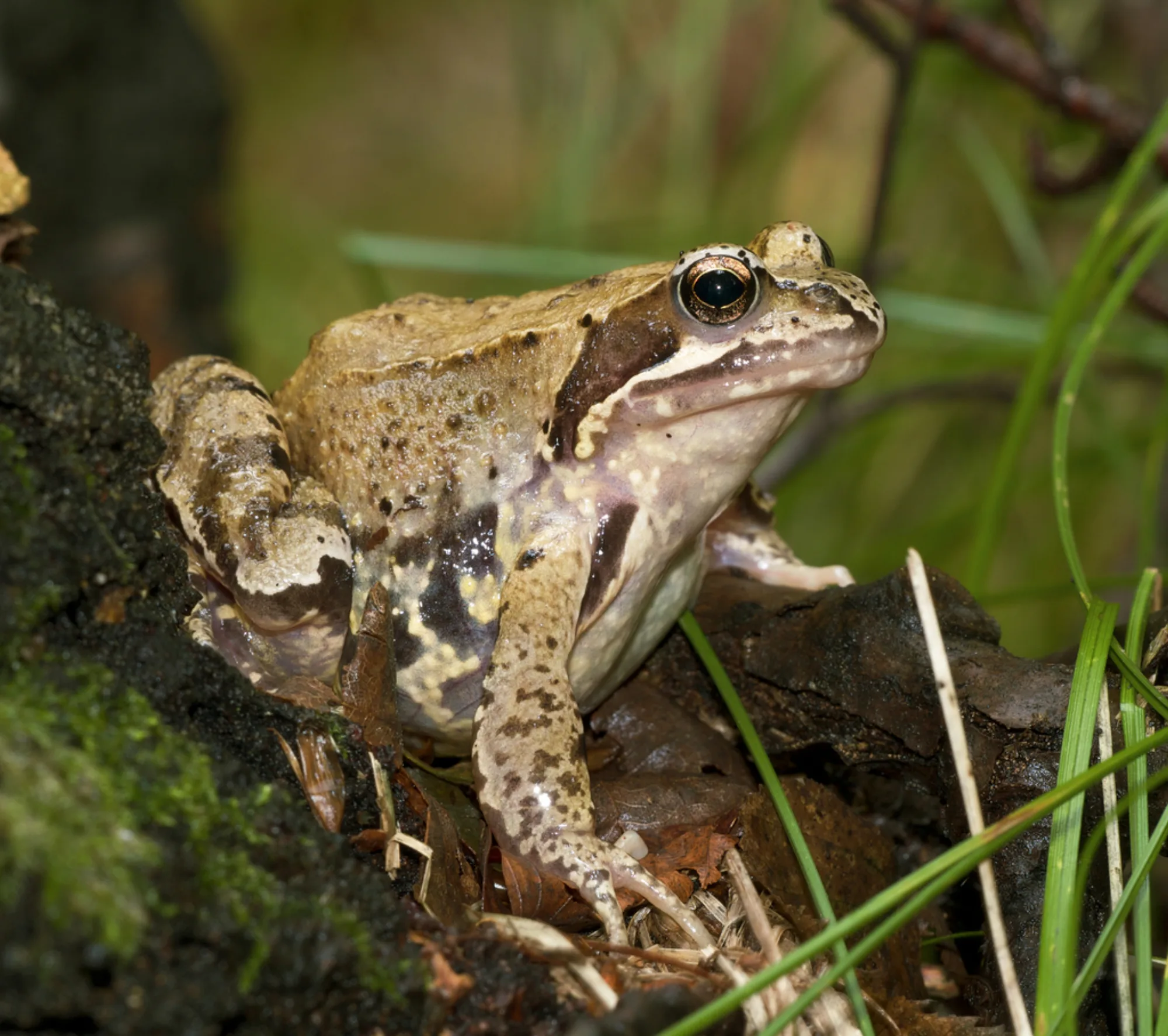
Plump-bodied and round-snouted, the Common Frog (Rana temporaria) has moist skin, webbed feet and long hind legs that carry it in hops on land and help it swim. Its back and sides can range from olive green to grey-brown, yellowish or reddish, often with irregular dark blotches. A dark patch usually sits behind each eye, and a chevron-shaped mark often appears on the back of the neck. Adults measure 6 to 9 centimetres in body length.
The species ranges across much of Europe, from Ireland north to Scandinavia and east through Asia to Japan, though it is missing from most of the Iberian Peninsula and the southern parts of Italy and the Balkans. It lives in rural and urban settings, including damp places near ponds and marshes and among long grass beside water. Outside the breeding season it lives alone, hiding in damp places by day and looking for food at night. It often waits for prey to come within reach, feeding in summer on adult crane flies and butterfly and moth larvae, as well as animals such as slugs, snails and earthworms. In the coldest months it hibernates in places including running water, muddy burrows and the bottoms of ponds or lakes.
Breeding takes place in shallow, still freshwater, often ponds, generally in April across the main part of its range. The eggs are laid in clumps, and the tadpoles feed mainly on algae and decomposed plants. Ranavirus can cause substantial population declines, while roads and buildings can isolate urban populations and reduce their genetic diversity. Frogs are also killed by vehicles, and both tadpoles and adults face a range of predators.
Written from the English Wikipedia article Common frog (CC BY-SA 4.0).
- Records
- 267,585
- Countries
- 37
No atlas park has a record of the Common Frog in or around it yet.
These are open occurrence records, so they show where people looked for and recorded the Common Frog as much as where it lives. Cells are up to 25 km across, and every location is generalised to its cell.
Generalised encounter areas, not exact locations. Each shape is a grid cell coloured by how likely the species is there.
- Very likelySwitzerland25 km zone · high confidence · 166381 records · updated 86 days ago
- Very likelyFrance25 km zone · high confidence · 47141 records · updated 86 days ago
- Very likelyUnited Kingdom25 km zone · high confidence · 13650 records · updated 86 days ago
- Very likelyAustria25 km zone · high confidence · 11172 records · updated 86 days ago
- Very likelyDenmark25 km zone · high confidence · 10806 records · updated 86 days ago
- Very likelyGermany25 km zone · high confidence · 4973 records · updated 86 days ago
- Very likelyItaly25 km zone · high confidence · 3857 records · updated 86 days ago
- Very likelyNorway25 km zone · high confidence · 2855 records · updated 86 days ago
- Very likelyLiechtenstein25 km zone · high confidence · 2258 records · updated 86 days ago
- Very likelySpain25 km zone · high confidence · 1139 records · updated 86 days ago
Conservation status not assessed here yet, so every location is generalised to its grid cell.