Cobia
Rachycentron canadum
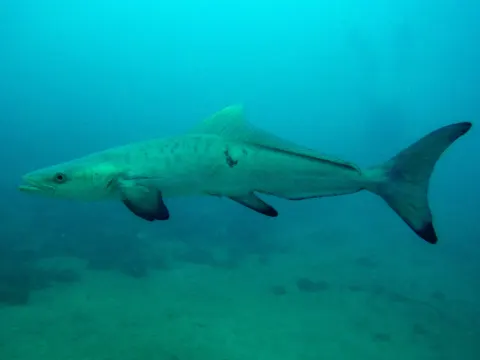
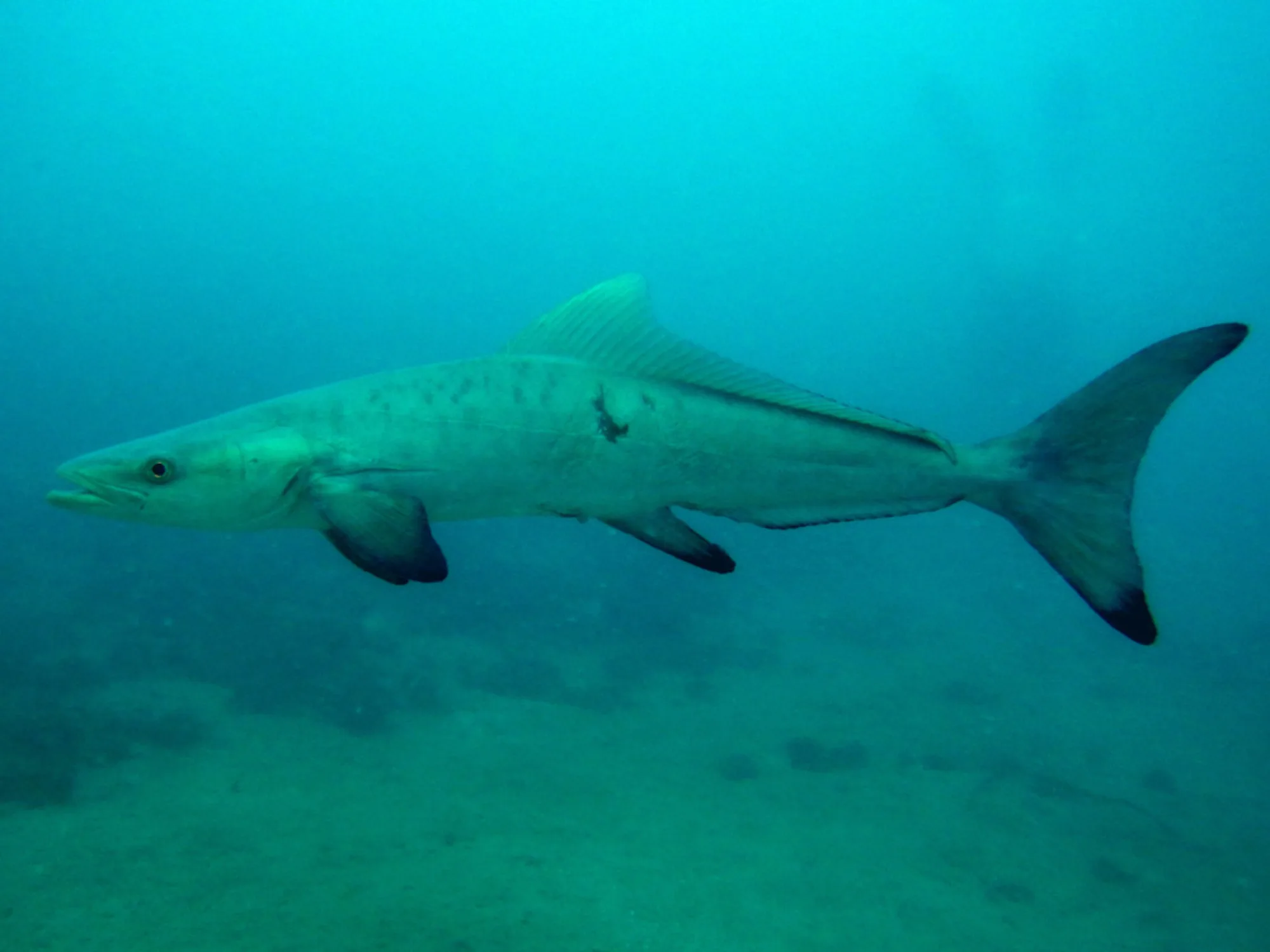
Long and streamlined, the Cobia has a broad, flattened head and can reach 2 m in length and 79 kg in weight. Its smooth, small-scaled body is dark brown above, fading to white underneath, with two darker stripes along the sides. Adults have a dark, forked tail, while juveniles have rounded tails and conspicuous black and white bands. During spawning, the stripes become more prominent as they darken and the background colour flashes.
Cobia live in warm-temperate and tropical waters on both sides of the Atlantic, throughout the Caribbean and in parts of the Indian Ocean and Pacific. They have also been reported in the eastern Mediterranean and introduced to the eastern Pacific. They migrate seasonally, spending winter in the Gulf of Mexico and moving north as far as Massachusetts in summer. Usually solitary, they sometimes gather around reefs, wrecks, harbours and buoys. Although they live in open water, they may enter estuaries and mangroves to hunt. Curious and showing little fear of boats, they feed mainly on crabs, squid and fish, and follow sharks, turtles and manta rays to scavenge.
Breeding takes place by day from April to September, when large groups gather offshore. Females can spawn up to 30 times during the season, releasing tiny buoyant eggs that drift with the currents until they hatch. Young cobia are eaten by mahi-mahi, while adults are preyed on by shortfin mako sharks. Parasites and bacterial infections also affect the fish. In aquaculture, disease and stress during transfers to offshore cages can cause high mortality.
Written from the English Wikipedia article Cobia (CC BY-SA 4.0).
- Records
- 700
- Countries
- 19
- Atlas places
- 2
These are open occurrence records, so they show where people looked for and recorded the Cobia as much as where it lives. Cells are up to 25 km across, and every location is generalised to its cell.
Generalised encounter areas, not exact locations. Each shape is a grid cell coloured by how likely the species is there.
- Very likelyAustralia25 km zone · medium confidence · 198 records · updated 80 days ago
- Very likelyUnited States25 km zone · medium confidence · 191 records · updated 80 days ago
- Very likelyMauritania25 km zone · high confidence · 110 records · updated 80 days ago
- Very likelyMozambique25 km zone · medium confidence · 67 records · updated 80 days ago
- Very likelyIndia25 km zone · medium confidence · 38 records · updated 80 days ago
- Very likelyTaiwan25 km zone · medium confidence · 23 records · updated 80 days ago
- Very likelyColombia25 km zone · medium confidence · 21 records · updated 80 days ago
- LikelyJapan25 km zone · medium confidence · 11 records · updated 80 days ago
- LikelySouth Africa25 km zone · medium confidence · 9 records · updated 80 days ago
- LikelyMyanmar (Burma)25 km zone · medium confidence · 4 records · updated 80 days ago
Conservation status not assessed here yet, so every location is generalised to its grid cell.