Common Grackle
Quiscalus quiscula
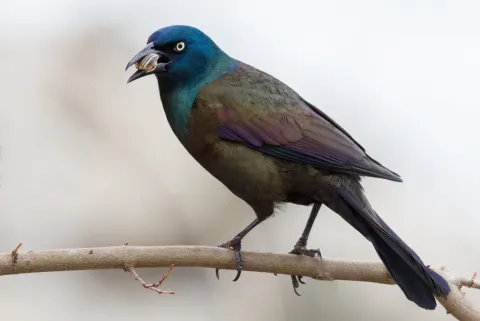
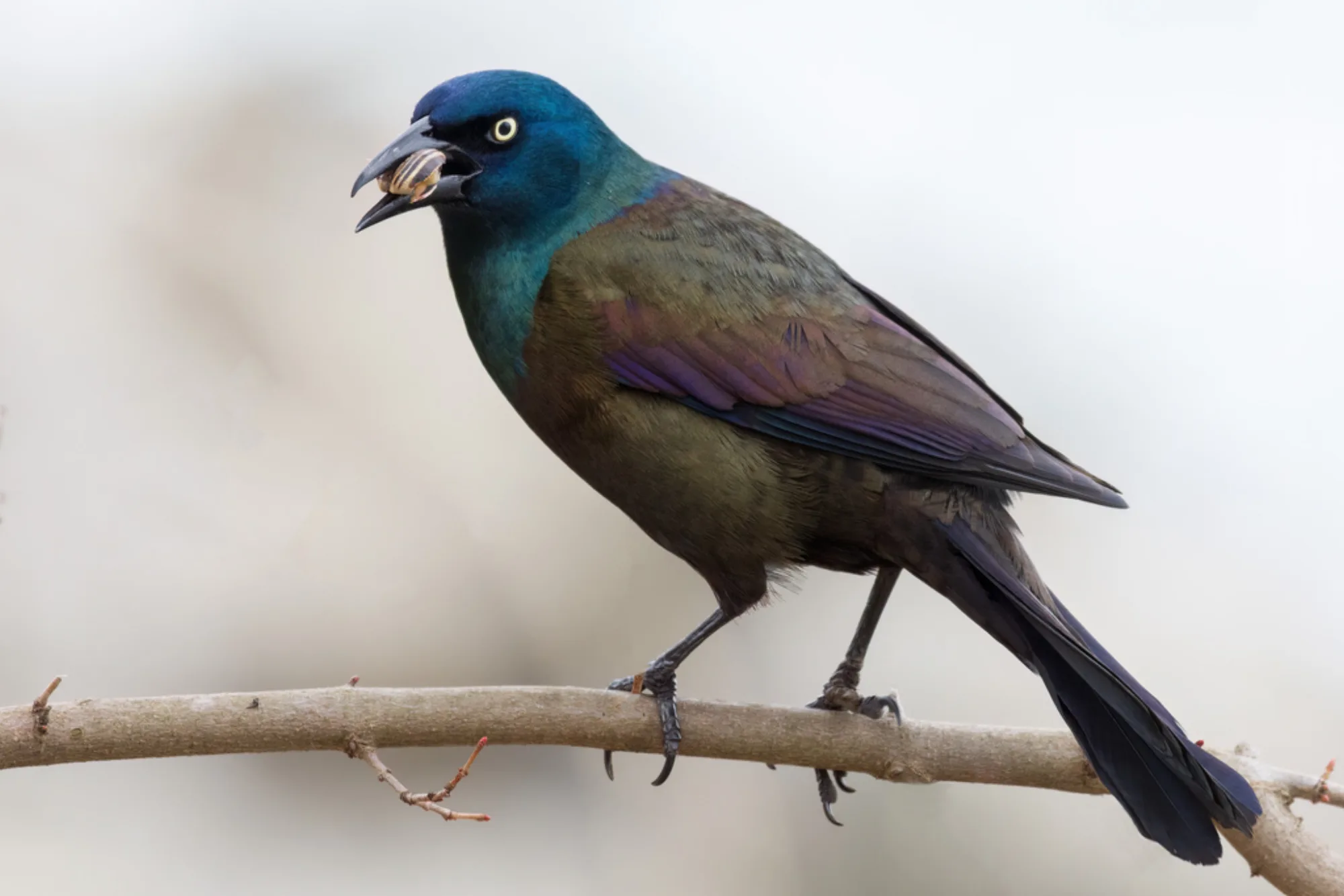
Look for the Common Grackle across much of North America east of the Rocky Mountains, where this adaptable bird is often numerous. Adults measure 28 to 34 cm in length; their eyes are pale yellow, their bills are dark, and both bill and tail are long. Their black-looking feathers catch purple, green or blue on the head and a mainly bronze sheen on the body. Females are usually smaller and less iridescent than males, while young birds are brown with dark brown eyes. Open and semiopen country provides breeding habitat, and suburban parks and lawns are familiar places to find them. Many stay in their range year-round, but northern birds travel in flocks to the southeastern United States.
Grackles search for food on the ground, in shallow water and among shrubs, taking insects, berries, seeds, grain and a range of small animals. Around outdoor eating areas, they gather for dropped food and may snatch a morsel from another bird's beak. Their harsh calls can be especially noticeable in a flock, and a song may sound like a buzzing power line. They can also imitate other birds and even people. During the breeding season, males tip back their heads and fluff their feathers in displays that help keep rivals away. Grackles often nest in colonies, hiding cup-shaped nests in dense trees or shrubs, usually close to water. They also sometimes use cavities or human-made structures, and a clutch contains four to seven eggs. Farmers in some areas regard the birds as pests because they gather in large numbers and eat grain; hawks or similar large birds of prey are sometimes used to control them. A 2011 study of Christmas Bird Count data found that the population had fallen by 61% from historic highs.
Written from the English Wikipedia article Common grackle (CC BY-SA 4.0).
- Records
- 4,519,274
- Countries
- 5
No atlas park has a record of the Common Grackle in or around it yet.
These are open occurrence records, so they show where people looked for and recorded the Common Grackle as much as where it lives. Cells are up to 25 km across, and every location is generalised to its cell.
Generalised encounter areas, not exact locations. Each shape is a grid cell coloured by how likely the species is there.
- Very likelyUnited States25 km zone · high confidence · 3611130 records · updated 86 days ago
- Very likelyCanada25 km zone · high confidence · 907501 records · updated 86 days ago
- LikelySt. Pierre & Miquelon25 km zone · high confidence · 545 records · updated today
- PossibleMexico25 km zone · medium confidence · 86 records · updated today
- UncommonBermuda25 km zone · medium confidence · 12 records · updated today
Conservation status not assessed here yet, so every location is generalised to its grid cell.