Greater Antillean Grackle
Quiscalus niger
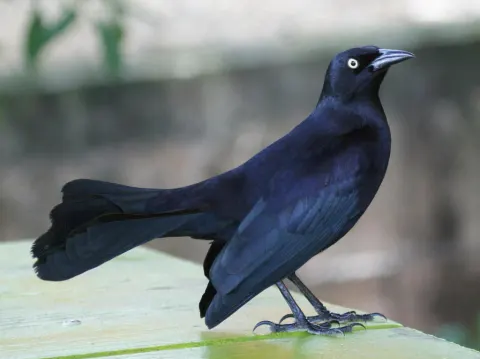
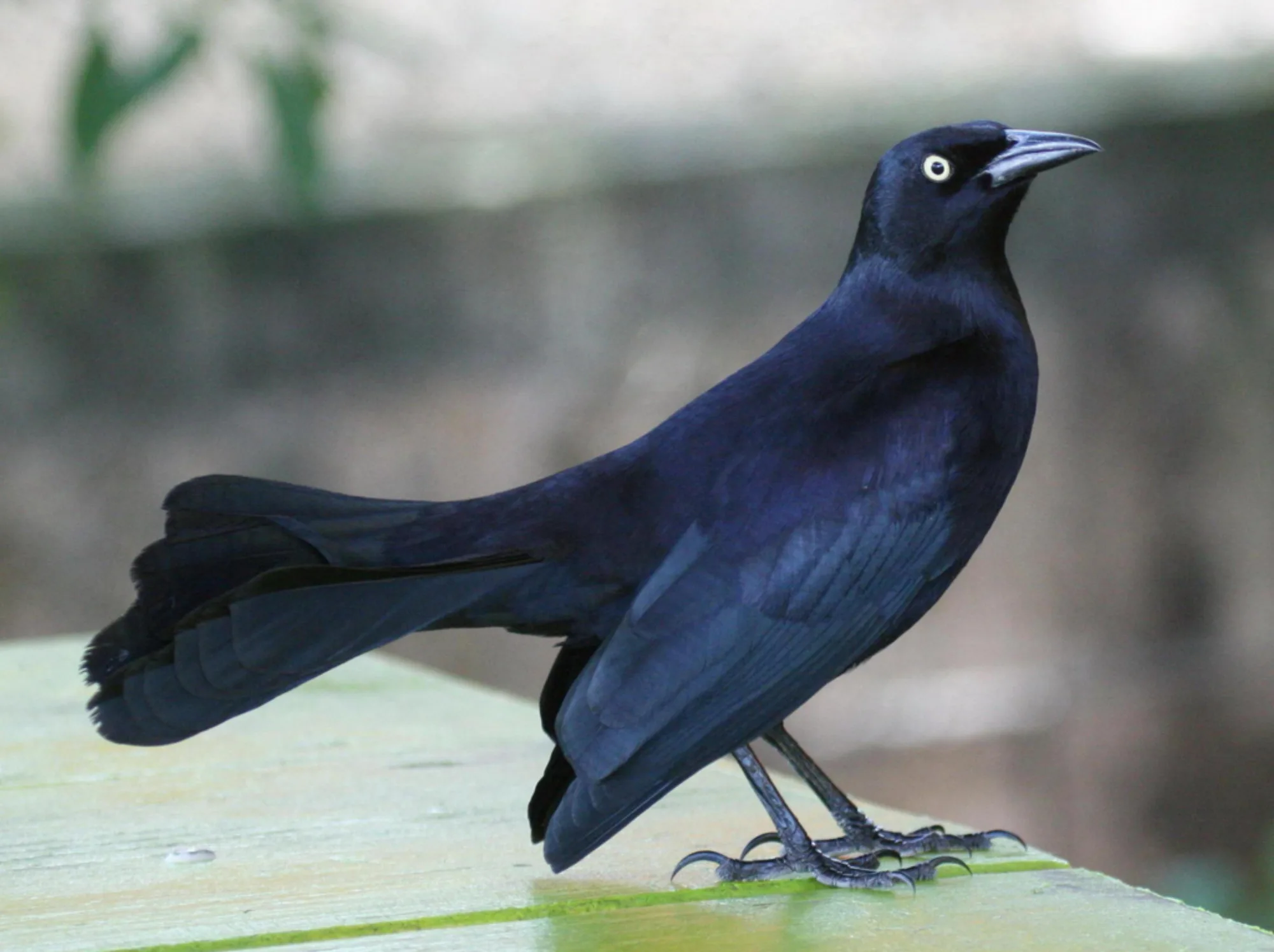
With its black plumage, yellow eyes and long tail, the Greater Antillean Grackle is a distinctive bird of the Caribbean. Adults of both sexes are black, although males have a glossy sheen and most females are less glossy. The male holds his long tail in a V shape, while the female's shorter tail is held flat. Young birds are brownish black, lack a gloss and have dark brown eyes. The species measures 25 to 30 cm in length, and its song can include metallic notes and flute-like whistles.
Look for it across the Greater Antilles, including Cuba and Puerto Rico, as well as in the Cayman Islands. It lives in mostly open landscapes, including savanna, pasture, cultivated land, scrub and light woodland. Marshes, mangroves, parks and gardens also provide habitat, and several thousand birds may gather to roost in towns and cities. It remains in its range year-round, although birds in Jamaica sometimes move locally in search of fruiting trees. Grackles regularly feed in flocks, taking insects, other arthropods, fruit, seeds and small vertebrates such as lizards. They also eat the eggs and chicks of small birds.
Breeding runs from February to September, peaking from April to early August overall and from March to July in Cuba. Birds nest in colonies, sometimes with up to 30 nests in mangrove forest. The nest is an open cup of plant fibres and mud, with a fine fibre lining, and is usually built in a palm or mangrove. A clutch contains three to four pale olive to brown eggs with black markings, and young leave the nest at least 23 days after hatching. No immediate threats have been identified, although the shiny cowbird is reported as a brood parasite in Puerto Rico to an apparently minor extent.
Written from the English Wikipedia article Greater Antillean grackle (CC BY-SA 4.0).
- Records
- 163,312
- Countries
- 6
No atlas park has a record of the Greater Antillean Grackle in or around it yet.
These are open occurrence records, so they show where people looked for and recorded the Greater Antillean Grackle as much as where it lives. Cells are up to 25 km across, and every location is generalised to its cell.
Generalised encounter areas, not exact locations. Each shape is a grid cell coloured by how likely the species is there.
- Very likelyPuerto Rico25 km zone · high confidence · 94194 records · updated 80 days ago
- Very likelyCuba25 km zone · high confidence · 35337 records · updated 80 days ago
- Very likelyCayman Islands25 km zone · high confidence · 11195 records · updated 80 days ago
- Very likelyDominican Republic25 km zone · high confidence · 10956 records · updated 80 days ago
- Very likelyJamaica25 km zone · high confidence · 10113 records · updated 80 days ago
- Very likelyHaiti25 km zone · high confidence · 1517 records · updated 80 days ago
Conservation status not assessed here yet, so every location is generalised to its grid cell.