African Bullfrog
Pyxicephalus adspersus
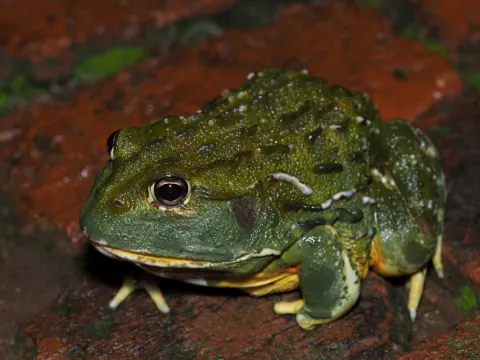
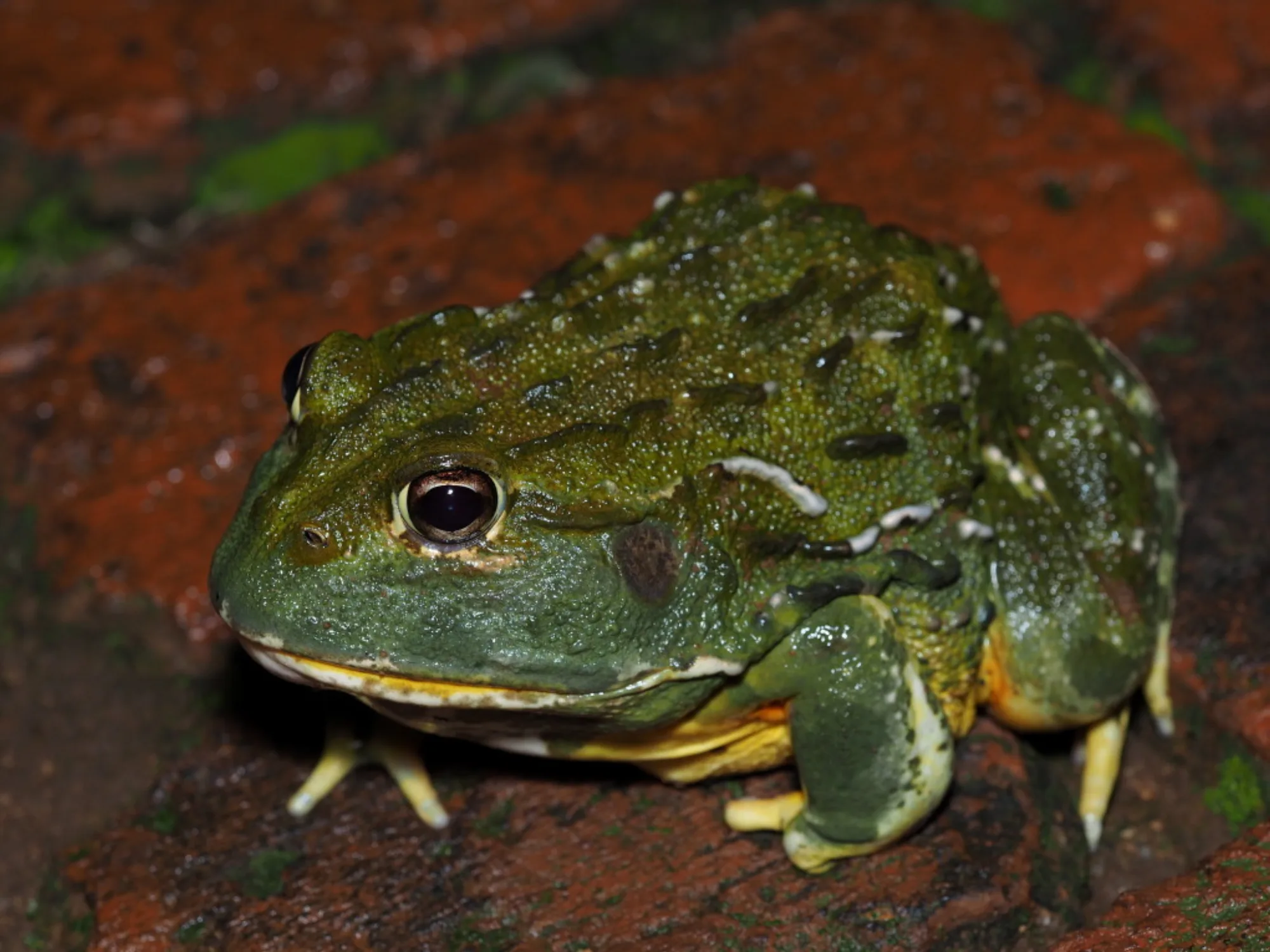
Heavy-bodied and olive-green, the African Bullfrog is among the largest frogs on the planet. Males can weigh up to 1.4 kg and reach 24.5 cm in length, while females are half their size. Young frogs are bright green, with a yellow stripe along the back; adults have white to creamy-yellow bellies, and breeding males have yellow forelimbs.
Its range includes South Africa, Namibia, Kenya and Tanzania, with a possible presence in the Democratic Republic of the Congo too. It has disappeared from Eswatini, while confusion with the edible bullfrog leaves the precise limits of its range uncertain. Habitats range from moist and dry savanna to dry shrubland, seasonal lakes and marshes, pasture, canals and flooded ditches. In dry conditions the frog becomes dormant and may form a cocoon that reduces water loss. Rain softens this covering, allowing the frog to crawl out.
A carnivore, it eats insects and other invertebrates, as well as rodents, reptiles, birds, fish and other amphibians small enough to swallow. Breeding usually begins after about 65 mm of rain over two days, in shallow temporary pools, pans and ditches. During the rainy season, males give a low-pitched whoop lasting about a second, and larger males defend the centre of breeding groups. Females lay about 3,000 to 4,000 eggs, and the tadpoles develop into frogs within three weeks. A father guards the tadpoles and may dig a channel to a larger pond if their pool threatens to dry out, though he sometimes eats some of them. Habitat loss has threatened the species in South Africa, where restoration, awareness campaigns and legal protections have helped reverse the trend.
Written from the English Wikipedia article African bullfrog (CC BY-SA 4.0).
- Records
- 97
- Countries
- 8
- Atlas places
- 4
These are open occurrence records, so they show where people looked for and recorded the African Bullfrog as much as where it lives. Cells are up to 25 km across, and every location is generalised to its cell.
Generalised encounter areas, not exact locations. Each shape is a grid cell coloured by how likely the species is there.
- Very likelySouth Africa25 km zone · medium confidence · 47 records · updated 80 days ago
- Very likelyNamibia25 km zone · medium confidence · 27 records · updated 80 days ago
- LikelyMalawi25 km zone · medium confidence · 9 records · updated 80 days ago
- LikelyBotswana25 km zone · medium confidence · 4 records · updated 80 days ago
- LikelyEswatini25 km zone · medium confidence · 4 records · updated 80 days ago
- LikelyZambia25 km zone · medium confidence · 4 records · updated 80 days ago
- PossibleZimbabwe25 km zone · medium confidence · 2 records · updated 80 days ago
Conservation status not assessed here yet, so every location is generalised to its grid cell.