African Rock Python
Python sebae
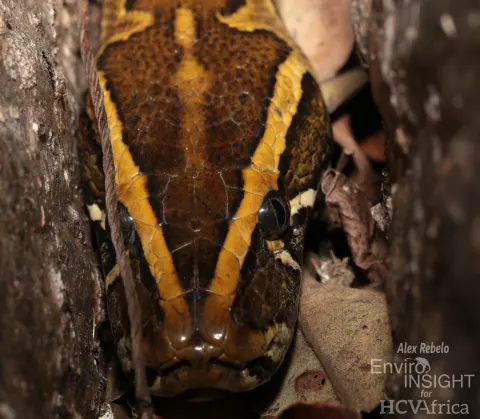
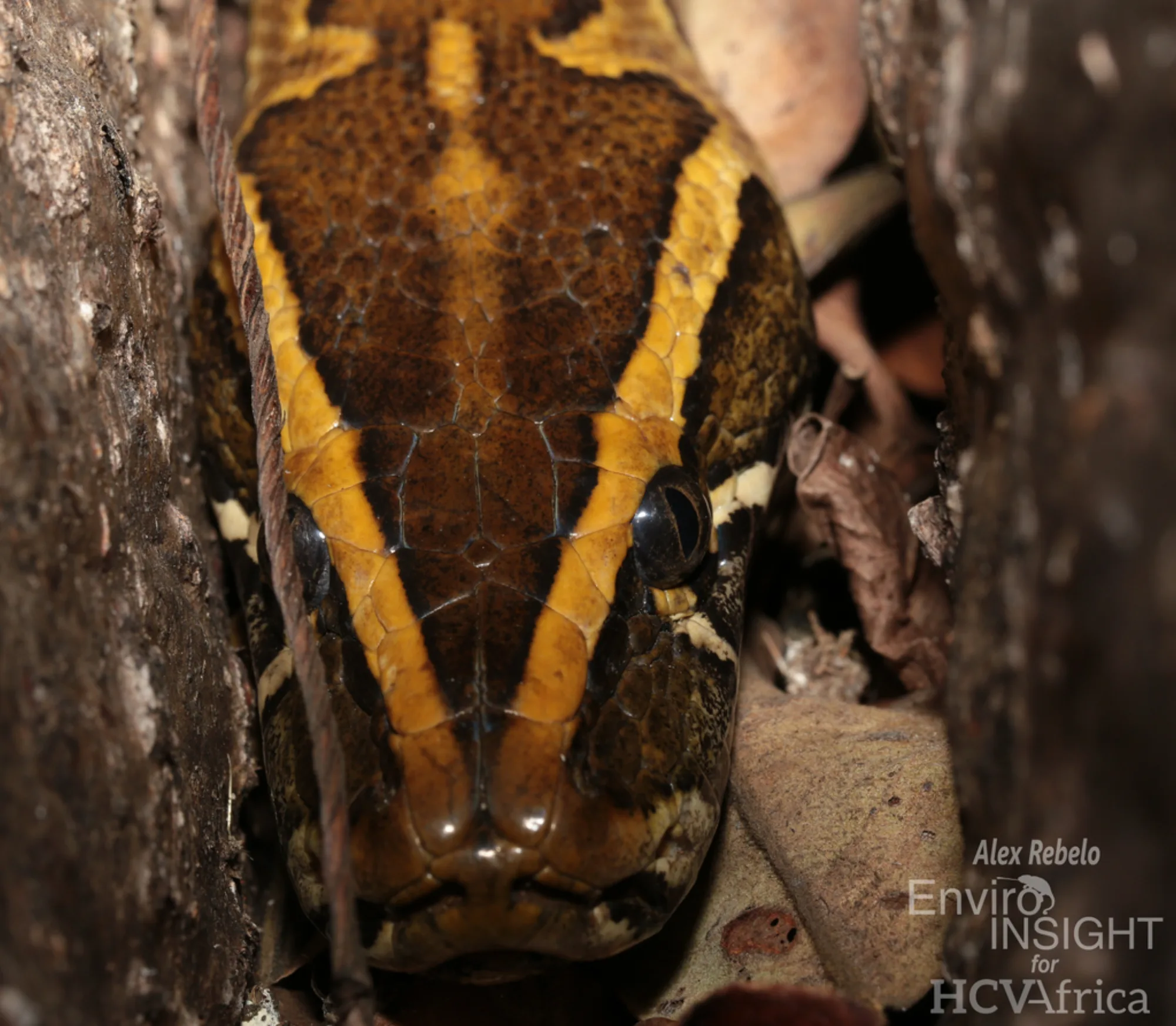
Africa's largest snake, the African Rock Python is a heavily built, nonvenomous constrictor native to sub-Saharan Africa. Adults measure 3 to 3.53 m in total length, though unusually large individuals can exceed 4.8 m. Its thick body carries brown, olive, chestnut or yellow blotches, often joined into an irregular stripe, with a white underside. The triangular head has a dark, spear-shaped mark edged in buffy yellow, and a triangular mark beneath each eye.
Across tropical sub-Saharan Africa, its range reaches from Senegal in the west to Ethiopia and Somalia in the east, and as far south as northern Angola and northern Tanzania. It lives in forests, savannas, grasslands, semideserts and rocky areas, favouring permanent water such as the margins of rivers, lakes and swamps. It also uses disturbed ground around settlements, especially cane fields, and becomes dormant in the dry season. The python kills by constriction and feeds mainly on small antelopes, hyraxes and monkeys, as well as occasional waterbirds, monitor lizards and crocodiles. In suburban areas, it also takes poultry, dogs, goats and other livestock.
In spring, females lay 20 to 100 eggs in an old burrow, termite mound or cave. A female coils around her clutch and guards it from predators until the eggs hatch around 90 days later; she may also guard the young for up to two weeks. In some areas, hunting for leather threatens the snake, and people collect it for the pet trade. In West Africa, it is heavily exploited for bushmeat and leather, while habitat destruction and oil industry exploration threaten mangroves and rainforests in southeastern Nigeria.
Written from the English Wikipedia article Central African rock python (CC BY-SA 4.0).
- Records
- 203
- Countries
- 8
- Atlas places
- 3
These are open occurrence records, so they show where people looked for and recorded the African Rock Python as much as where it lives. Cells are up to 25 km across, and every location is generalised to its cell.
Generalised encounter areas, not exact locations. Each shape is a grid cell coloured by how likely the species is there.
- Very likelyBenin25 km zone · medium confidence · 197 records · updated 80 days ago
- UncommonCongo - Brazzaville25 km zone · medium confidence · 3 records · updated 80 days ago
- UncommonEthiopia25 km zone · medium confidence · 3 records · updated 80 days ago
- UncommonNigeria25 km zone · low confidence · 0 records · updated 80 days ago
- UncommonUnited States25 km zone · low confidence · 0 records · updated 80 days ago
- RareGabon25 km zone · low confidence · 0 records · updated 80 days ago
- RareKenya25 km zone · low confidence · 0 records · updated 80 days ago
- RareTanzania25 km zone · low confidence · 0 records · updated 80 days ago
Conservation status not assessed here yet, so every location is generalised to its grid cell.