Ball Python
Python regius
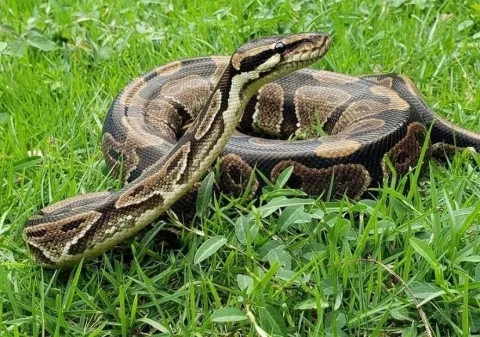
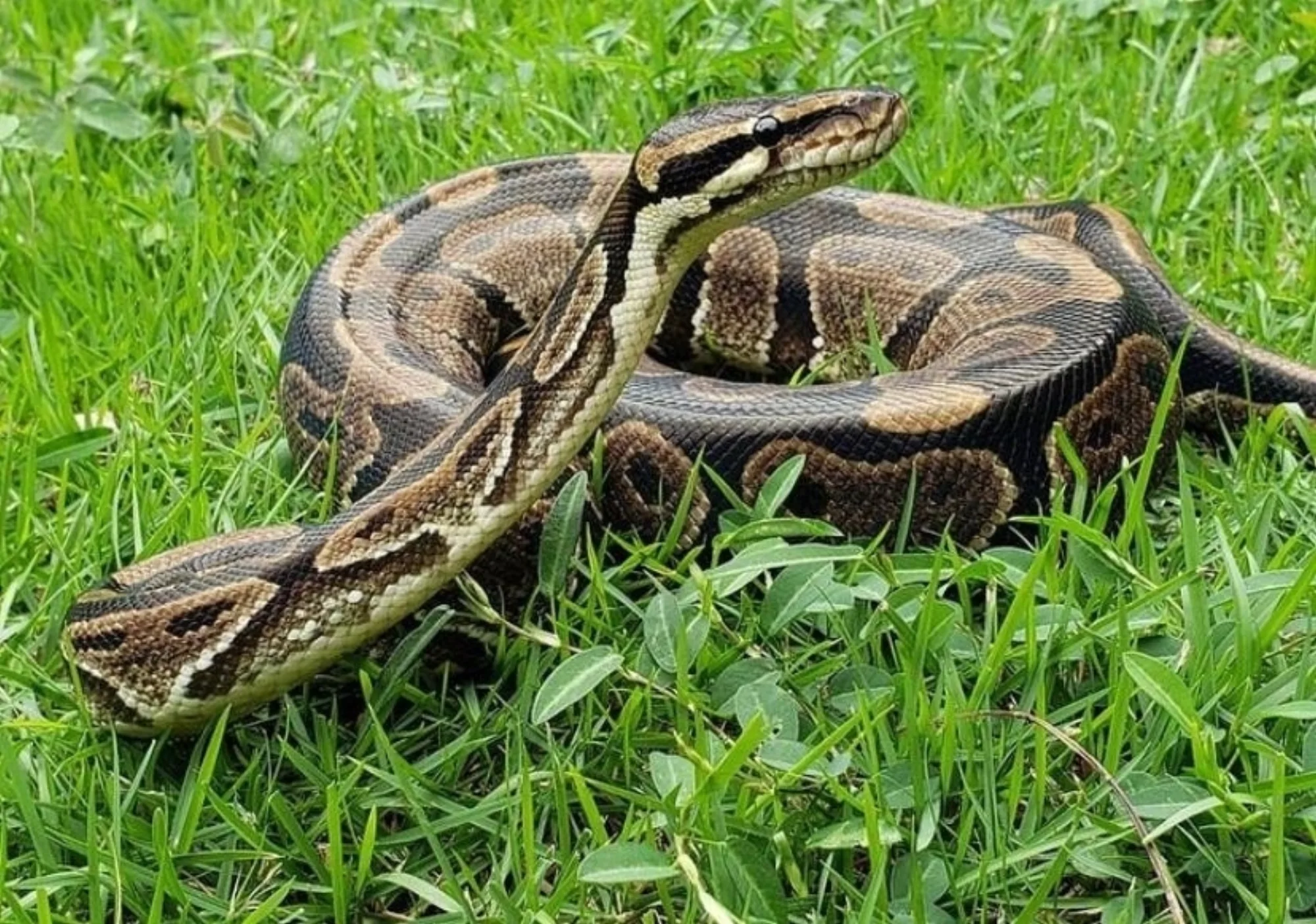
A stocky snake with a small head and smooth scales, the Ball Python is dark brown, with lighter brown blotches across its upper body and flanks. Black marks scatter its pale belly, which can be white or cream, and adults can reach 182 cm in length. Nonvenomous and the smallest of the African pythons, it takes its common name from its habit of curling into a ball when frightened. Across West and Central Africa, its range stretches from Senegal to Uganda and Sudan, taking in Cameroon, and it favours grasslands, savannas and areas with sparse tree cover.
Look for it around dusk or dawn, or at night, when it is typically active. In the wild it uses mammal burrows and other underground refuges, where it also aestivates. When threatened, it coils tightly and hides its head and neck at the centre, usually using this defence instead of biting. Males tend to spend more time in trees, while females tend to stay on the ground. Small mammals make up most of its wild diet, although young snakes under 70 cm mainly eat small birds. Females lay three to 11 leathery eggs, which hatch after 55 to 60 days. Once the eggs hatch, the female leaves the young to fend for themselves.
Poaching for the international exotic pet trade is the main threat, and wild snakes continue to be captured for sale despite the availability of captive-bred animals. People also hunt the species for its skin and meat and for use in traditional medicine. Intensified agriculture and pesticide use contribute to habitat loss, while in Togo rural hunters collect pregnant females and clutches of eggs for sale to snake ranches.
Written from the English Wikipedia article Ball python (CC BY-SA 4.0).
- Records
- 188
- Countries
- 3
No atlas park has a record of the Ball Python in or around it yet.
These are open occurrence records, so they show where people looked for and recorded the Ball Python as much as where it lives. Cells are up to 25 km across, and every location is generalised to its cell.
Generalised encounter areas, not exact locations. Each shape is a grid cell coloured by how likely the species is there.
- Very likelyBenin25 km zone · medium confidence · 178 records · updated 80 days ago
- Very likelyGhana25 km zone · medium confidence · 10 records · updated 80 days ago
- RareGuinea25 km zone · low confidence · 0 records · updated 80 days ago
Conservation status not assessed here yet, so every location is generalised to its grid cell.