Indian Rock Python
Python molurus
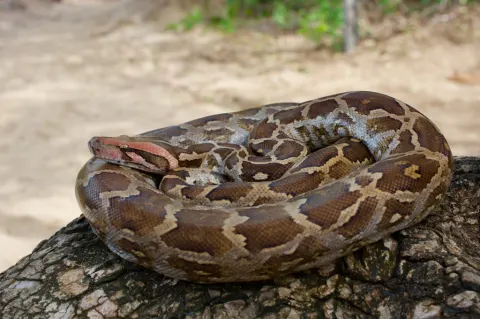
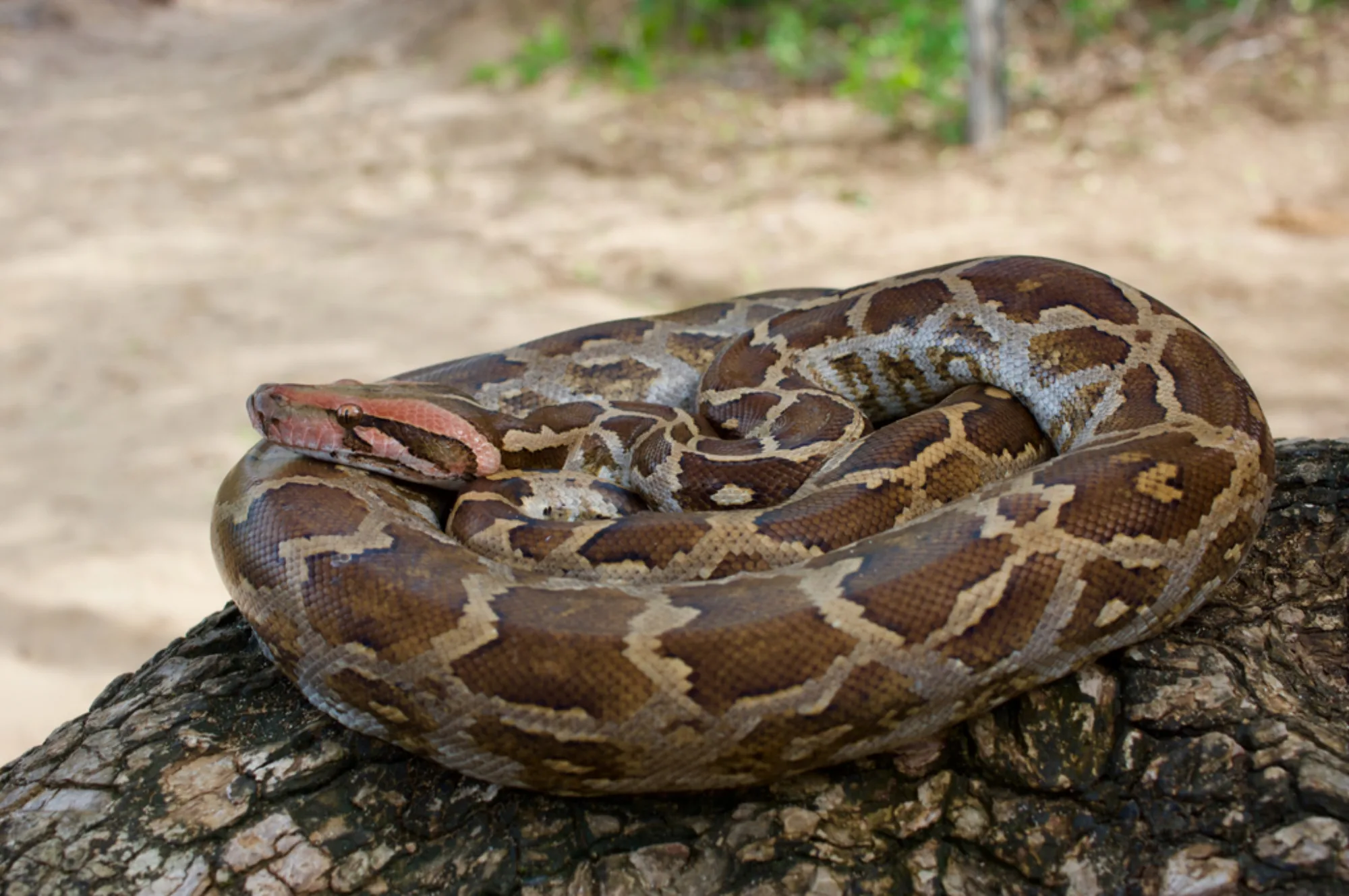
Pale and patterned with brown blotches, the Indian Rock Python is a large, nonvenomous snake that usually reaches 3 m. Its base colour ranges from whitish to yellowish, while the blotches can be tan or dark brown. Colour varies with habitat: hill forest snakes in Assam and the Western Ghats tend to be darker than those in the Eastern Ghats and on the Deccan Plateau.
Its range covers nearly all the Indian subcontinent, reaching south from the Himalayas to Sri Lanka and including southern Nepal, Bhutan, southeastern Pakistan and Bangladesh; it probably extends into northern Myanmar. It needs dependable water and occupies habitats ranging from river valleys and marshes to open forest, grasslands, swamps, woodlands and rocky foothills. Abandoned mammal burrows, hollow trees, dense reeds by water and mangrove thickets offer places to hide. Slow moving and timid, it rarely tries to attack even when attacked. It is also an excellent swimmer, able to stay submerged for many minutes, although it usually prefers to remain near the bank.
The python eats mammals, birds, reptiles and amphibians, with an apparent preference for mammals. It constricts live prey before swallowing it head first, and may fast for weeks after a heavy meal. A female lays up to 100 eggs, which she protects and incubates; the young hatch at 45 to 60 cm long and grow quickly. Habitat loss, over-exploitation and a lack of conservation action have contributed to a likely decline in the population.
Written from the English Wikipedia article Indian python (CC BY-SA 4.0).
- Records
- 26
- Countries
- 1
- Atlas places
- 1
These are open occurrence records, so they show where people looked for and recorded the Indian Rock Python as much as where it lives. Cells are up to 25 km across, and every location is generalised to its cell.
Generalised encounter areas, not exact locations. Each shape is a grid cell coloured by how likely the species is there.
- Very likelyIndia25 km zone · medium confidence · 26 records · updated 80 days ago
Conservation status not assessed here yet, so every location is generalised to its grid cell.