Burmese Python
Python bivittatus
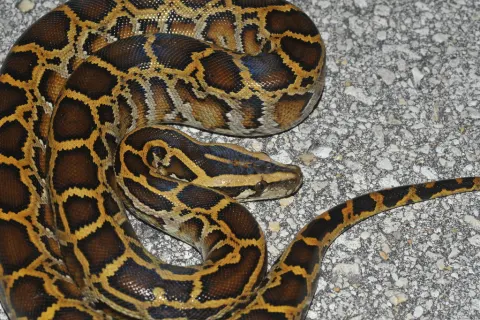
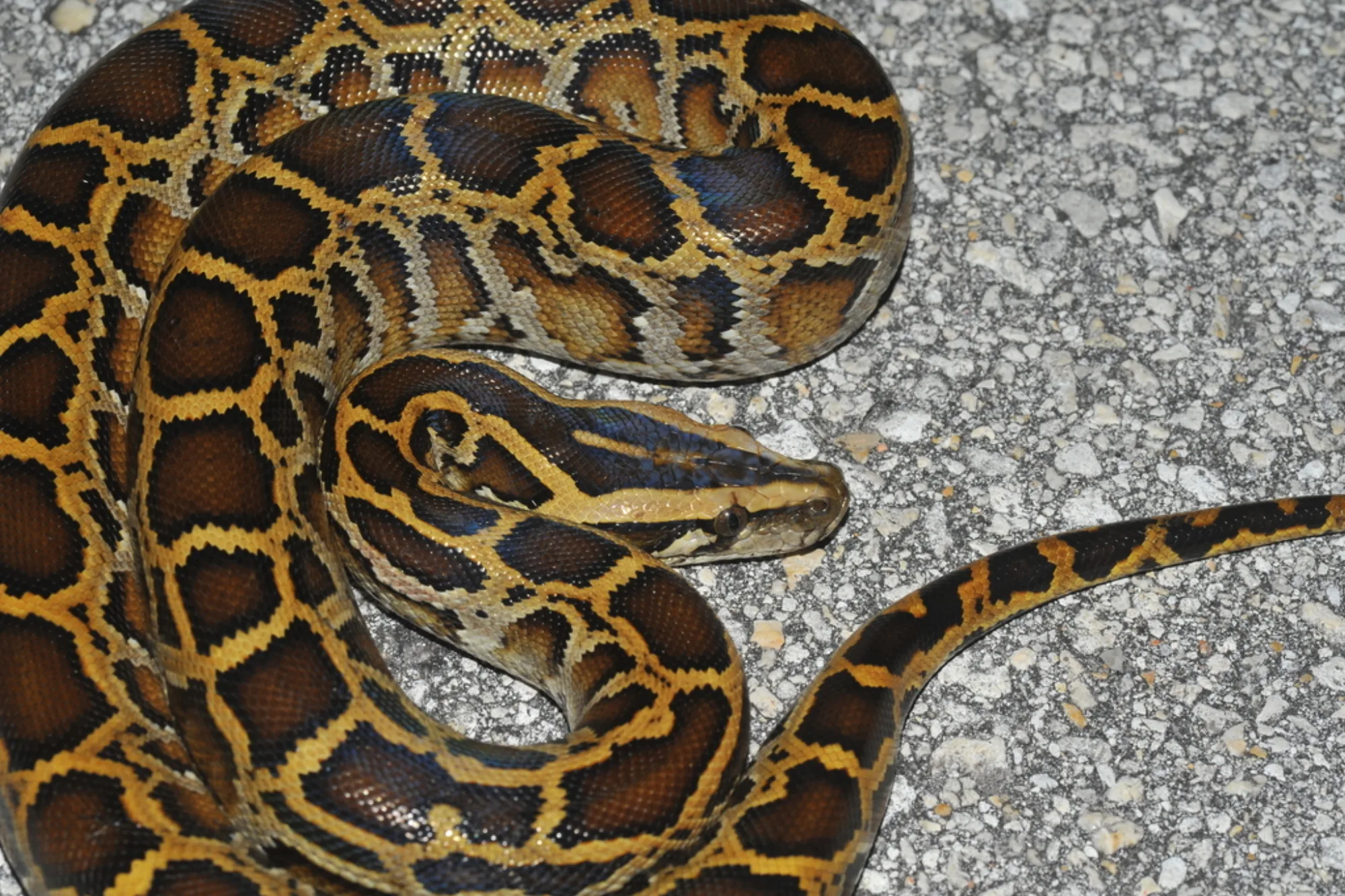
Dark in colour, the Burmese Python (Python bivittatus) has brown blotches edged in black along its back. This non-venomous snake is among the world's largest, and wild individuals typically grow to 5 m. Females are considerably heavier and bulkier than males, although they are only slightly longer on average.
Its native range stretches across parts of southern and Southeast Asia, from eastern India to southern China and several Indonesian islands. It needs a permanent source of water and lives in habitats ranging from marshes and swamps to grasslands, woodlands and jungle clearings. It can swim and climb, though it spends most of its time on land. Young pythons use both trees and the ground, while heavier adults tend to move mainly on the ground. Mostly nocturnal, they spend much of their time concealed in undergrowth. They are usually solitary, coming together in pairs to mate.
The python waits relatively still for prey, then strikes, coils around it and swallows it whole. Birds and mammals make up most of its diet, but it also eats amphibians and reptiles. In early spring, females lay 12 to 36 eggs and stay wrapped around them until they hatch, using muscle movements to warm them. The young receive no further maternal care after hatching and begin to hunt after their first skin shed. Habitat loss and over-harvesting have contributed to a decline in wild populations. In Florida, where it has become invasive, people remove pythons, and winter freezes can also kill them.
Written from the English Wikipedia article Burmese python (CC BY-SA 4.0).
- Records
- 8,117
- Countries
- 9
- Atlas places
- 4
These are open occurrence records, so they show where people looked for and recorded the Burmese Python as much as where it lives. Cells are up to 25 km across, and every location is generalised to its cell.
Generalised encounter areas, not exact locations. Each shape is a grid cell coloured by how likely the species is there.
- Very likelyUnited States25 km zone · high confidence · 8034 records · updated 80 days ago
- LikelyHong Kong SAR China25 km zone · medium confidence · 40 records · updated 80 days ago
- PossibleChina25 km zone · medium confidence · 14 records · updated 80 days ago
- PossibleThailand25 km zone · medium confidence · 13 records · updated 80 days ago
- UncommonIndia25 km zone · low confidence · 13 records · updated 80 days ago
- UncommonNepal25 km zone · medium confidence · 2 records · updated 80 days ago
- UncommonIndonesia25 km zone · medium confidence · 1 record · updated 80 days ago
- RareTaiwan25 km zone · low confidence · 0 records · updated 80 days ago
- RareVietnam25 km zone · low confidence · 0 records · updated 80 days ago
Conservation status not assessed here yet, so every location is generalised to its grid cell.