Eurasian Bullfinch
Pyrrhula pyrrhula
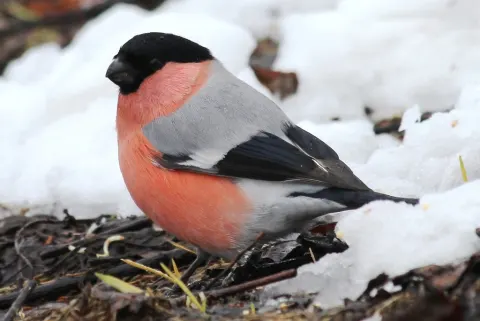
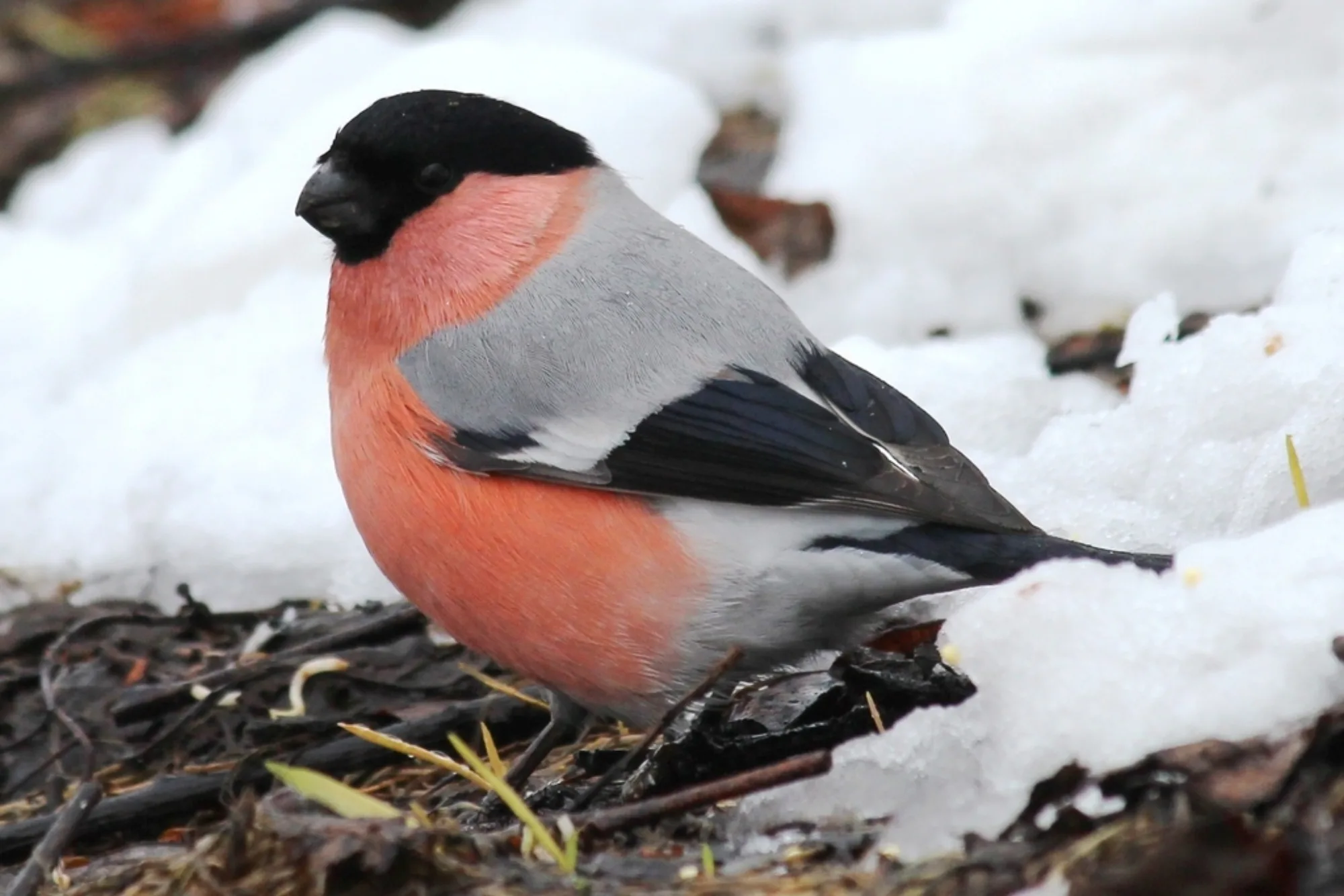
A bulky shape, black cap and short, stocky bill give the Eurasian Bullfinch a distinctive appearance. This small finch has grey upperparts, black flight feathers and a white rump and wing bars that stand out in flight. Adult males have a rich red chest and underparts, while females and young birds are grey-buff below. Juveniles have a greyish-brown cap and face, unlike the black markings of adults. The bird can be unobtrusive, and its song, a scratchy warble mixed with soft, fluted whistles, carries only a short distance. Its usual call is a quiet, low whistle, rendered as peeu or pew.
Its breeding range extends through much of Europe into temperate Asia, and it favours mixed woodland with some conifers, as well as parkland and gardens. It mostly stays in its range year-round, though many northern birds travel farther south for winter. Outside the breeding season, look for pairs or family groups rather than large flocks. Bullfinches eat mainly seeds and fruit-tree buds, with ash and hawthorn favoured in autumn and early winter. Adults also bring invertebrates to their chicks. A nest may be placed in a bush, mature scrub or a tree, and holds four to seven pale blue eggs mottled with red-brown. Between early May and mid-July, it raises two or three broods. In the UK, populations have declined since the 1970s because orchards and woodlands have been lost. Fruit-tree buds can also draw bullfinches into conflict with orchard growers: in England, parishes once paid bounties for birds killed.
Written from the English Wikipedia article Eurasian bullfinch (CC BY-SA 4.0).
- Records
- 542,472
- Countries
- 56
No atlas park has a record of the Eurasian Bullfinch in or around it yet.
These are open occurrence records, so they show where people looked for and recorded the Eurasian Bullfinch as much as where it lives. Cells are up to 25 km across, and every location is generalised to its cell.
Generalised encounter areas, not exact locations. Each shape is a grid cell coloured by how likely the species is there.
- Very likelyNorway25 km zone · high confidence · 161565 records · updated 86 days ago
- Very likelyFinland25 km zone · high confidence · 159396 records · updated 86 days ago
- Very likelyUnited Kingdom25 km zone · high confidence · 85361 records · updated 86 days ago
- Very likelySweden25 km zone · high confidence · 45585 records · updated 86 days ago
- Very likelyFrance25 km zone · high confidence · 21100 records · updated 86 days ago
- Very likelyBelgium25 km zone · high confidence · 7605 records · updated 86 days ago
- Very likelyGermany25 km zone · high confidence · 6890 records · updated 86 days ago
- Very likelyDenmark25 km zone · high confidence · 5285 records · updated 86 days ago
- Very likelyRussia25 km zone · high confidence · 5239 records · updated 86 days ago
- Very likelyIreland25 km zone · high confidence · 4567 records · updated 86 days ago
Conservation status not assessed here yet, so every location is generalised to its grid cell.