Alpine Chough
Pyrrhocorax graculus
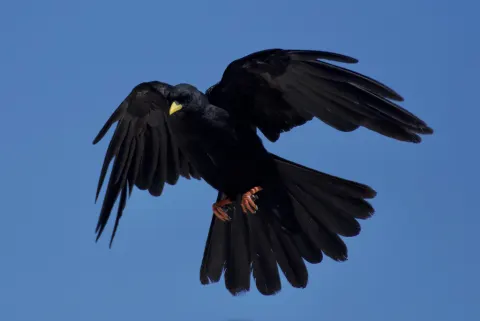
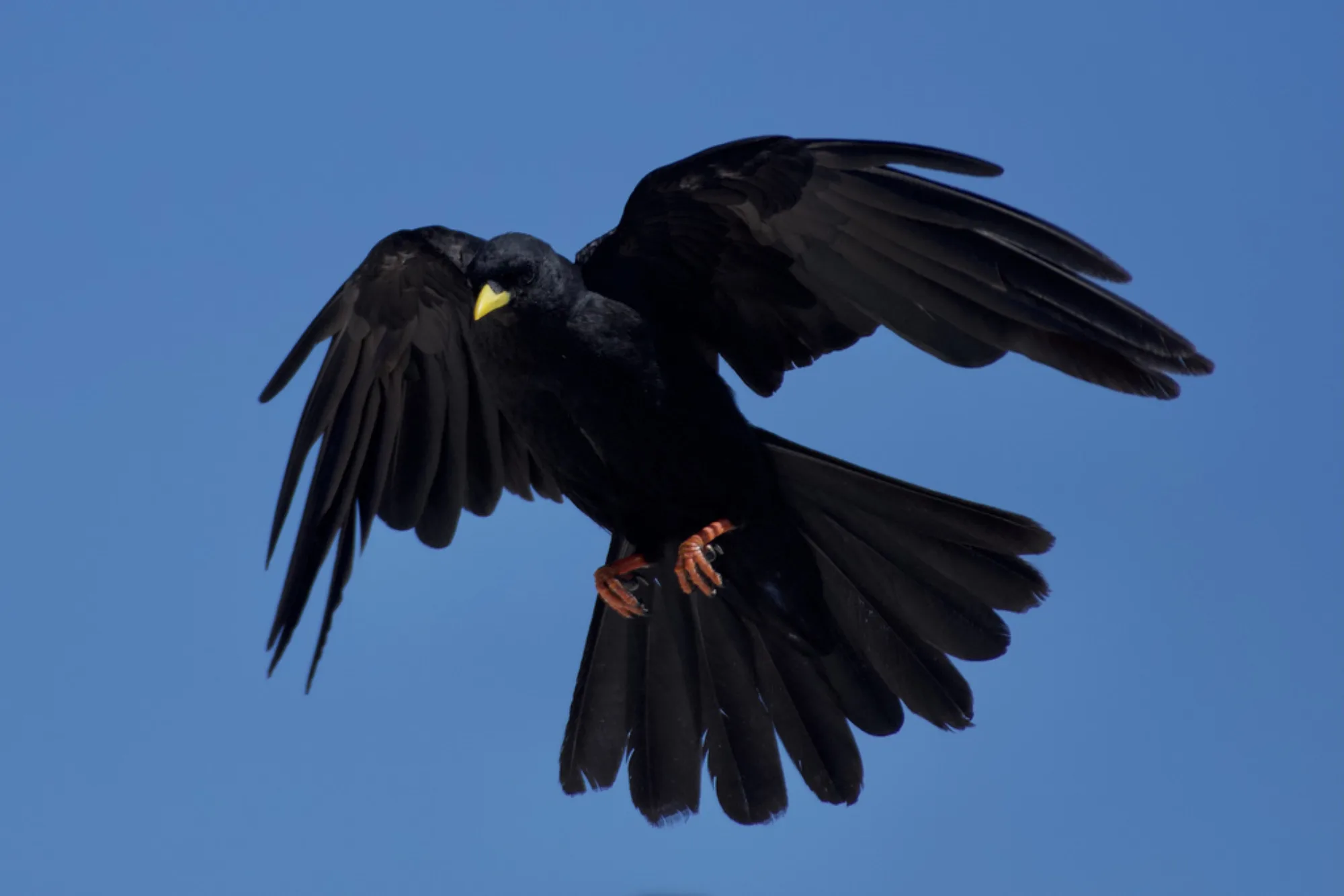
Glossy black feathers, a short yellow bill and red legs make the Alpine Chough easy to recognise. This member of the crow family has a buoyant, acrobatic flight, often soaring on updraughts along cliff faces. Listen, too, for its rippling calls and whistles, as well as the quieter warbles and squeaks of birds feeding or resting. Juveniles look duller than adults, with brownish legs and a dull yellow bill.
The Alpine Chough lives year-round in high mountains, with a range stretching from Spain across southern Europe and Central Asia to the Himalayas and western China. It also occurs in Morocco and on the islands of Corsica and Crete. It forages on alpine meadows and scree slopes, and usually nests in cavities or cracks in inaccessible rock faces. In winter, flocks often gather around settlements, ski resorts and hotels, sometimes waiting by windows for food. After snowfall, birds may feed near valley bottoms by day and return to the mountains to roost.
Choughs forage in groups, eating mainly invertebrates such as beetles, snails and grasshoppers in summer, then mostly fruit through the colder months. They also hide food in cracks, covering it with pebbles. Pairs stay together from year to year and build lined nests of roots, sticks and plant stems, often on cliffs. The female incubates three to five eggs, and both parents feed the chicks. Predators include peregrine falcons, golden eagles and Eurasian eagle-owls, while ravens take nestlings. Changes in farming can reduce feeding habitat, as can ski resorts and other development on alpine meadows. Climate change may eventually push suitable mountain habitat higher, leaving less space for the birds.
Written from the English Wikipedia article Alpine chough (CC BY-SA 4.0).
- Records
- 56,684
- Countries
- 37
- Atlas places
- 4
These are open occurrence records, so they show where people looked for and recorded the Alpine Chough as much as where it lives. Cells are up to 25 km across, and every location is generalised to its cell.
Generalised encounter areas, not exact locations. Each shape is a grid cell coloured by how likely the species is there.
- Very likelyFrance25 km zone · high confidence · 22233 records · updated 86 days ago
- Very likelySpain25 km zone · high confidence · 7886 records · updated 86 days ago
- Very likelySwitzerland25 km zone · high confidence · 6446 records · updated 86 days ago
- Very likelyItaly25 km zone · high confidence · 3731 records · updated 86 days ago
- Very likelyIndia25 km zone · high confidence · 3103 records · updated 86 days ago
- Very likelyAustria25 km zone · high confidence · 2796 records · updated 86 days ago
- Very likelyGermany25 km zone · high confidence · 1972 records · updated 86 days ago
- Very likelyMorocco25 km zone · high confidence · 1529 records · updated 86 days ago
- Very likelyGeorgia25 km zone · high confidence · 1173 records · updated 86 days ago
- Very likelyNepal25 km zone · high confidence · 969 records · updated 86 days ago
Conservation status not assessed here yet, so every location is generalised to its grid cell.