Flathead Catfish
Pylodictis olivaris
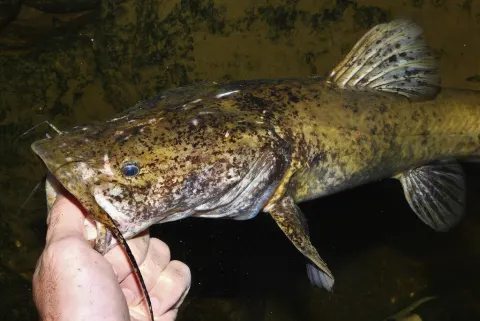
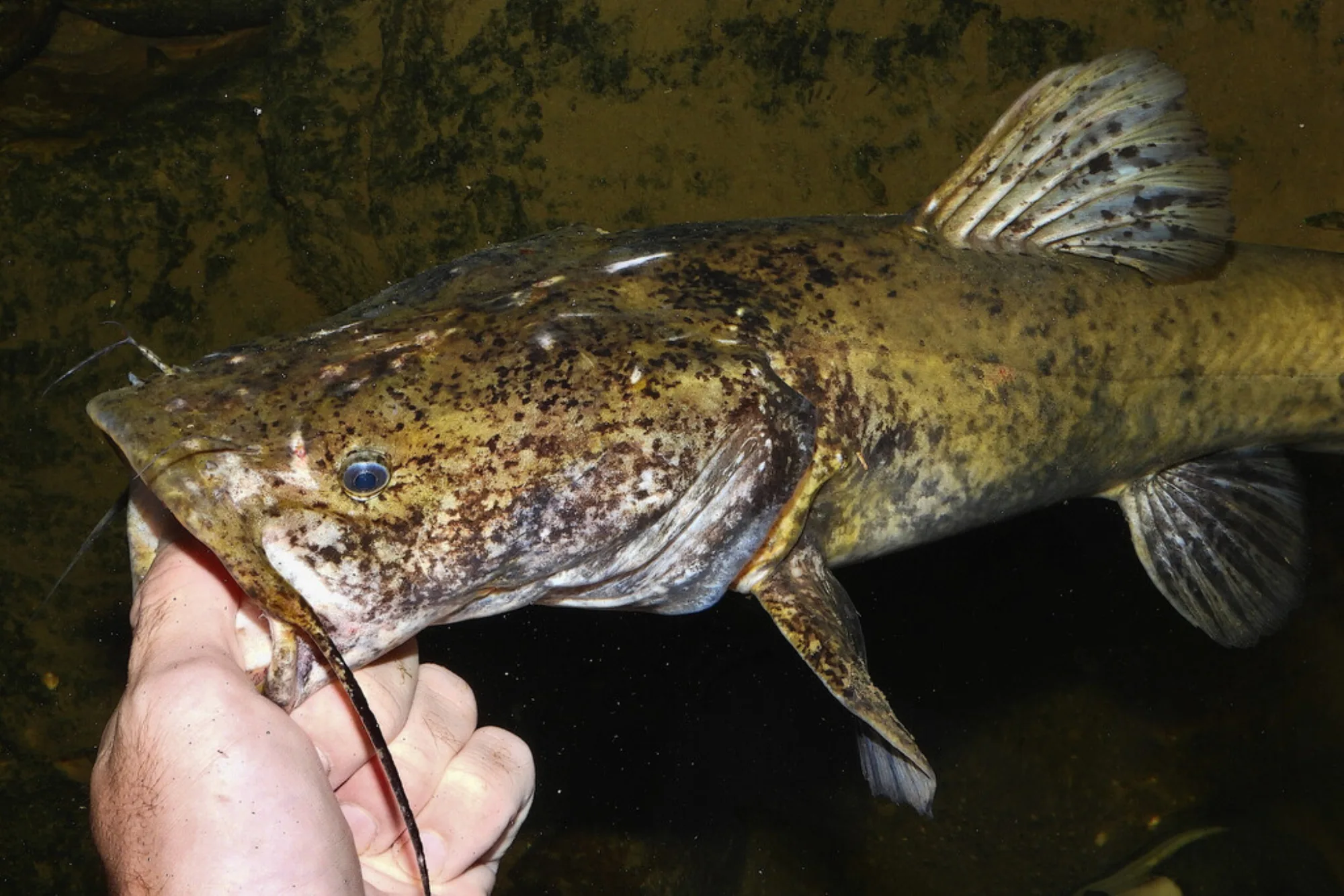
Broad-headed and large, the Flathead Catfish is a North American freshwater fish also known as the mudcat or shovelhead cat. Its sides and back are olive, its underside is white to yellow, and its small eyes sit above a projecting lower jaw. Dark brown to black mottling can be especially strong in young fish from clearer water. Adults commonly measure about 38 to 114 cm, although larger individuals have been recorded.
Its native range covers large rivers in the Mississippi, Missouri and Ohio basins, west of the Appalachian Mountains. The range reaches Canada in the north, Texas in the west, and the Gulf of Mexico and northeastern Mexico in the south. The fish has also been widely introduced and is invasive in some places. It favours relatively warm, medium to large rivers with steady, slow currents, and spends its time near the bottom. Overhanging banks, fallen trees and woody debris provide the kind of habitat it prefers. Its home range tends to be less than 2 kilometres, and it does not migrate.
Live prey is its preference, with a diet that includes fish, insects, worms and crustaceans. Young fish feed mainly on insect larvae, while larger individuals feed almost entirely on other fish. In spring and summer, movement increases between midnight and dawn, with activity greatest in summer. Spawning takes place in late June and early July, when males build nests among submerged logs and debris. They defend the eggs and fan them with their fins to provide oxygen. The young frequent shallow areas with rocky or sandy bottoms, where they eat insects and worms.
Written from the English Wikipedia article Flathead catfish (CC BY-SA 4.0).
- Records
- 5,146
- Countries
- 3
- Atlas places
- 1
These are open occurrence records, so they show where people looked for and recorded the Flathead Catfish as much as where it lives. Cells are up to 25 km across, and every location is generalised to its cell.
Generalised encounter areas, not exact locations. Each shape is a grid cell coloured by how likely the species is there.
- Very likelyUnited States25 km zone · medium confidence · 5068 records · updated 80 days ago
- Very likelyMexico25 km zone · medium confidence · 68 records · updated 80 days ago
- LikelyCanada25 km zone · medium confidence · 10 records · updated 80 days ago
Conservation status not assessed here yet, so every location is generalised to its grid cell.