Chinstrap Penguin
Pygoscelis antarcticus
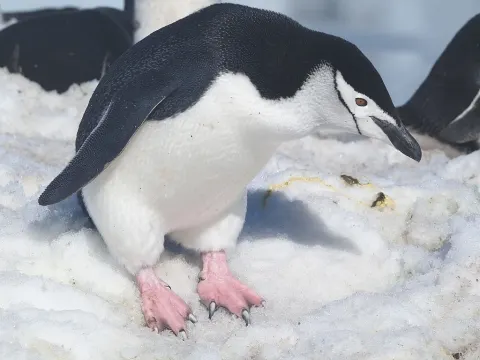
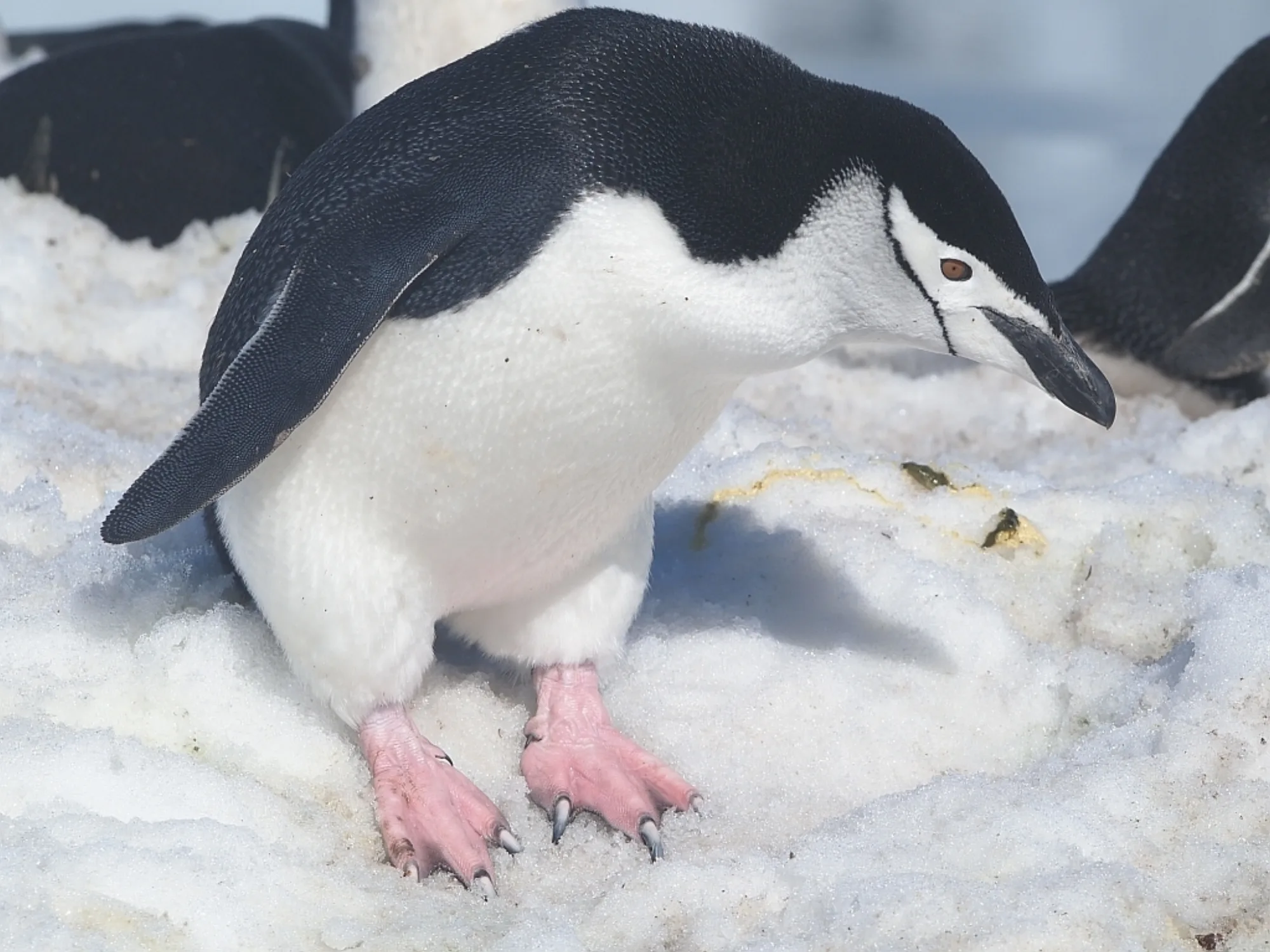
A narrow black band beneath its head gives the Chinstrap Penguin its name and the appearance of wearing a helmet. Its white face extends behind reddish-brown eyes, while its short bill is black and its webbed feet are pink. Black flippers have white edges, and a black back contrasts with the white underside. On land, short legs give it a distinctive waddle, and its call is loud and harsh.
Chinstrap Penguins range around the Antarctic, living on coastal stretches and islands across the Antarctic and Southern Pacific Oceans. Breeding sites include Antarctica, Argentina, Chile and Bouvet Island, as well as South Georgia and the South Sandwich Islands and the French Southern Territories. At sea, they swim as far as 80 km offshore each day to find small fish, krill, shrimp and squid. Their densely packed feathers form a waterproof coat that helps them swim in freezing water. On land, pairs build circular stone nests and take turns incubating two eggs. Chicks hatch after around 37 days, spending 20 to 30 days in the nest before gathering with other young in a crèche. At around 50 to 60 days old, they gain adult feathers and go to sea. Adults can be aggressive near their nesting grounds, attacking approaching predators, humans and other penguin species.
Climate change is the main threat, reducing krill abundance in parts of the penguin's range and likely making breeding less successful. Human fishing for krill and volcanic events are other potential threats. Leopard seals prey on the penguins at sea, while skuas and southern giant petrels most often take eggs and young on land.
Written from the English Wikipedia article Chinstrap penguin (CC BY-SA 4.0).
- Records
- 11,811
- Countries
- 6
- Atlas places
- 1
These are open occurrence records, so they show where people looked for and recorded the Chinstrap Penguin as much as where it lives. Cells are up to 25 km across, and every location is generalised to its cell.
Generalised encounter areas, not exact locations. Each shape is a grid cell coloured by how likely the species is there.
- Very likelyAntarctica25 km zone · high confidence · 10923 records · updated 80 days ago
- Very likelySouth Georgia & South Sandwich Islands25 km zone · high confidence · 838 records · updated 80 days ago
- LikelyAustralia25 km zone · medium confidence · 21 records · updated 80 days ago
- PossibleArgentina25 km zone · medium confidence · 16 records · updated 80 days ago
- PossibleFalkland Islands25 km zone · medium confidence · 8 records · updated 80 days ago
- PossibleBouvet Island25 km zone · medium confidence · 5 records · updated 80 days ago
Conservation status not assessed here yet, so every location is generalised to its grid cell.