Adelie Penguin
Pygoscelis adeliae
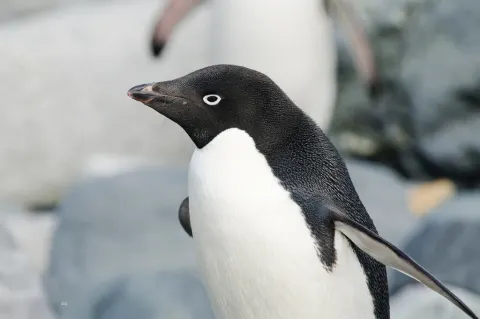
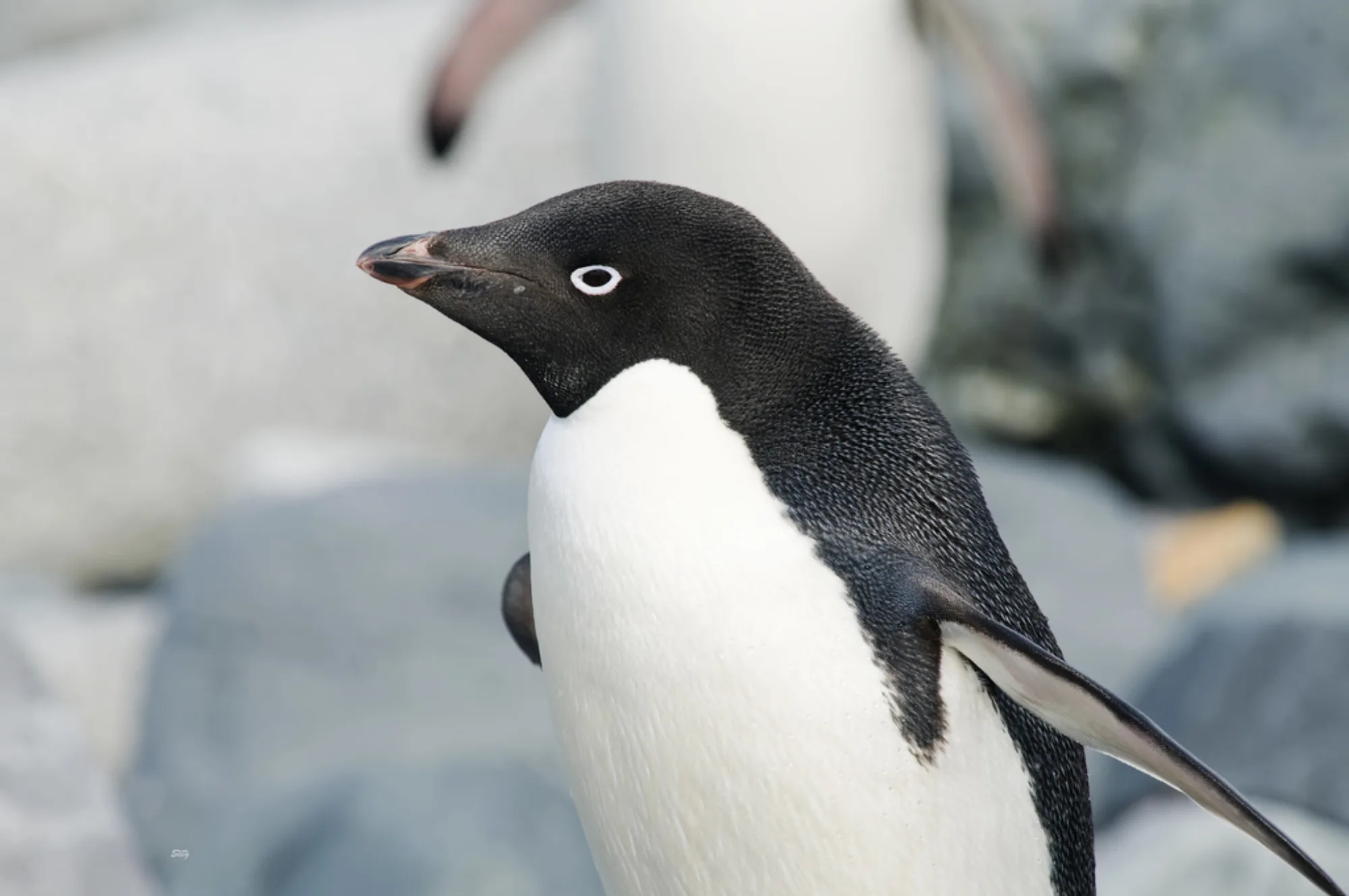
Along Antarctica’s coast, the Adelie Penguin stands out with a black head and back, white underparts and a clear white ring around each eye. Adults measure 70 to 73 cm long and have pinkish legs and feet. Their long, stiff tail feathers sweep the ground as they walk, and the birds also use their tails for support. Bold and boisterous, they will challenge other animals, even much larger predators.
Breeding colonies lie along the Antarctic coast and on several sub-Antarctic islands. The penguins build stone nests on bare, rocky ground, favouring places where wind or sunlight keeps snow from piling up. They breed from October to February, laying two eggs that both parents take turns to incubate. Chicks stay in the nest for 22 days, then join groups of other chicks before going to sea after 50 to 60 days. After breeding, adults generally move onto ice floes or shelves to moult, although some stay ashore. In winter they remain among the pack ice, sometimes travelling hundreds or thousands of kilometres from their colonies. They eat mainly krill and fish, with their chick-rearing diet varying by location and including squid and other sea creatures.
Life on the ice carries risks. Leopard seals regularly prey on adults, while south polar skuas and giant petrels kill chicks and eat eggs. Reduced sea ice has been associated with a 65% fall in Adelie Penguin populations on the Antarctic Peninsula over 25 years. Bird flu is another concern: in 2024, researchers reported more than 532 dead birds on Heroína Island, with H5N1 suspected as the cause.
Written from the English Wikipedia article Adélie penguin (CC BY-SA 4.0).
- Records
- 121,520
- Countries
- 1
No atlas park has a record of the Adelie Penguin in or around it yet.
These are open occurrence records, so they show where people looked for and recorded the Adelie Penguin as much as where it lives. Cells are up to 25 km across, and every location is generalised to its cell.
Generalised encounter areas, not exact locations. Each shape is a grid cell coloured by how likely the species is there.
- Very likelyAntarctica25 km zone · high confidence · 121520 records · updated 80 days ago
Conservation status not assessed here yet, so every location is generalised to its grid cell.