Piranha
Pygocentrus nattereri
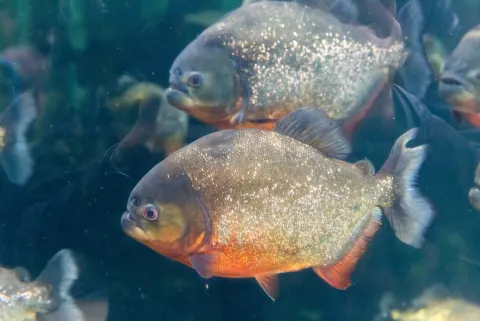
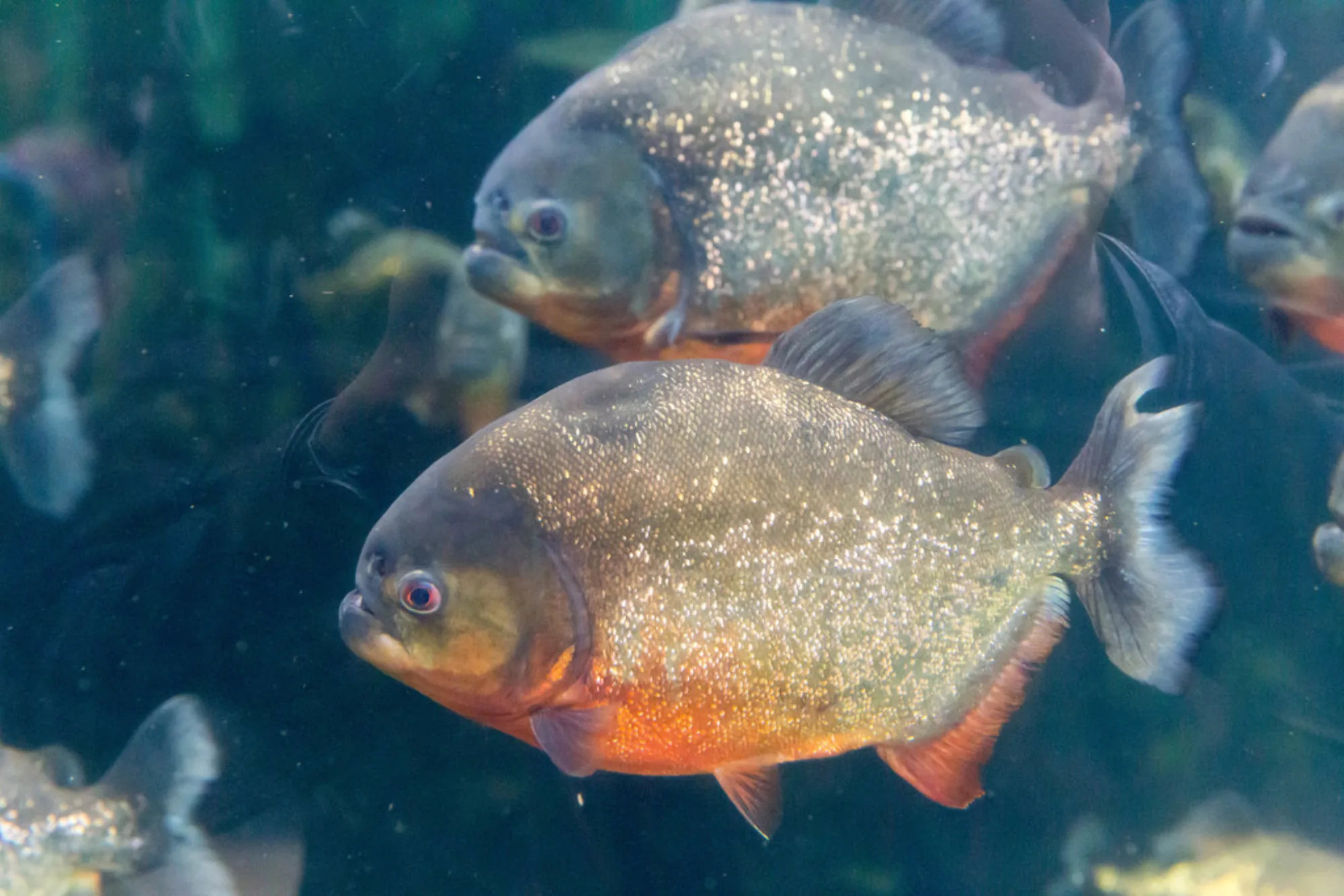
In South America's fresh waters, the red-bellied Piranha is a deep-bodied fish with a long dorsal fin. Adults have a reddish belly and a grey body often flecked with silver, while juveniles are silver with darker spots. The fins near the front and underside can range from red to orange. It can reach 50 cm in length, though it rarely exceeds 35 cm.
Its South American range spans the basins of the Amazon, Paraguay, Paraná and Essequibo, along with rivers on Brazil's northeastern coast. It lives in major rivers, streams and lakes, as well as floodplains and flooded forests. Whitewater is its most usual setting, but it has also been recorded in blackwater and clearwater. Although it does not migrate, it travels in search of suitable breeding conditions when rainfall increases.
Piranhas often travel in shoals for protection from predators, which include dolphins, caimans, large fish and aquatic birds. They are primarily scavengers and foragers, eating insects, fish, plants and carrion, among other foods. Smaller fish search for food by day, whereas larger ones feed around dawn, late afternoon and early evening. They may also hide in vegetation and ambush passing prey. During the rainy season, females deposit around 5,000 eggs among recently flooded plants, in nests made by males. The eggs hatch after two to three days, and the young shelter among plants until they can defend themselves. Other fish may eat unattended eggs, while collection for the aquarium trade may pose a low risk to local populations.
Written from the English Wikipedia article Red-bellied piranha (CC BY-SA 4.0).
- Records
- 358
- Countries
- 9
- Atlas places
- 5
These are open occurrence records, so they show where people looked for and recorded the Piranha as much as where it lives. Cells are up to 25 km across, and every location is generalised to its cell.
Generalised encounter areas, not exact locations. Each shape is a grid cell coloured by how likely the species is there.
- Very likelyBrazil25 km zone · medium confidence · 222 records · updated 80 days ago
- Very likelyBolivia25 km zone · medium confidence · 49 records · updated 80 days ago
- Very likelyPeru25 km zone · medium confidence · 20 records · updated 80 days ago
- Very likelyParaguay25 km zone · medium confidence · 18 records · updated 80 days ago
- Very likelyEcuador25 km zone · medium confidence · 16 records · updated 80 days ago
- Very likelyGuyana25 km zone · medium confidence · 16 records · updated 80 days ago
- LikelyArgentina25 km zone · medium confidence · 14 records · updated 80 days ago
- LikelyUnited States25 km zone · medium confidence · 3 records · updated 80 days ago
- UncommonColombia25 km zone · low confidence · 0 records · updated 80 days ago
Conservation status not assessed here yet, so every location is generalised to its grid cell.