Red-shanked Douc
Pygathrix nemaeus
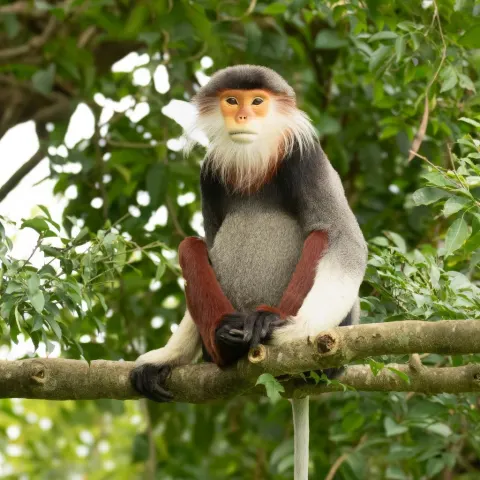
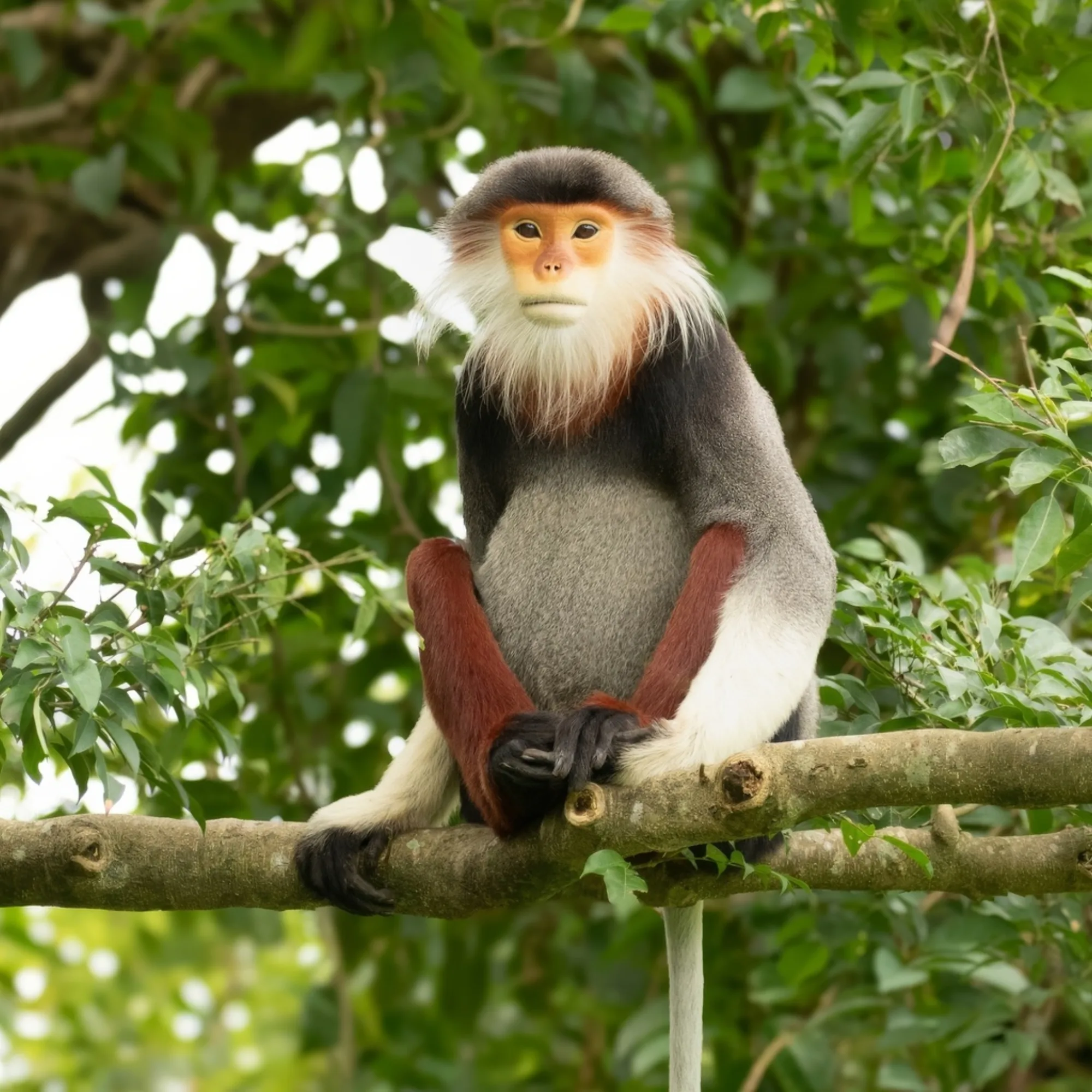
High in the forest canopy, the Red-shanked Douc moves through the trees by day and sleeps among the branches at night. This long, slender monkey has a yellow-brown face, pale blue eyelids, white cheeks and throat, and a white tail. Its lower legs are red, although animals farther south tend to have smaller red patches and less intense colouring. In Laos, some have red patches confined to their ankles.
The species lives in Vietnam and southern Laos, and has also been observed in northeastern Cambodia. It inhabits evergreen and semi-evergreen forests, and occasionally limestone forest, at elevations up to 1,600 metres. In central Vietnam, Sơn Trà Nature Reserve and Phong Nha - Kẻ Bàng National Park are important places for the species. Doucs spend most of their time in the canopy, but sometimes come to the ground to drink or eat mineral-rich soil. They can leap up to 6 metres, landing on two feet, and may flee silently through the canopy when disturbed.
Bands average 18 individuals and split into smaller groups during the morning and early afternoon, coming together again overnight. Leaves and buds form much of their diet, while figs are eaten throughout the year. They feed peacefully together and sometimes pass pieces of foliage to one another. Births occur throughout the year, usually producing a single infant, and other group members have been seen caring for infants in captivity. Hunting is the main threat, with the monkeys killed for food and other uses. The pet trade, forest fragmentation, agricultural expansion and military installations also threaten them, while development plans pose a risk to their habitat at Sơn Trà.
Written from the English Wikipedia article Red-shanked douc (CC BY-SA 4.0).
- Records
- 29
- Countries
- 1
No atlas park has a record of the Red-shanked Douc in or around it yet.
These are open occurrence records, so they show where people looked for and recorded the Red-shanked Douc as much as where it lives. Cells are up to 25 km across, and every location is generalised to its cell.
Generalised encounter areas, not exact locations. Each shape is a grid cell coloured by how likely the species is there.
- Very likelyVietnam25 km zone · medium confidence · 29 records · updated 80 days ago
Conservation status not assessed here yet, so every location is generalised to its grid cell.