Red-vented Bulbul
Pycnonotus cafer
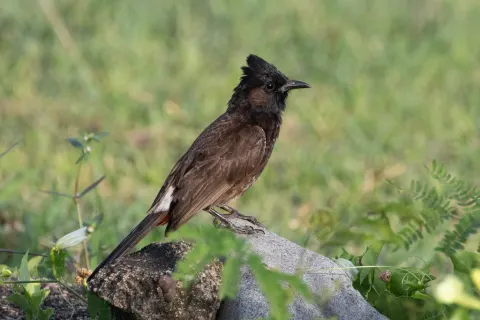
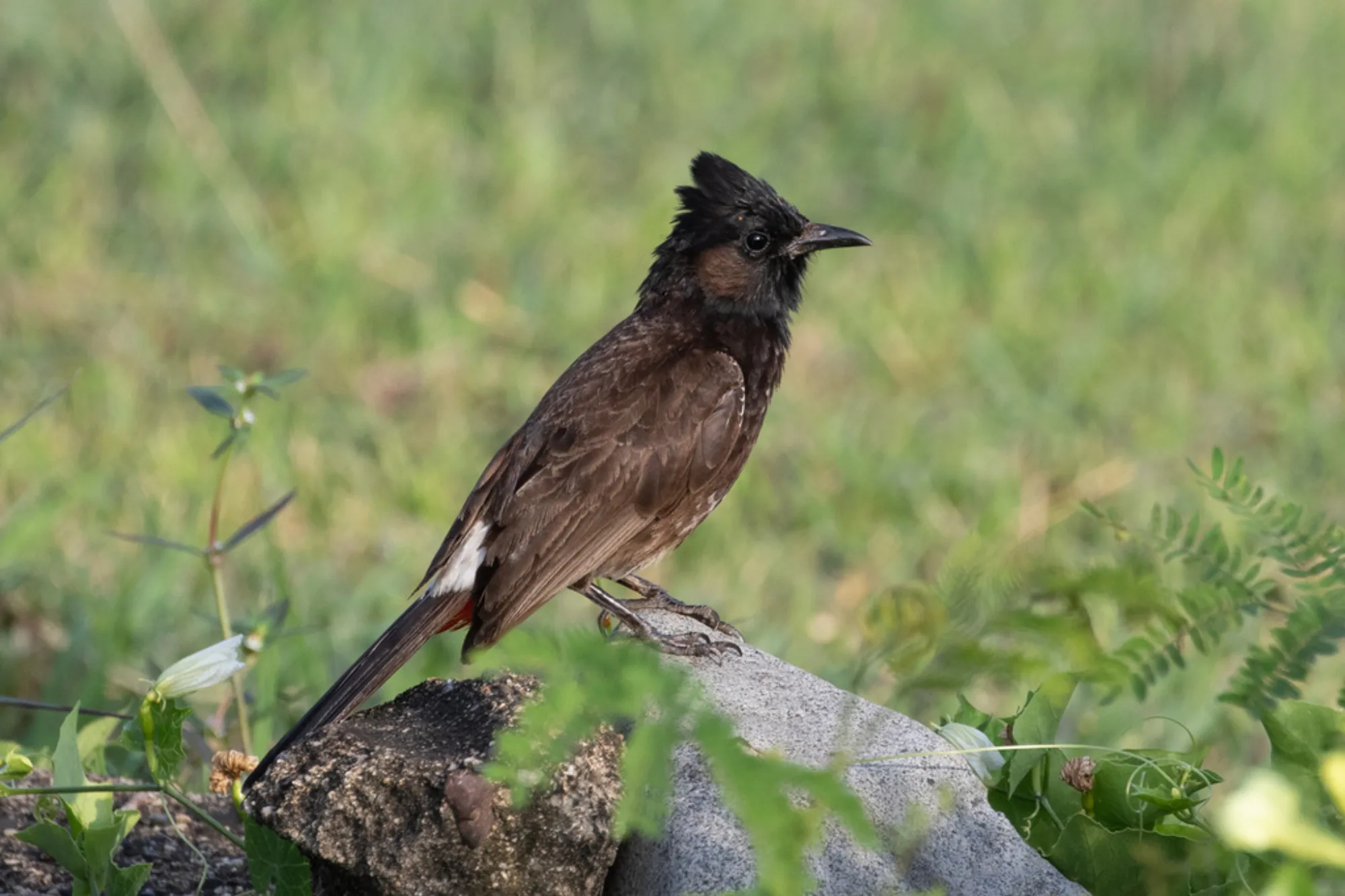
A short crest gives the Red-vented Bulbul a square-looking head, while its dark brown body has a scaly pattern. Look for a darker or black head, a white rump and a red patch beneath the tail. About 20 cm long, it has a long black tail tipped with white; young birds are duller than adults. Its calls include a phrase rendered as “ginger beer” and sharp single notes like “pick”, and it calls throughout the year. Other bird species often respond to its alarm calls.
The bulbul breeds year-round as a resident across South Asia, extending east to Burma, and has established populations in places including Fiji, Tonga and Argentina. It favours dry scrub, open forest, plains and cultivated land, and is rarely found in mature forest within its native range. Its varied diet includes fruit, flower petals, nectar and insects, as well as occasional house geckos. It also eats leaves and disperses seeds, including those of some invasive plants. Small, flat cup nests are usually built in bushes, though birds sometimes choose houses, tree cavities or holes in mud banks. Breeding runs from June to September, and a clutch usually contains two or three eggs; both parents feed the chicks, and pairs can raise multiple clutches in a year. The eggs hatch after about 14 days.
In scrub habitats in southern India, fires, heavy rain and predators are the main causes of death among fledglings. The species is also a host to the brood-parasitic pied crested cuckoo. In some introduced regions, people regard the bulbul as a pest because it damages fruit crops; extermination campaigns have targeted populations in New Zealand.
Written from the English Wikipedia article Red-vented bulbul (CC BY-SA 4.0).
- Records
- 860,259
- Countries
- 28
- Atlas places
- 19
- Bandipur National Park· India
- Jim Corbett National Park· India
- Kanha National Park· India
- Nagarhole National Park· India
- Ranthambore National Park· India
- Yala National Park· Sri Lanka
- Annapurna Conservation Area· Nepal
- Bandhavgarh National Park· India
- Chitwan National Park· Nepal
- Eravikulam National Park· India
- Kaziranga National Park· India
- Langtang National Park· Nepal
- Manas National Park· India
- Minneriya National Park· Sri Lanka
- Pench National Park· India
- Sundarbans National Park· India
- Tadoba Andhari Tiger Reserve· India
- Udawalawe National Park· Sri Lanka
- Wasgamuwa National Park· Sri Lanka
These are open occurrence records, so they show where people looked for and recorded the Red-vented Bulbul as much as where it lives. Cells are up to 25 km across, and every location is generalised to its cell.
Generalised encounter areas, not exact locations. Each shape is a grid cell coloured by how likely the species is there.
- Very likelyIndia25 km zone · high confidence · 699080 records · updated 86 days ago
- Very likelyUnited States25 km zone · high confidence · 48336 records · updated 86 days ago
- Very likelySri Lanka25 km zone · high confidence · 37549 records · updated 86 days ago
- Very likelyNepal25 km zone · high confidence · 20966 records · updated 86 days ago
- Very likelyUnited Arab Emirates25 km zone · high confidence · 16935 records · updated 86 days ago
- Very likelyBangladesh25 km zone · high confidence · 10266 records · updated 86 days ago
- Very likelyBhutan25 km zone · high confidence · 7189 records · updated 86 days ago
- Very likelyPakistan25 km zone · high confidence · 5160 records · updated 86 days ago
- Very likelyFiji25 km zone · high confidence · 3040 records · updated today
- Very likelyChina25 km zone · high confidence · 2783 records · updated today
Conservation status not assessed here yet, so every location is generalised to its grid cell.