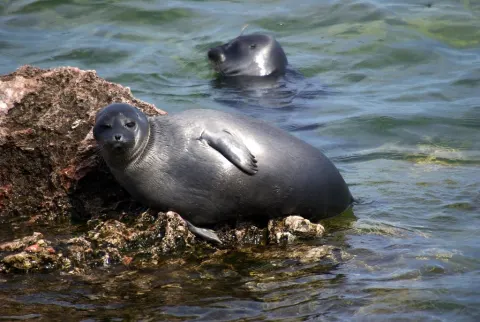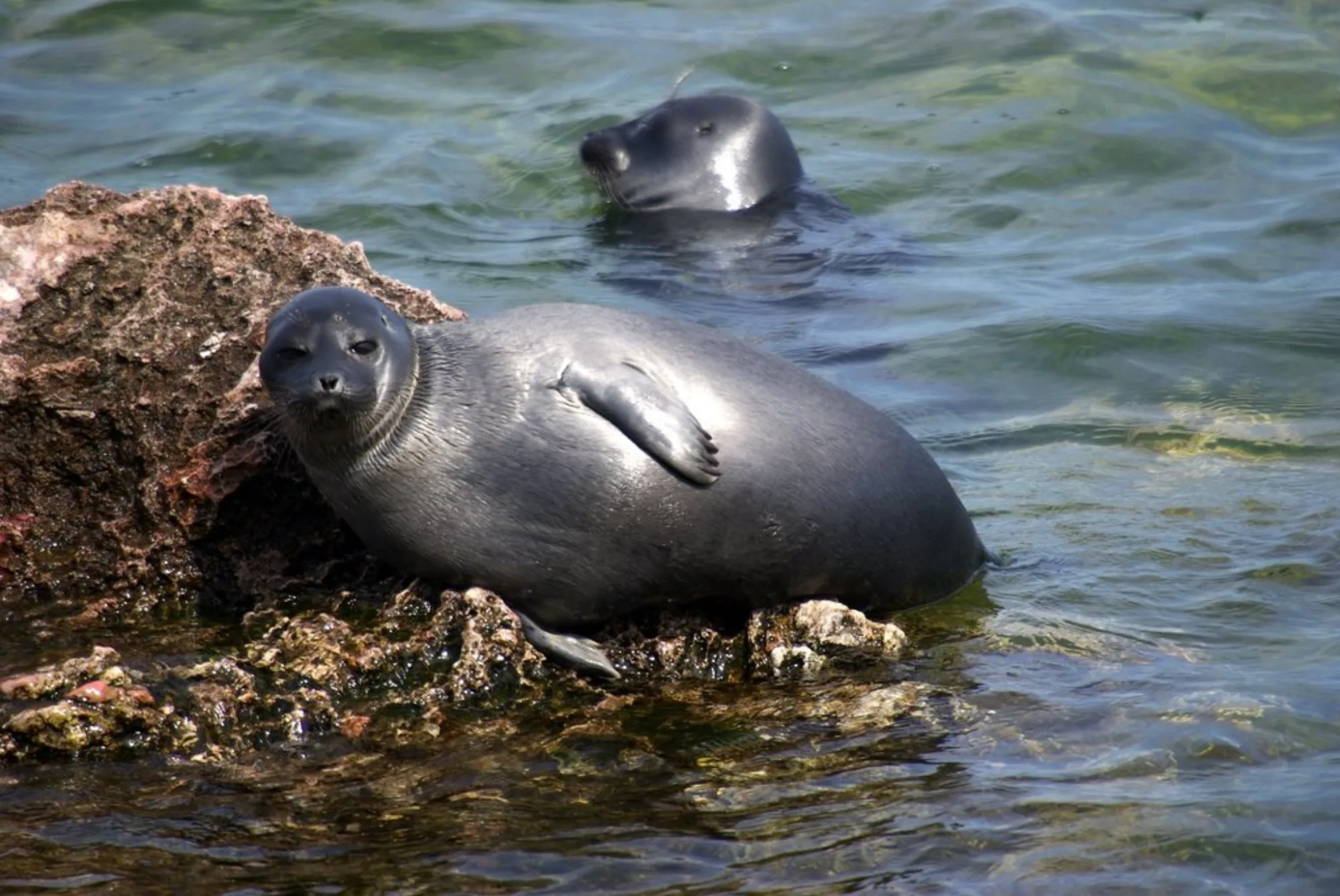
Baikal Seal
Pusa sibirica
In Siberia's Lake Baikal, the Baikal Seal lives its entire life in fresh water. One of the smallest true seals, it typically reaches 1.1 to 1.4 m in length and weighs 63 to 70 kg. Its back is steely grey, while its belly has a yellowish tinge; weathered fur turns brownish. Newborn pups have white, silky coats that soon give way to darker fur.
For much of the year these seals live alone, sometimes kilometres apart. They are more concentrated in the north of the lake, where winter ice lasts longer and provides conditions for pupping. In winter they maintain breathing holes in the ice, staying close to them; as the ice melts, they tend to move towards shore. Their main prey is the golomyanka, an oilfish found only in Lake Baikal, although they also eat other fish and invertebrates. They feed mainly at twilight and during the night, and most dives last less than 10 minutes. In spring and summer, groups of up to 500 can gather on ice floes and shores.
Females usually give birth to one pup on the ice in late winter and raise it alone in a den beneath the ice. When the ice melts in spring, the den usually collapses and the pup must fend for itself. Hunting and poaching kill seals, while others drown in fishing gear. Pollutants are thought to have worsened disease epidemics, and warming could affect the lake's closed, cold-water ecosystem.
Written from the English Wikipedia article Baikal seal (CC BY-SA 4.0).
- Records
- 8
- Countries
- 1
No atlas park has a record of the Baikal Seal in or around it yet.
These are open occurrence records, so they show where people looked for and recorded the Baikal Seal as much as where it lives. Cells are up to 25 km across, and every location is generalised to its cell.
Generalised encounter areas, not exact locations. Each shape is a grid cell coloured by how likely the species is there.
- Very likelyRussia25 km zone · medium confidence · 8 records · updated 80 days ago
Conservation status not assessed here yet, so every location is generalised to its grid cell.