Manx Shearwater
Puffinus puffinus
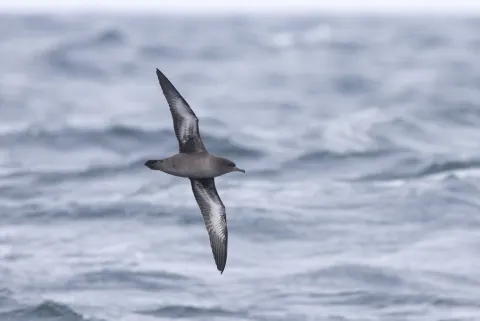
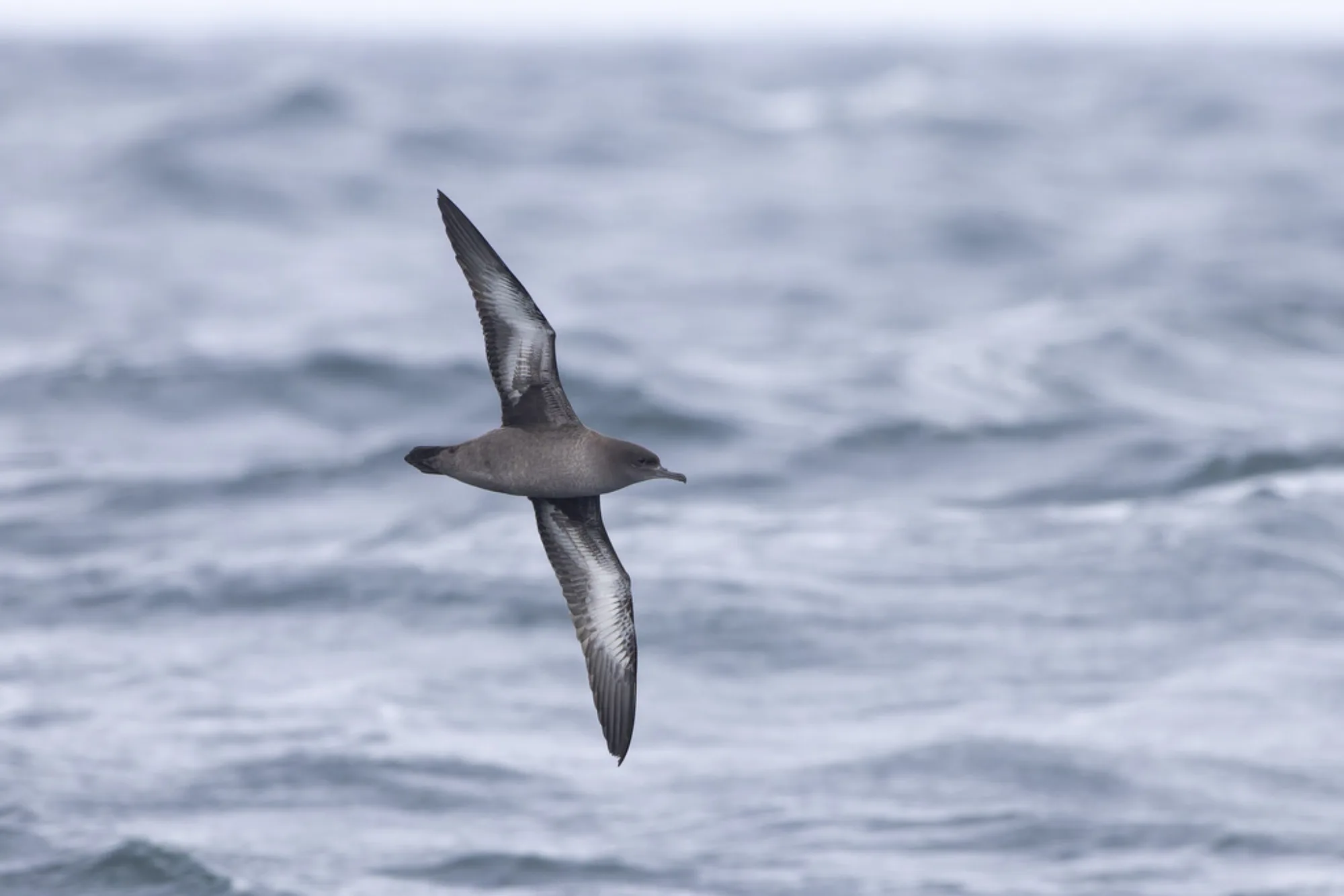
Low over the sea, the Manx Shearwater banks from side to side on stiff, narrow wings, with its wingtips nearly brushing the water. Its black upperparts and white underside flash alternately into view as it flies, giving this medium-sized seabird a changing appearance. It is usually quiet at sea, but its breeding colonies resound at night with harsh calls, croons and howls. Travellers may see large numbers from boats or headlands, especially during autumn migration.
This marine bird nests in burrows on small islands across the North Atlantic, including islands around Britain and Ireland, the Faroes, Iceland and Madeira. Islands near Northern Ireland, Scotland and Wales hold the most important colonies. The colonies empty between July and March, when the birds travel south and spend the winter chiefly near Argentina and Brazil. During breeding, adults travel between their colonies and offshore feeding grounds, sometimes up to 1,500 km away. They take small fish, crustaceans, cephalopods and surface offal, catching food at the surface or by diving after it. A nest may be dug by a shearwater, taken over from a rabbit or sheltered beneath a rock, and may be used again in later years. The female lays a single white egg.
On land, limited mobility leaves shearwaters exposed to large gulls and great skuas, while birds of prey also kill adults. Rats and cats pose a serious problem on islands where they occur, and artificial lighting can strand newly fledged birds in built-up areas. In the Faroes, chicks are also legally taken for food.
Written from the English Wikipedia article Manx shearwater (CC BY-SA 4.0).
- Records
- 78,280
- Countries
- 15
- Atlas places
- 1
These are open occurrence records, so they show where people looked for and recorded the Manx Shearwater as much as where it lives. Cells are up to 25 km across, and every location is generalised to its cell.
Generalised encounter areas, not exact locations. Each shape is a grid cell coloured by how likely the species is there.
- Very likelyUnited Kingdom25 km zone · high confidence · 30066 records · updated 80 days ago
- Very likelyUnited States25 km zone · high confidence · 20903 records · updated 80 days ago
- Very likelyIreland25 km zone · high confidence · 9872 records · updated 80 days ago
- Very likelySpain25 km zone · high confidence · 4916 records · updated 80 days ago
- Very likelyPortugal25 km zone · high confidence · 2849 records · updated 80 days ago
- Very likelyIsle of Man25 km zone · high confidence · 1560 records · updated 80 days ago
- Very likelyIceland25 km zone · high confidence · 1551 records · updated 80 days ago
- Very likelyFrance25 km zone · high confidence · 1441 records · updated 80 days ago
- Very likelyNorway25 km zone · high confidence · 1397 records · updated 80 days ago
- Very likelyCanada25 km zone · high confidence · 1229 records · updated 80 days ago
Conservation status not assessed here yet, so every location is generalised to its grid cell.