Oriental Ratsnake
Ptyas mucosa
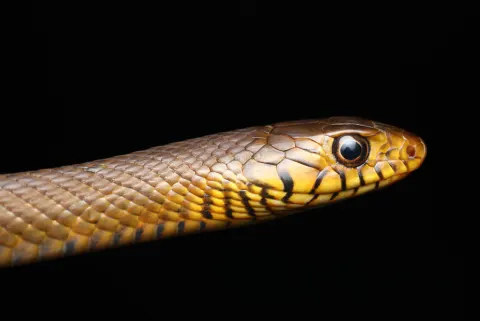
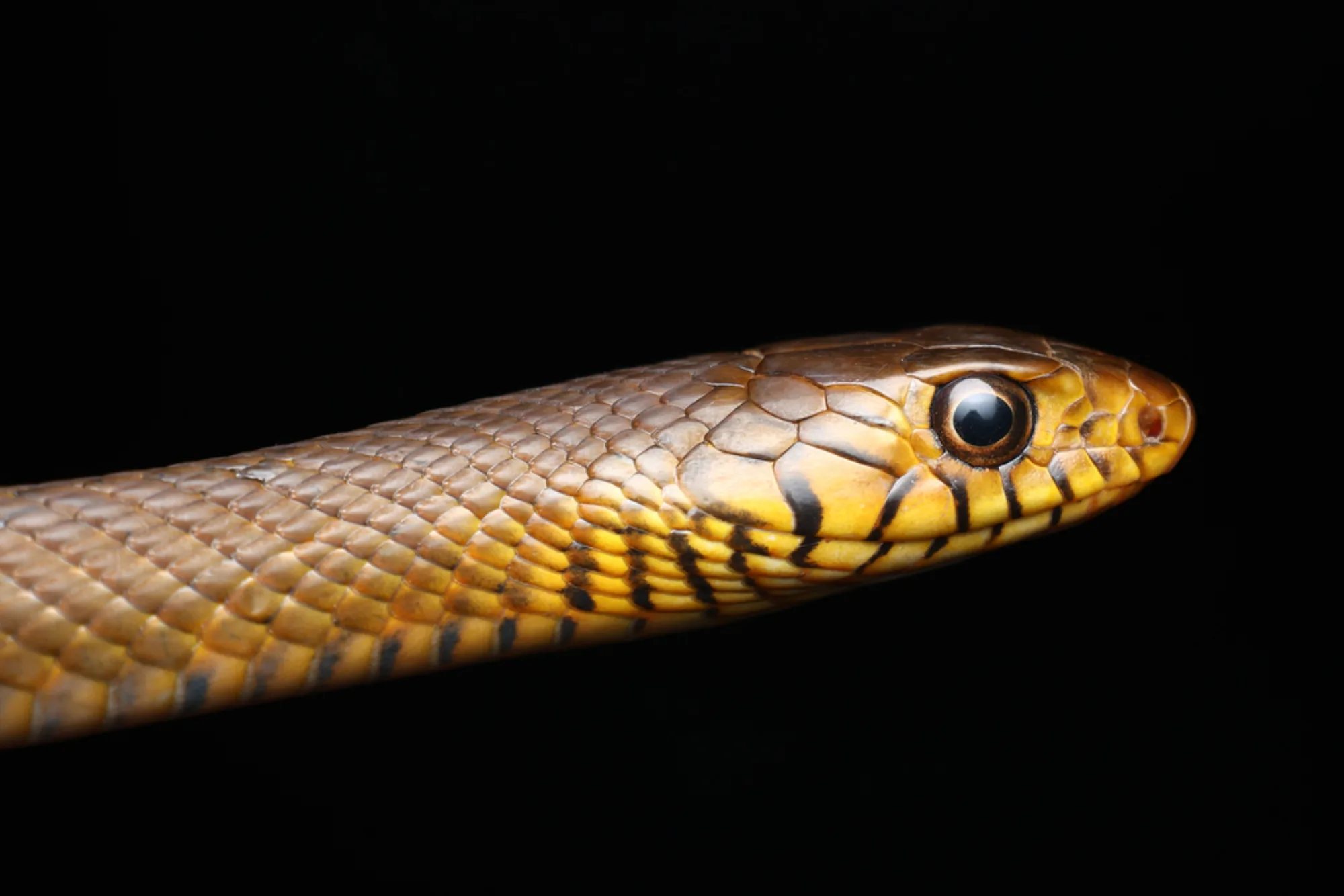
Fast-moving and slender despite its size, the Oriental Ratsnake (Ptyas mucosa) is a non-venomous snake of South and Southeast Asia. Mature snakes typically measure around 1.5 to 1.95 m in total length, though some exceed 2 m. Its colour ranges from pale brown in arid areas to almost black in damp forests. Many have dark crossbands towards the rear of the body and on the tail, while young snakes usually have light crossbands on the front half. The underside is yellowish. Its range includes India, Sri Lanka, China, Indonesia, Thailand and Vietnam, among other countries. It lives on forest floors and in wetlands, rice paddies, farmland and suburban areas, and is often found in towns and cities where rodents thrive.
Active by day, the snake moves quickly and spends some of its time in trees. It eats small reptiles, amphibians, birds and mammals, and adults often subdue prey by sitting on it and using their weight. Breeding takes place in late spring and early summer, although it can occur year round in tropical areas. Several weeks after mating, females lay 6 to 15 eggs per clutch. When threatened, adults inflate their necks and make a growling sound. In human settlements they may be mistaken for venomous snakes and killed. People also hunt them for their skins and meat in some parts of their range, and trade rules in China and Indonesia are often ignored. King cobras prey on young snakes, which are also wary of raptors, larger reptiles and medium-sized mammals.
Written from the English Wikipedia article Oriental rat snake (CC BY-SA 4.0).
- Records
- 435
- Countries
- 11
- Atlas places
- 10
- Eravikulam National Park· India
- Yala National Park· Sri Lanka
- Bandhavgarh National Park· India
- Jim Corbett National Park· India
- Minneriya National Park· Sri Lanka
- Nagarhole National Park· India
- Periyar National Park· India
- Ranthambore National Park· India
- Sundarbans National Park· India
- Wasgamuwa National Park· Sri Lanka
These are open occurrence records, so they show where people looked for and recorded the Oriental Ratsnake as much as where it lives. Cells are up to 25 km across, and every location is generalised to its cell.
Generalised encounter areas, not exact locations. Each shape is a grid cell coloured by how likely the species is there.
- Very likelyIndia25 km zone · medium confidence · 331 records · updated 80 days ago
- Very likelyTaiwan25 km zone · medium confidence · 41 records · updated 80 days ago
- Very likelyMyanmar (Burma)25 km zone · medium confidence · 24 records · updated 80 days ago
- Very likelyChina25 km zone · medium confidence · 9 records · updated 80 days ago
- Very likelyHong Kong SAR China25 km zone · medium confidence · 7 records · updated 80 days ago
- LikelySri Lanka25 km zone · medium confidence · 17 records · updated 80 days ago
- LikelyThailand25 km zone · medium confidence · 5 records · updated 80 days ago
- PossibleIndonesia25 km zone · medium confidence · 1 record · updated 80 days ago
- PossiblePakistan25 km zone · low confidence · 0 records · updated 80 days ago
- UncommonBangladesh25 km zone · low confidence · 0 records · updated 80 days ago
Conservation status not assessed here yet, so every location is generalised to its grid cell.