Large Flying Fox
Pteropus vampyrus
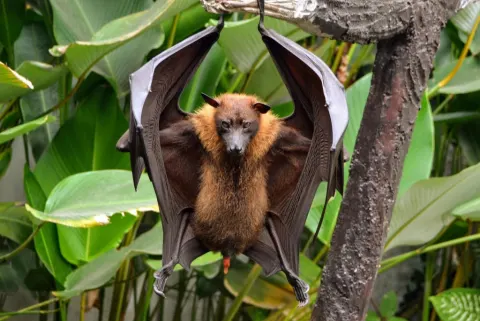
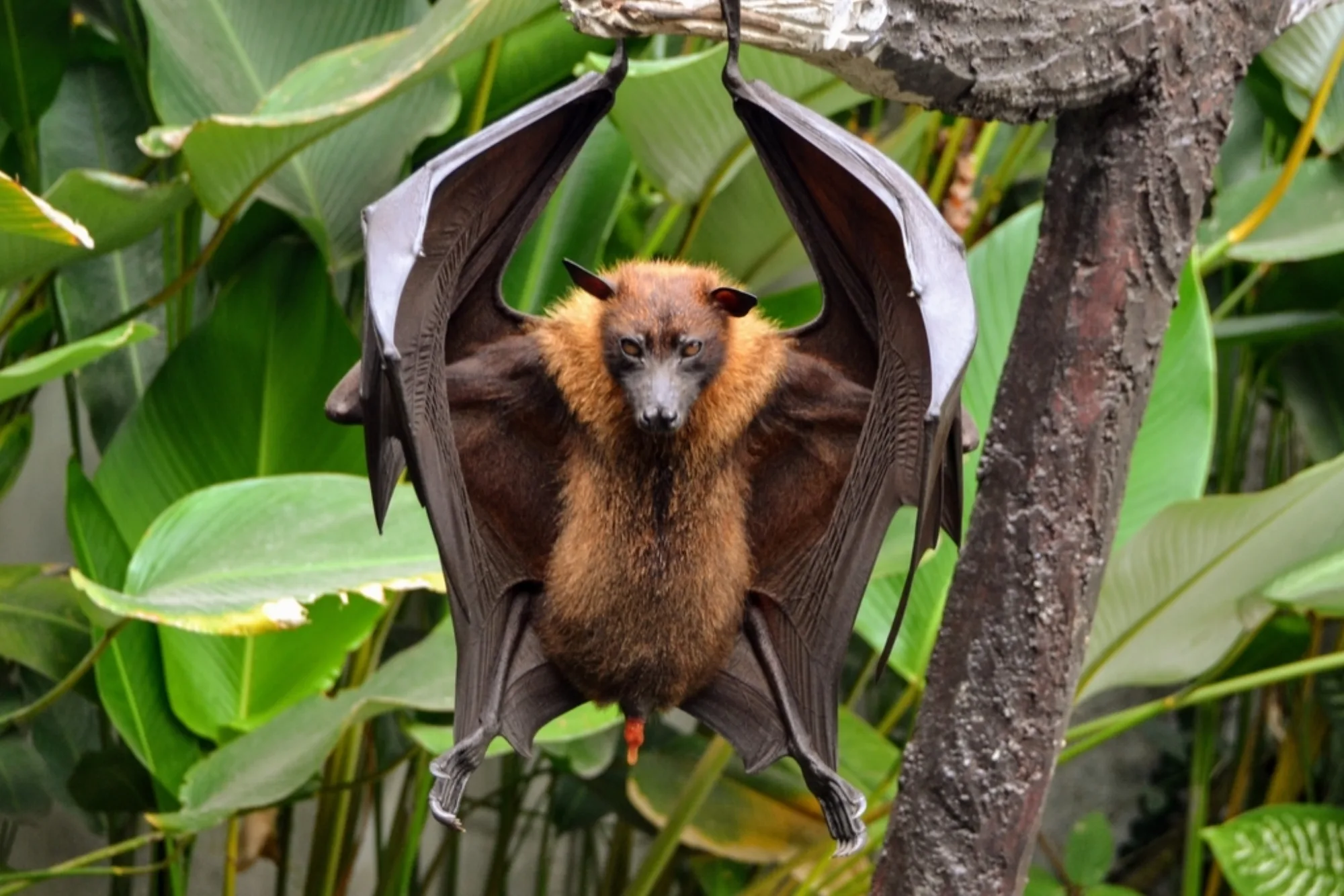
With a fox-like face and pointed ears, the Large Flying Fox ranks among the world's largest bats, its wings reaching 1.5 m across. It has no tail, and its long, woolly coat varies with age and sex. Its head can be reddish, orange or almost black, and its chest tends towards deep golden brown or russet. Its eyesight is well developed, although it cannot echolocate.
This Southeast Asian fruit bat ranges from the Malay Peninsula east to the Philippines and south through Indonesian islands including Sumatra, Java, Borneo and Timor. It uses primary and mangrove forests, coconut groves and fruit orchards, and can occur as high as 1,370 m. By day, it may roost in mangrove or coconut trees, hanging upside down with its wings wrapped around its body. Colonies can be large: one mangrove roost in Timor held around 2,000 bats. At night, colonies leave in scattered streams and may travel up to 50 km to feeding grounds. There, the bats gather noisily around food, favouring flowers and nectar when fruit is also available. Their food includes coconut and durian flowers, figs, mangoes and bananas.
Breeding times vary across the range, and females usually have one young. Mothers carry their young for the first few days, then leave them at the roost while they forage; weaning takes two to three months. Hunting for bushmeat and habitat loss through deforestation threaten the species. It is also sold for traditional medicine in southeast Indonesia, while some farmers regard it as a pest because it feeds in orchards.
Written from the English Wikipedia article Large flying fox (CC BY-SA 4.0).
- Records
- 17
- Countries
- 4
- Atlas places
- 1
These are open occurrence records, so they show where people looked for and recorded the Large Flying Fox as much as where it lives. Cells are up to 25 km across, and every location is generalised to its cell.
Generalised encounter areas, not exact locations. Each shape is a grid cell coloured by how likely the species is there.
- Very likelyPhilippines25 km zone · medium confidence · 6 records · updated 80 days ago
- Very likelyVietnam25 km zone · medium confidence · 4 records · updated 80 days ago
- LikelyMalaysia25 km zone · medium confidence · 5 records · updated 80 days ago
- LikelyIndonesia25 km zone · medium confidence · 2 records · updated 80 days ago
Conservation status not assessed here yet, so every location is generalised to its grid cell.