Gray-headed Flying Fox
Pteropus poliocephalus
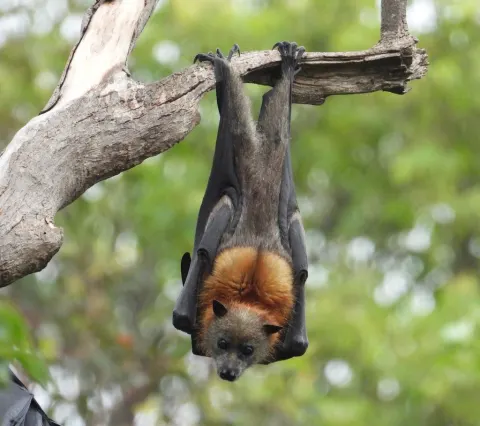
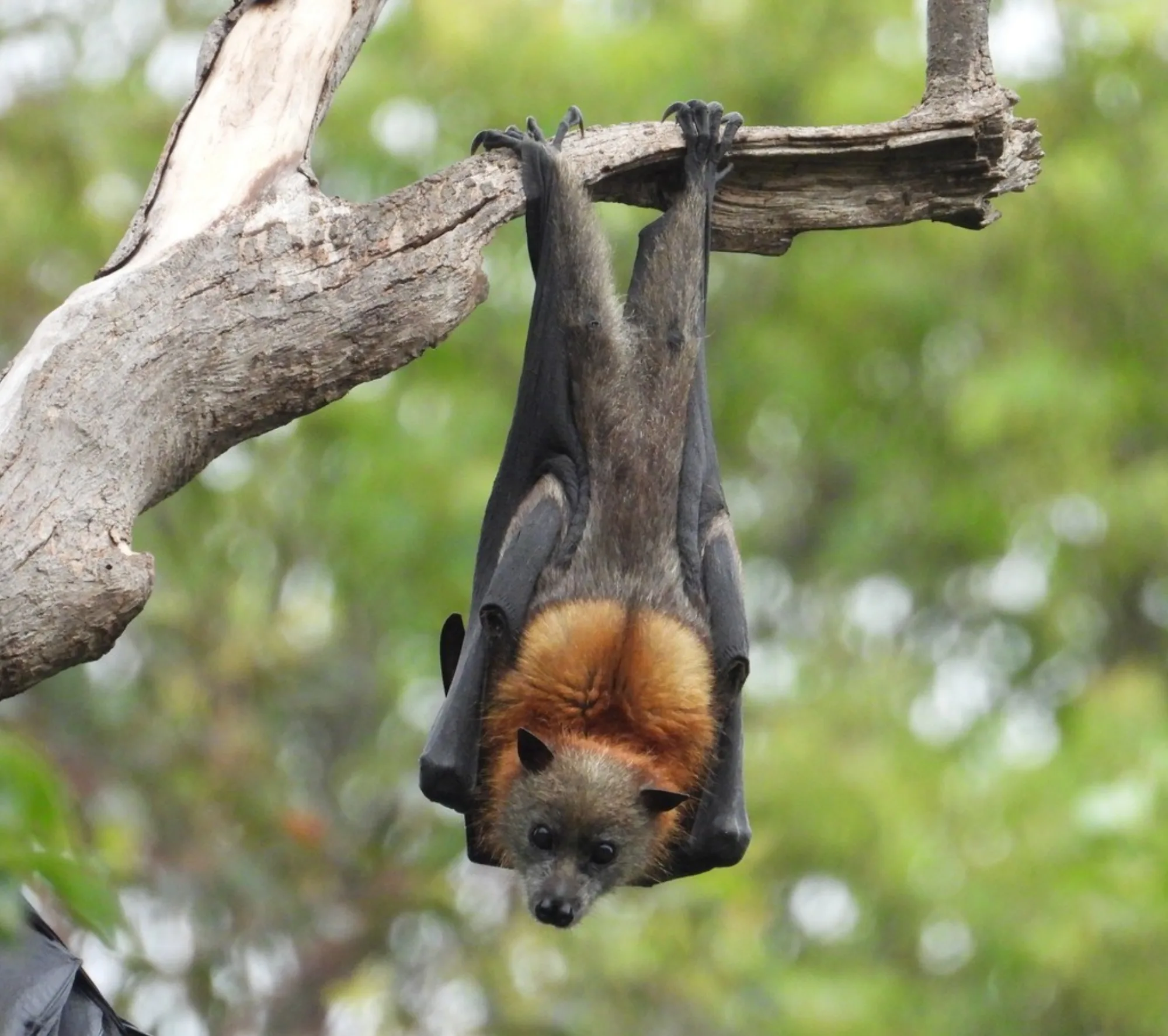
Australia's largest bat, the Gray-headed Flying Fox has a dark grey body, a lighter grey head and a reddish-brown collar around its neck. Its long fur is streaked with grey, and its face has a dog-like appearance. Adults can reach a wingspan of 1 m and weigh up to 1 kg. Large eyes help it find food, along with its sense of smell.
This flying fox lives mostly east of the Great Dividing Range in south-eastern Australia, ranging from around Bundaberg to Geelong, with outlying colonies farther north and south. It inhabits rainforest, woodland and swamps, and also roosts in urban areas. By day, it gathers in camps that can hold hundreds to tens of thousands of bats. Camps move with the seasons, and in warmer months large groups use cool, wet gullies. Around dusk, the bats leave to feed, travelling up to 50 km in a night for pollen, nectar and fruit. Their movements follow food availability, including the irregular flowering of plants, and they disperse pollen and seeds across the landscape.
A female typically has one young a year, with births between late September and November, though some occur as late as January. For their first three weeks, the young cling to their mothers during feeding trips, then stay at the roost. Loss of feeding and roosting habitat is a major threat, while extreme heat can kill large numbers in camps. The bats can also become tangled in netting, barbed wire and discarded fishing line, and face killing in orchards and harassment or destruction of roosts.
Written from the English Wikipedia article Grey-headed flying fox (CC BY-SA 4.0).
- Records
- 87,991
- Countries
- 1
- Atlas places
- 3
These are open occurrence records, so they show where people looked for and recorded the Gray-headed Flying Fox as much as where it lives. Cells are up to 25 km across, and every location is generalised to its cell.
Generalised encounter areas, not exact locations. Each shape is a grid cell coloured by how likely the species is there.
- Very likelyAustralia25 km zone · high confidence · 87991 records · updated 80 days ago
Conservation status not assessed here yet, so every location is generalised to its grid cell.