Indian Flying Fox
Pteropus medius
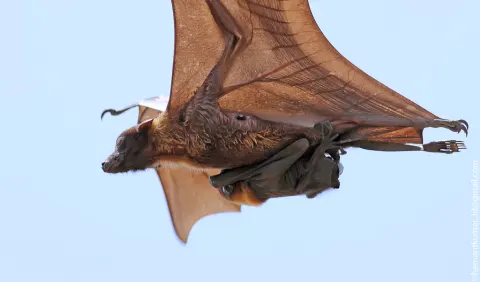
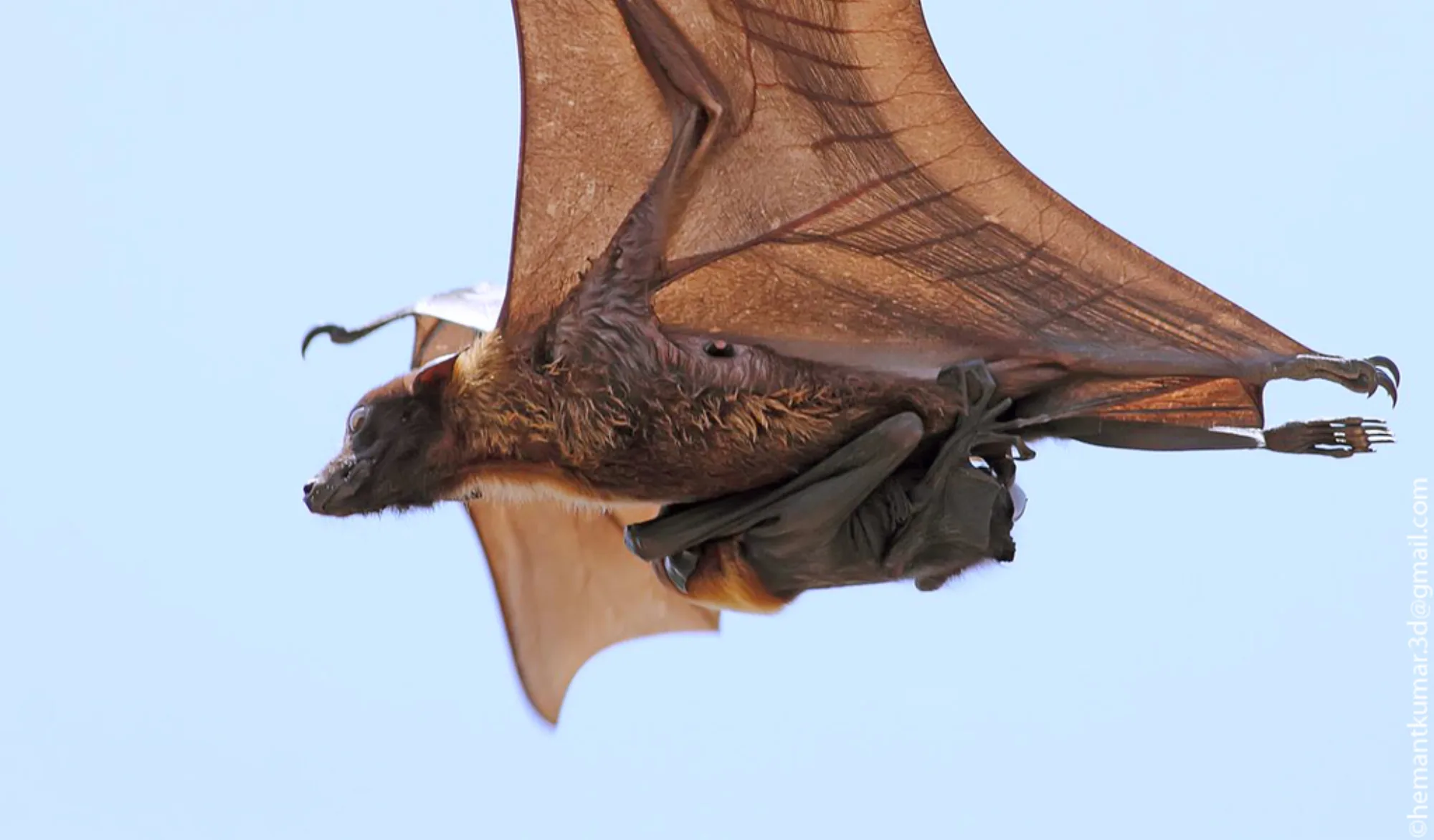
With a wingspan of 1.2 to 1.5 m, the Indian Flying Fox (Pteropus medius) ranks among the world's largest bats. It has a brown head, a pale yellow-brown mantle and a black back lightly streaked with grey, while its underparts are dark brownish. Large eyes and the absence of a tail add to its distinctive appearance.
Across the Indian subcontinent, it occurs in countries including India, Nepal, Bangladesh and Sri Lanka. Colonies gather on exposed branches of tall trees, often near water, homes and farmland, and sometimes in towns or at temples. Camps can hold thousands of bats, with roosts often occupied throughout the year and used for more than ten years. During sunny hours the bats chatter, call and fan their wings, while on cloudy days they tend to be quiet and wrap their wings around themselves. Most leave after sunset, flying out one by one before foraging individually for ripe fruit and nectar. Guava, mangoes and figs are among the fruits they eat, and they also take blossoms, leaves and insects. By dispersing seeds, they help plants propagate, although their visits to orchards can damage crops.
Breeding takes place each year from July to October, with births from February to May and an average of 1 to 2 pups. Mothers carry their young for the first few weeks, and the young learn to fly at approximately 11 weeks. Urban expansion and road widening destroy habitat, and roost trees are sometimes cut down, scattering colonies. The bats are also killed to protect orchards and for use in traditional medicine.
Written from the English Wikipedia article Indian flying fox (CC BY-SA 4.0).
- Records
- 455
- Countries
- 6
- Atlas places
- 10
- Bandipur National Park· India
- Minneriya National Park· Sri Lanka
- Nagarhole National Park· India
- Ranthambore National Park· India
- Wasgamuwa National Park· Sri Lanka
- Yala National Park· Sri Lanka
- Gir National Park· India
- Kaziranga National Park· India
- Periyar National Park· India
- Udawalawe National Park· Sri Lanka
These are open occurrence records, so they show where people looked for and recorded the Indian Flying Fox as much as where it lives. Cells are up to 25 km across, and every location is generalised to its cell.
Generalised encounter areas, not exact locations. Each shape is a grid cell coloured by how likely the species is there.
- Very likelyIndia25 km zone · medium confidence · 318 records · updated 80 days ago
- Very likelySri Lanka25 km zone · medium confidence · 113 records · updated 80 days ago
- LikelyMaldives25 km zone · medium confidence · 16 records · updated 80 days ago
- LikelyBangladesh25 km zone · medium confidence · 5 records · updated 80 days ago
- LikelyNepal25 km zone · medium confidence · 3 records · updated 80 days ago
- PossiblePakistan25 km zone · low confidence · 0 records · updated 80 days ago
Conservation status not assessed here yet, so every location is generalised to its grid cell.