Giant Otter
Pteronura brasiliensis
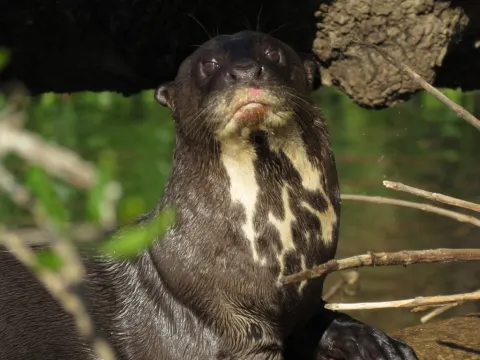
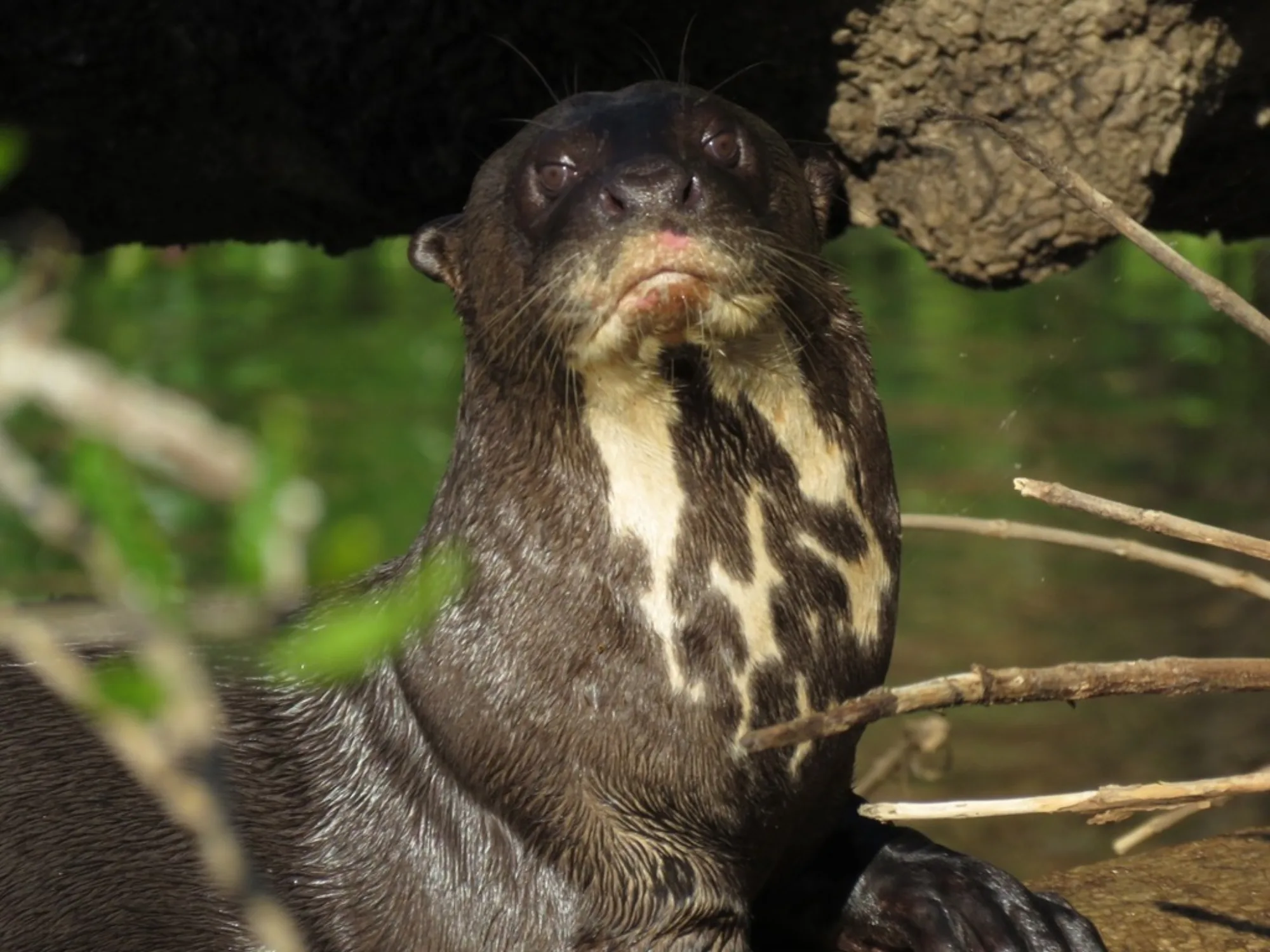
With a long body, a wing-like tail and large webbed feet, the Giant Otter is built for life around water. This South American member of the weasel family can reach 1.8 m in length. Its dense fur is usually chocolate brown and looks nearly black when wet, while individual otters have distinctive white or cream markings on the throat and under the chin.
Giant otters range across north-central South America, mainly around the Amazon River and the Pantanal wetlands, though their distribution is now broken up. They favour freshwater rivers and streams that flood seasonally, as well as some lakes and springs. Near feeding areas, they clear vegetation to create campsites and dig dens into riverbanks. Active during daylight, these noisy animals live in cooperative family groups, typically with three to eight members around a breeding pair. They use calls to signal alarm, aggression and reassurance, and defend their territories against other groups. Fish make up nearly all their diet, especially characins and catfish, though they also eat animals such as crabs, turtles and small caimans. They hunt alone, in pairs or in groups, pursuing prey through shallow water.
Females give birth in dens, and wild births may peak in the dry season. Fathers and older siblings help rear the pups, while the whole group helps catch fish for the young. Habitat loss and degradation are now the greatest threats, with riverbank clearing and expanding human activity isolating populations. Past hunting for their velvety pelts greatly reduced their numbers, and they still face conflict with fishermen and disturbance from tourism.
Written from the English Wikipedia article Giant otter (CC BY-SA 4.0).
- Records
- 350
- Countries
- 7
- Atlas places
- 5
These are open occurrence records, so they show where people looked for and recorded the Giant Otter as much as where it lives. Cells are up to 25 km across, and every location is generalised to its cell.
Generalised encounter areas, not exact locations. Each shape is a grid cell coloured by how likely the species is there.
- Very likelyFrench Guiana25 km zone · medium confidence · 200 records · updated 80 days ago
- Very likelyBrazil25 km zone · medium confidence · 103 records · updated 80 days ago
- LikelyPeru25 km zone · medium confidence · 24 records · updated 80 days ago
- LikelyEcuador25 km zone · medium confidence · 14 records · updated 80 days ago
- LikelyColombia25 km zone · medium confidence · 7 records · updated 80 days ago
- PossibleGuyana25 km zone · medium confidence · 2 records · updated 80 days ago
- RareSuriname25 km zone · low confidence · 0 records · updated 80 days ago
Conservation status not assessed here yet, so every location is generalised to its grid cell.