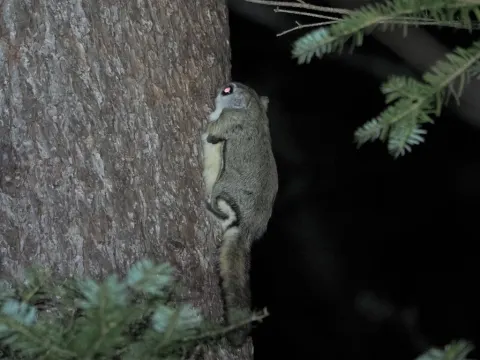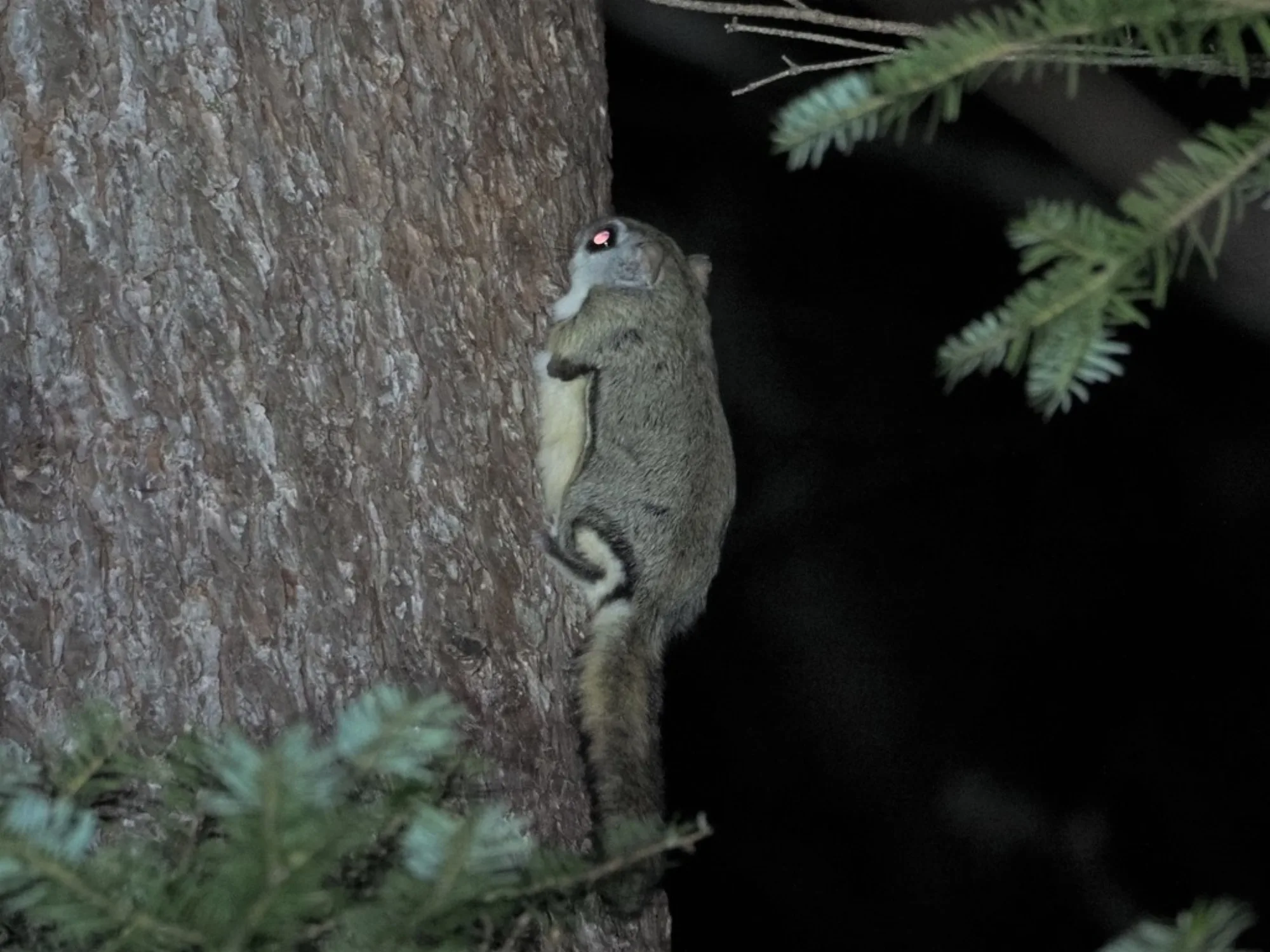
Japanese Flying Squirrel
Pteromys momonga
Found only in Japan, the Japanese Flying Squirrel makes its home on the islands of Kyushu, Honshu, and Shikoku. These small mammals favor sub-alpine and boreal evergreen forests, where they prefer to nest in conifers like spruce and pine. They often line their tree-hole nests with mosses and lichens. During the daylight hours, they remain hidden in these cavities or at the points where branches meet the trunk, only emerging after dark to begin their activities.
This species is recognizable by its grey-brown fur on the back and a white belly. It is a small creature, with a body measuring 14 to 20 centimetres and a tail of 10 to 14 centimetres. Large eyes help it navigate the night, while a skin membrane called a patagium allows it to glide between trees. This membrane stretches from the wrists to the ankles, functioning like a wingsuit to help the animal maneuver through the air. Weighing between 150 and 220 grams, it is significantly smaller than the giant flying squirrel species also found in the region.
When feeding on seeds, fruit, buds, or bark, this squirrel often hangs from branches. If a twig is too weak to hold its weight, the squirrel uses its forepaws to pull the food toward its mouth. Outside of the breeding season, groups of the same sex may share a single tree. They typically mate twice a year between May and July, usually producing litters of two or three young. While the exact population size is not known, the squirrel has a wide range and lives in several protected areas. No major threats to the species have been identified.
Written from the English Wikipedia article Japanese dwarf flying squirrel (CC BY-SA 4.0).
- Atlas places
- 0
These are open occurrence records, so they show where people looked for and recorded the Japanese Flying Squirrel as much as where it lives. Cells are up to 25 km across, and every location is generalised to its cell.
No encounter zones yet
Where and when you can expect to see Japanese Flying Squirrel is calculated from observation density. No zones have been computed for this species yet.
Conservation status not assessed here yet, so every location is generalised to its grid cell.