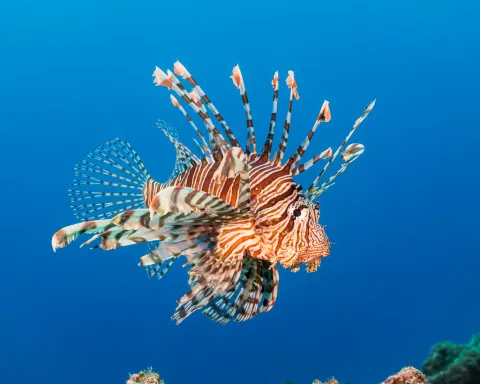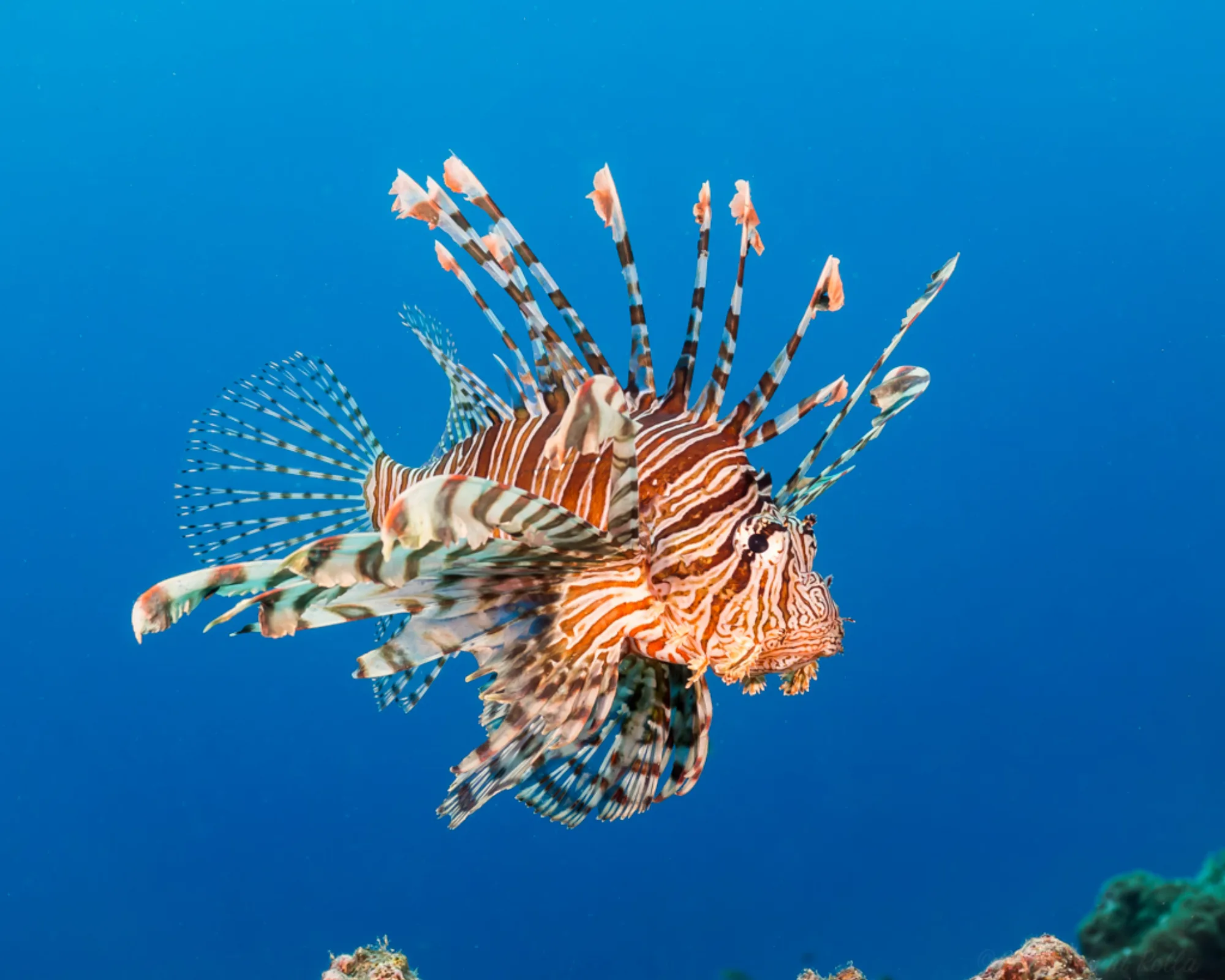
Lionfish
Pterois volitans
White stripes alternate with red, maroon or brown across the Lionfish, while long fins spread around its body like a mane. This venomous reef fish can reach 47 cm in length, and its prominent spines deter most potential predators. When threatened, it turns those spines towards an attacker, sometimes swimming upside down to do so. The species is mainly native to the Indo-Pacific, including the western and central Pacific and waters off western Australia. It has also become invasive in the Caribbean, the Western Atlantic and the northern Gulf of Mexico, and has been found at Fernando de Noronha in Brazil.
Lionfish usually live alone and are mostly active at night, hunting from late afternoon until dawn. They eat mostly crustaceans, including shrimps and crabs, along with other invertebrates and small fish, sometimes including young lionfish. On a hunt, a lionfish can use its large fins to corner prey before swallowing it whole. It also approaches slowly and continuously, taking advantage of pauses in a prey fish's swimming. Lionfish reproduce monthly, and females have been observed laying more eggs in warmer months. Their larvae can disperse quickly, helping the species expand its invasive range.
Venomous spines offer strong protection, but lionfish do have predators. In their native range, moray eels have been found eating them, and a Bobbit worm has been filmed catching one in Indonesia. In the Bahamas, Nassau and tiger groupers have eaten lionfish in invaded waters. People also harvest lionfish for food as part of efforts to limit their growing populations.
Written from the English Wikipedia article Red lionfish (CC BY-SA 4.0).
- Records
- 4,127
- Countries
- 42
- Atlas places
- 2
These are open occurrence records, so they show where people looked for and recorded the Lionfish as much as where it lives. Cells are up to 25 km across, and every location is generalised to its cell.
Generalised encounter areas, not exact locations. Each shape is a grid cell coloured by how likely the species is there.
- Very likelyUnited States25 km zone · medium confidence · 1228 records · updated 80 days ago
- Very likelyPuerto Rico25 km zone · medium confidence · 587 records · updated 80 days ago
- Very likelyVenezuela25 km zone · medium confidence · 430 records · updated 80 days ago
- Very likelyGuadeloupe25 km zone · medium confidence · 417 records · updated 80 days ago
- Very likelyU.S. Virgin Islands25 km zone · high confidence · 302 records · updated 80 days ago
- Very likelyAustralia25 km zone · medium confidence · 193 records · updated 80 days ago
- Very likelyMartinique25 km zone · medium confidence · 146 records · updated 80 days ago
- Very likelyBarbados25 km zone · high confidence · 136 records · updated 80 days ago
- Very likelyEgypt25 km zone · medium confidence · 86 records · updated 80 days ago
- Very likelyJapan25 km zone · medium confidence · 74 records · updated 80 days ago
Conservation status not assessed here yet, so every location is generalised to its grid cell.