Timneh Parrot
Psittacus timneh
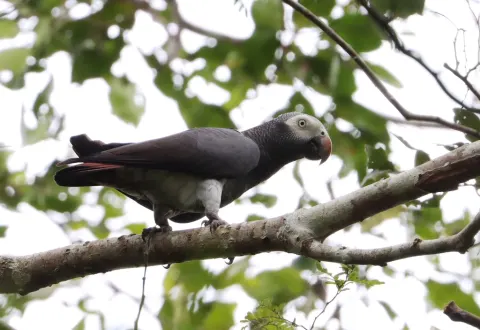
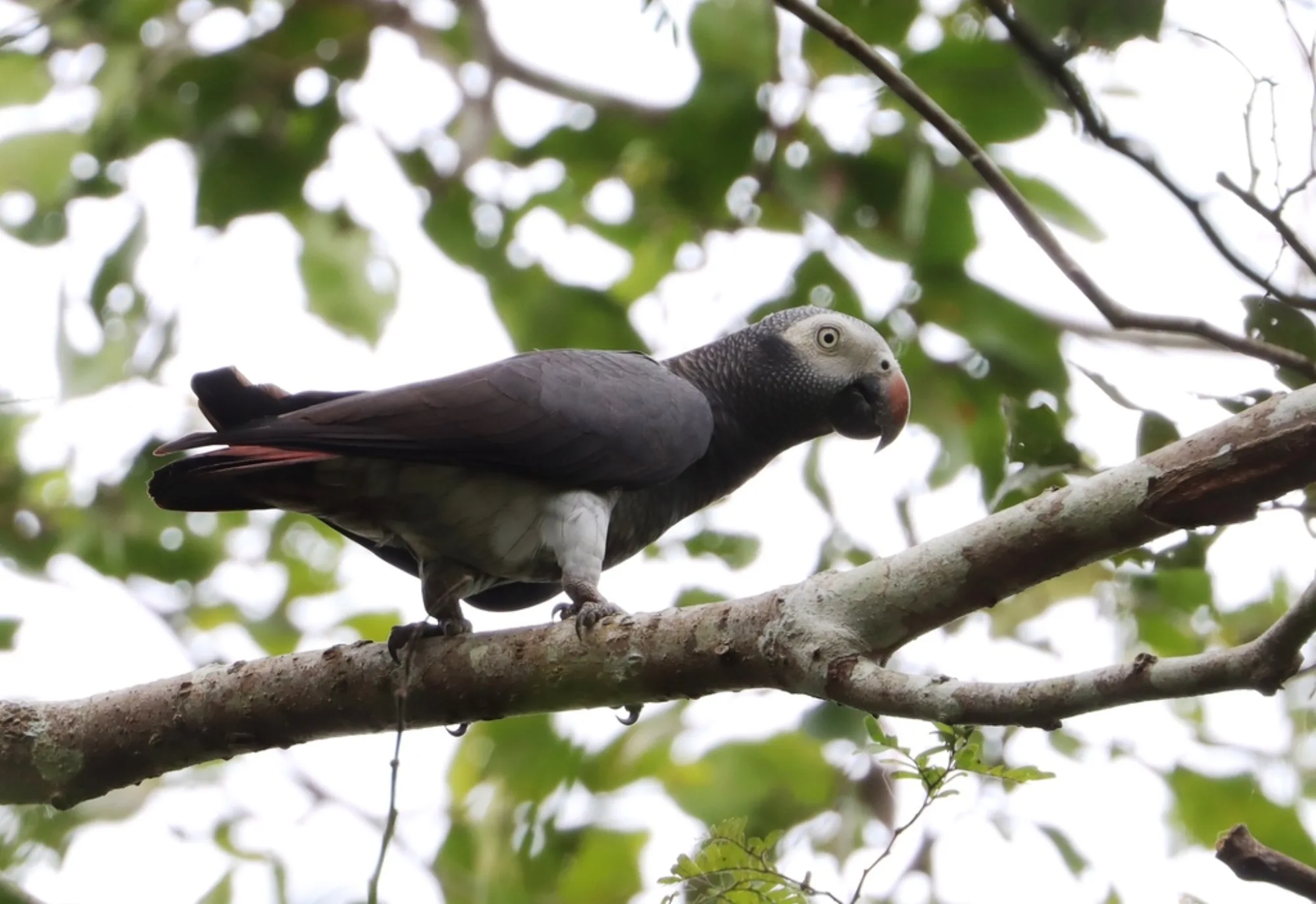
Look for pale yellow eyes set in a white facial mask against the mottled grey plumage of the Timneh Parrot, a medium-sized bird of West Africa. It grows to 28 to 33 centimetres long and weighs 275 to 375 grams. Its dark maroon tail and horn-coloured patch on the upper bill help distinguish it from the larger, lighter grey parrot.
The Timneh lives in the western part of the moist Upper Guinean forests and neighbouring savannas, with a range extending eastwards into Ivory Coast and westwards to Guinea-Bissau, and including Sierra Leone and southern Mali. Dense forest is its usual habitat, but it also visits forest edges and clearings, woodland along waterways, savanna woodland and mangroves. Birds are sometimes seen in gardens and cultivated land, although it is unclear whether these places support populations on their own. During the dry season, some birds may move seasonally away from the driest parts of their range. The species can mimic human speech and may be more outgoing around people than the grey parrot.
Its food includes fruit, seeds, flowers, leaf buds and sap, and its ability to find food and change diets helps it respond to environmental change. Forest loss and fragmentation, together with changes in climate, have become major influences on the food available to parrots. The Timneh is declining as its forest habitat disappears and birds are trapped for the international wild bird trade. Legal trade may account for only a small share of the birds taken from the wild. Surveys suggest that the species has disappeared from forests around Mount Nimba and in Liberia's Nimba County.
Written from the English Wikipedia article Timneh parrot (CC BY-SA 4.0).
- Records
- 544
- Countries
- 5
No atlas park has a record of the Timneh Parrot in or around it yet.
These are open occurrence records, so they show where people looked for and recorded the Timneh Parrot as much as where it lives. Cells are up to 25 km across, and every location is generalised to its cell.
Generalised encounter areas, not exact locations. Each shape is a grid cell coloured by how likely the species is there.
- Very likelyCôte d’Ivoire25 km zone · high confidence · 438 records · updated 80 days ago
- LikelySierra Leone25 km zone · medium confidence · 59 records · updated 80 days ago
- LikelyLiberia25 km zone · medium confidence · 33 records · updated 80 days ago
- PossibleGuinea25 km zone · medium confidence · 7 records · updated 80 days ago
- PossibleGuinea-Bissau25 km zone · medium confidence · 7 records · updated 80 days ago
Conservation status not assessed here yet, so every location is generalised to its grid cell.