Grey Parrot
Psittacus erithacus
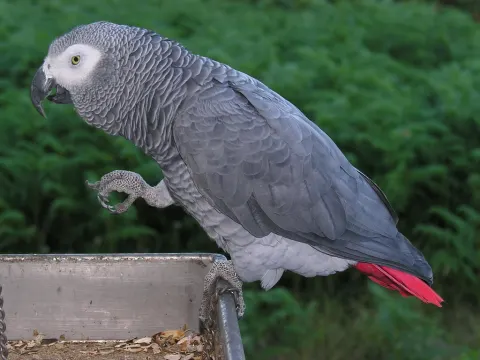
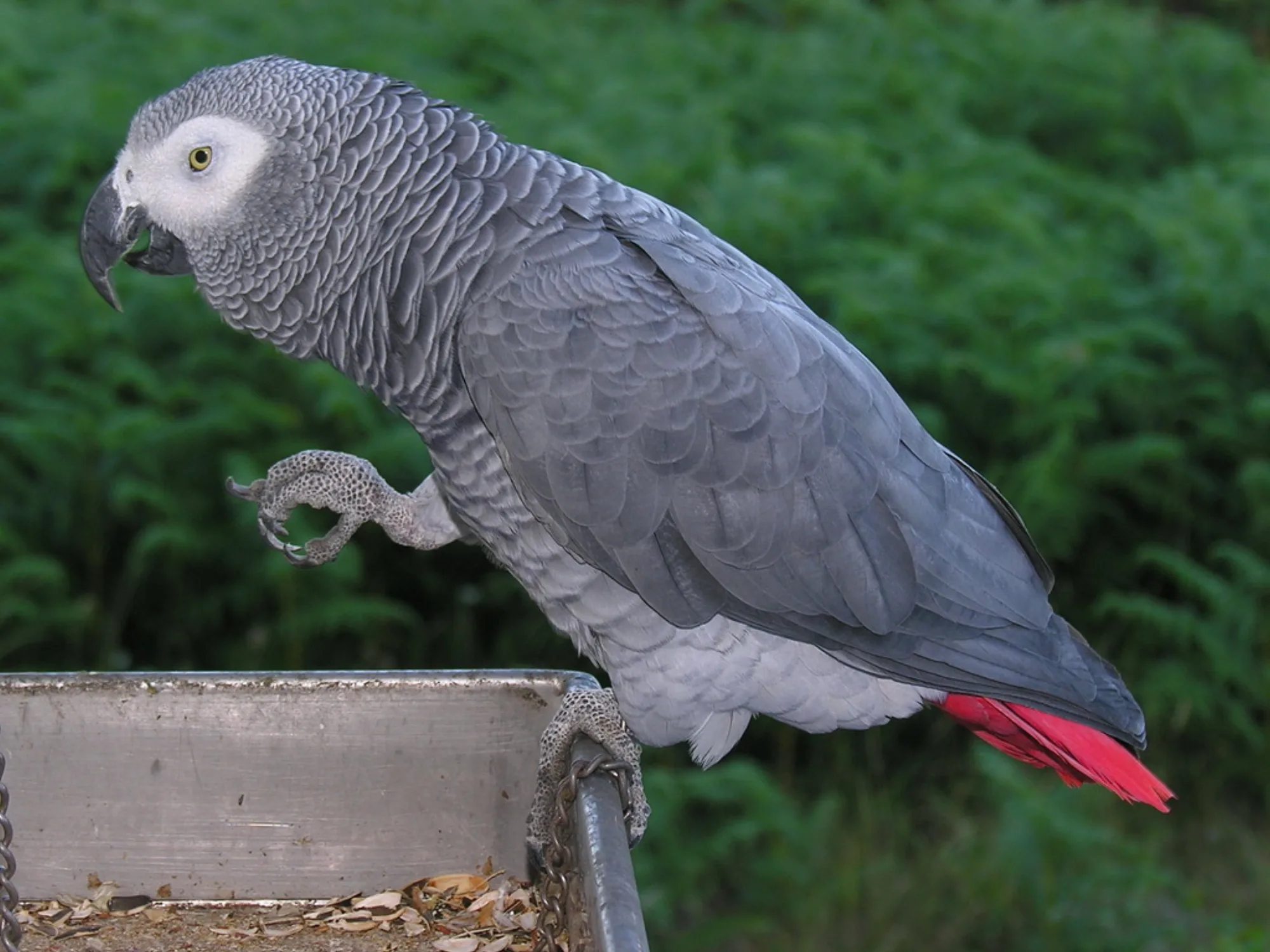
Across equatorial Africa, the Grey Parrot favours dense forest but also lives at forest edges and in gallery and savanna forests. Its range extends from Kenya to eastern Ivory Coast, and it is native to countries including Ghana, Cameroon, Gabon, the Congo and Uganda. This medium to large parrot is mostly grey, with a black bill and a red tail that sometimes has touches of black. Its head and wings are generally darker than its body, and fine white edges mark the feathers of its head and body. Adults have yellow eyes around dark pupils, while young birds typically have dark grey to black eyes. A typical bird measures about 33 cm long, with a wingspan of 46 to 52 cm.
Grey parrots can be secretive in the wild, where relatively little is known about their daily behaviour. They can imitate sounds they hear, and recordings of two birds at a roost included imitations of other wild birds and a bat. Fruit, nuts and seeds make up most of their diet, including the fruit of the oil palm, but they also sometimes eat flowers, bark, insects and snails. They feed partly on the ground and nest in tree cavities, with each pair using its own tree. The female lays three to five eggs and incubates them for 30 days while her mate feeds her; both adults defend the nest site. Young leave the nest at 12 weeks, but their parents continue caring for them for 4 to 5 weeks after fledging.
Capture for the pet trade and loss of habitat threaten wild populations, and the birds are also hunted for meat and body parts used in traditional medicines. In Ghana, local people identified the pet trade and timber felling as the main causes of a steep decline.
Written from the English Wikipedia article Grey parrot (CC BY-SA 4.0).
- Records
- 10,518
- Countries
- 25
- Atlas places
- 11
- Kibale National Park· Uganda
- Rwenzori Mountains National Park· Uganda
- Bwindi Impenetrable National Park· Uganda
- Queen Elizabeth National Park· Uganda
- Semuliki National Park· Uganda
- Kilimanjaro National Park· Tanzania
- Lake Mburo National Park· Uganda
- Murchison Falls National Park· Uganda
- Nairobi National Park· Kenya
- Nyungwe National Park· Rwanda
- Volcanoes National Park· Rwanda
These are open occurrence records, so they show where people looked for and recorded the Grey Parrot as much as where it lives. Cells are up to 25 km across, and every location is generalised to its cell.
Generalised encounter areas, not exact locations. Each shape is a grid cell coloured by how likely the species is there.
- Very likelyUganda25 km zone · medium confidence · 5966 records · updated 86 days ago
- Very likelyGhana25 km zone · high confidence · 948 records · updated 86 days ago
- Very likelyEquatorial Guinea25 km zone · high confidence · 596 records · updated 86 days ago
- Very likelyGabon25 km zone · high confidence · 585 records · updated 86 days ago
- Very likelyCameroon25 km zone · medium confidence · 508 records · updated 86 days ago
- Very likelySão Tomé & Príncipe25 km zone · high confidence · 451 records · updated 86 days ago
- Very likelyCongo - Brazzaville25 km zone · high confidence · 431 records · updated 86 days ago
- Very likelyCongo - Kinshasa25 km zone · high confidence · 370 records · updated 86 days ago
- Very likelyKenya25 km zone · high confidence · 173 records · updated 86 days ago
- Very likelyNigeria25 km zone · high confidence · 158 records · updated 86 days ago
Conservation status not assessed here yet, so every location is generalised to its grid cell.