Rose-ringed Parakeet
Psittacula krameri
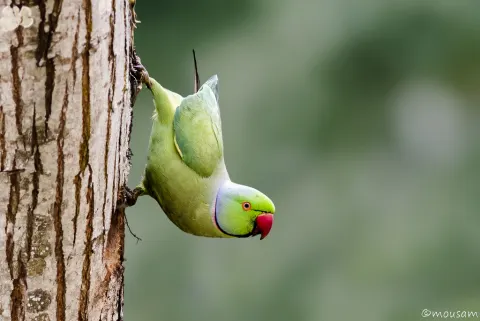
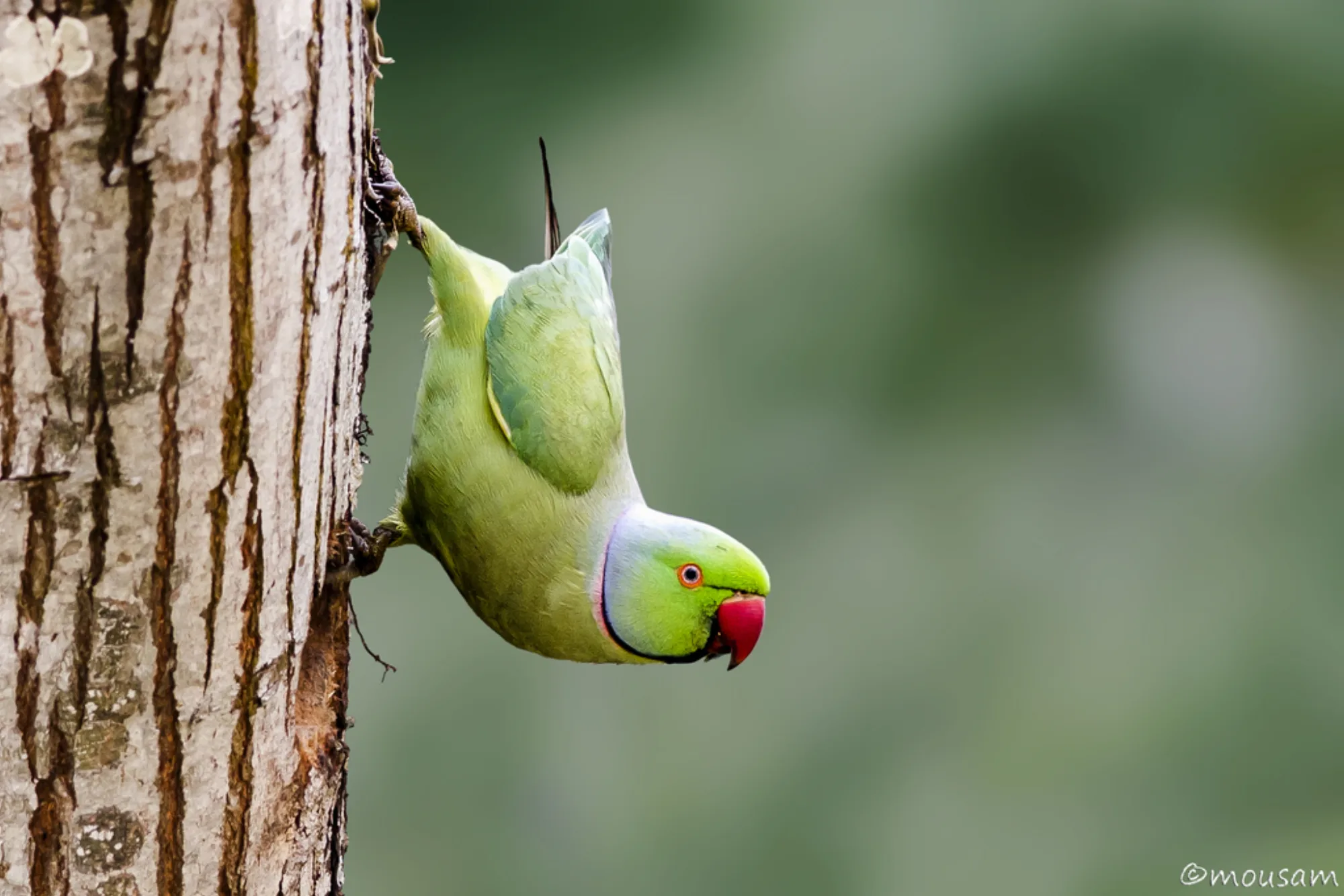
Listen for a loud squawking call, then look for green feathers, a red beak and a blue tail. The Rose-ringed Parakeet is a medium-sized parrot, with a long tail that accounts for much of its 37 to 43 cm length. Adult males have a pink and black ring around the neck, while females and young birds may have a faint grey ring or none at all. The species does not migrate.
Its native range stretches across tropical northern Africa and the Indian subcontinent, including Sri Lanka. In Africa it occurs in a belt that roughly follows the Sudanian savannas, while its Asian range reaches the Himalayan foothills. It has adapted to disturbed habitats and lives in cities as well as other places outside its native range. Escaped or released birds have established populations in many countries, including the UK, France and Germany. Around London, large flocks can be seen in parks and other green spaces, including Richmond Park and Wimbledon Common.
Wild birds eat buds, nectar, fruit, nuts, berries, seeds and grains, as well as insects. Flocks also travel to feed in farmland and orchards, while feral birds visit gardens and bird feeders. In northwestern India, pairs form from September to December and defend their chosen nest sites. They care for their young from April to June, and the fledglings leave the nest before the monsoon. The pet trade and conflict with farmers have reduced numbers in parts of the native range. In the UK, birds of prey and owls also hunt these parakeets.
Written from the English Wikipedia article Rose-ringed parakeet (CC BY-SA 4.0).
- Records
- 1,114,379
- Countries
- 108
- Atlas places
- 17
- Kidepo Valley National Park· Uganda
- Bandipur National Park· India
- Kanha National Park· India
- Ranthambore National Park· India
- Annapurna Conservation Area· Nepal
- Chitwan National Park· Nepal
- Dorob National Park· Namibia
- Jim Corbett National Park· India
- Kaziranga National Park· India
- Langtang National Park· Nepal
- Nairobi National Park· Kenya
- Namib-Naukluft· Namibia
- Pench National Park· India
- Sundarbans National Park· India
- Tadoba Andhari Tiger Reserve· India
- Walvis Bay· Namibia
- Yala National Park· Sri Lanka
These are open occurrence records, so they show where people looked for and recorded the Rose-ringed Parakeet as much as where it lives. Cells are up to 25 km across, and every location is generalised to its cell.
Generalised encounter areas, not exact locations. Each shape is a grid cell coloured by how likely the species is there.
- Very likelyIndia25 km zone · high confidence · 632877 records · updated 86 days ago
- Very likelyUnited Kingdom25 km zone · high confidence · 124942 records · updated 86 days ago
- Very likelyFrance25 km zone · high confidence · 48383 records · updated 86 days ago
- Very likelyIsrael25 km zone · high confidence · 44257 records · updated 86 days ago
- Very likelySpain25 km zone · high confidence · 30640 records · updated 86 days ago
- Very likelySri Lanka25 km zone · high confidence · 26013 records · updated 86 days ago
- Very likelyPalestinian Territories25 km zone · high confidence · 22781 records · updated 86 days ago
- Very likelyPortugal25 km zone · high confidence · 22021 records · updated 86 days ago
- Very likelySouth Africa25 km zone · high confidence · 20901 records · updated 86 days ago
- Very likelyUnited States25 km zone · high confidence · 17031 records · updated 86 days ago
Conservation status not assessed here yet, so every location is generalised to its grid cell.