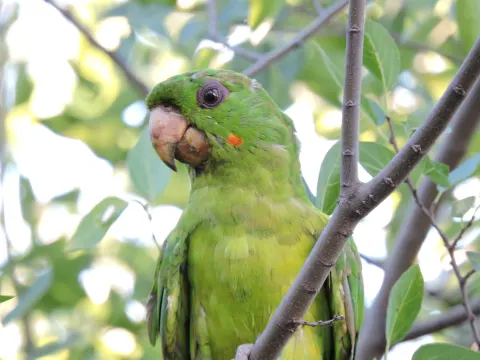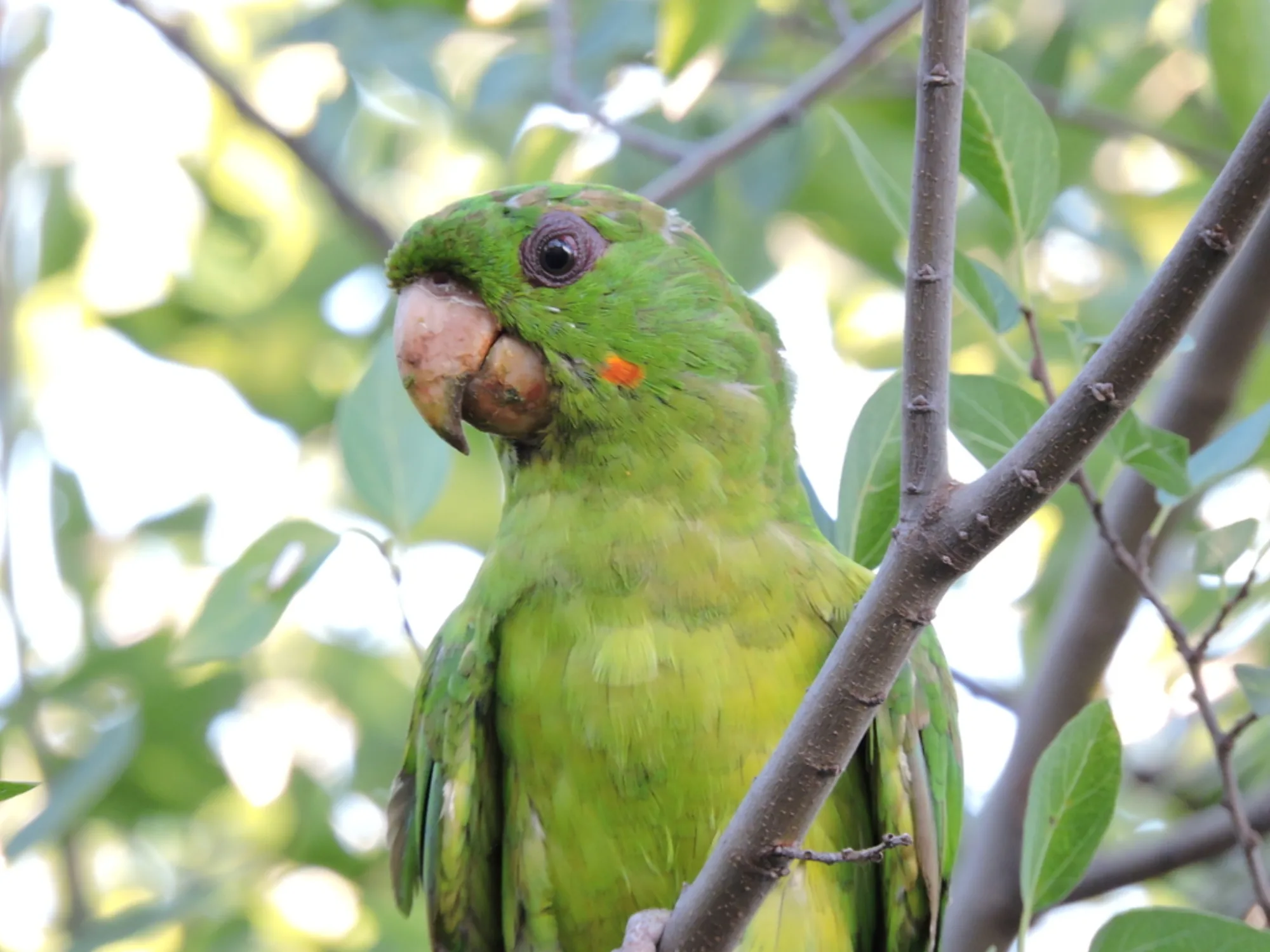
Green Parakeet
Psittacara holochlorus
Look for the Green Parakeet's mostly green plumage, which becomes paler and more yellow on the underside. This New World parrot measures 28 to 30.5 cm in length and weighs about 230 g. Males and females look alike, and adults can have varying amounts of red speckling on the cheeks and throat. In flight, the undersides of the long flight feathers and tail appear olive-yellow, while the feathers covering the underside of the wing are yellowish green. The bill is horn-coloured, the legs and feet are brownish, and pale beige skin surrounds each orange-red eye.
The species is native to Mexico and the Rio Grande Valley of southern Texas. In eastern Mexico, its range extends south to Veracruz from the states of Nuevo León and Tamaulipas; it also occurs in the northwestern states of Sonora, Sinaloa and Chihuahua. It favours semi-open country, including deciduous woodland, gallery forest and scrubland, and avoids humid lowland forest. It is typically found between 500 and 2,000 m, though in Texas it also occurs in cities and towns. Listen for sharp squeaks, loud harsh calls and shrill chatter; its flight call is a rolling, high-pitched screek.
Green Parakeets do not migrate, but move locally as food availability changes. Their diet is not fully documented, although seeds and fruit are known foods, and they can damage crops. Breeding appears to take place at least from January to April, with nesting sites in caves, cliff faces and hollows in trees. A clutch contains four eggs, and incubation is thought to last 23 days. No immediate threats have been identified for the Mexican population, while hunting pressure is a concern in Texas.
Written from the English Wikipedia article Green parakeet (CC BY-SA 4.0).
- Records
- 35,951
- Countries
- 7
- Atlas places
- 1
These are open occurrence records, so they show where people looked for and recorded the Green Parakeet as much as where it lives. Cells are up to 25 km across, and every location is generalised to its cell.
Generalised encounter areas, not exact locations. Each shape is a grid cell coloured by how likely the species is there.
- Very likelyMexico25 km zone · high confidence · 20392 records · updated 81 days ago
- Very likelyUnited States25 km zone · high confidence · 11634 records · updated 81 days ago
- Very likelyHonduras25 km zone · high confidence · 3387 records · updated 81 days ago
- Very likelyEl Salvador25 km zone · high confidence · 249 records · updated 81 days ago
- LikelyNicaragua25 km zone · high confidence · 206 records · updated 81 days ago
- LikelyGuatemala25 km zone · medium confidence · 47 records · updated 81 days ago
- LikelyBelize25 km zone · medium confidence · 36 records · updated 81 days ago
Conservation status not assessed here yet, so every location is generalised to its grid cell.