Saola
Pseudoryx nghetinhensis
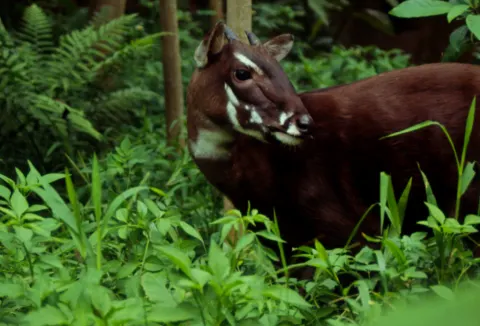
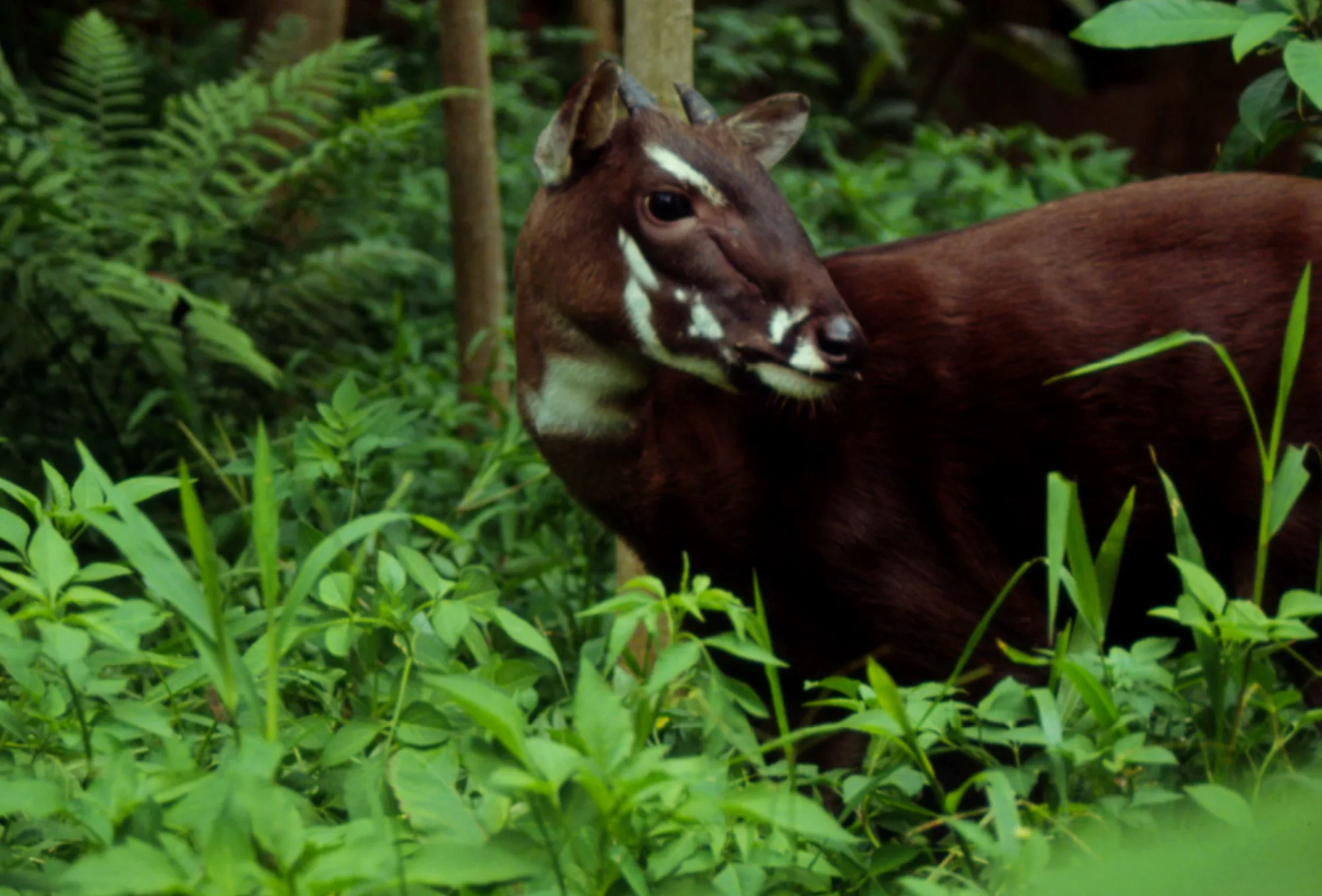
This elusive bovid, often called the Asian unicorn, is a forest dweller native to the Annamite Range of Laos and Vietnam. Reaching about 84 cm at the shoulder, the Saola is recognized by its chocolate brown coat marked with white patches on the face and throat. Both sexes carry long, dark, nearly parallel horns that resemble the spinning-wheel posts used by local people. This quiet animal moves through the landscape with a gentle nature, possessing large maxillary glands that it uses to mark vegetation with a pungent secretion.
Preferring river valleys, the species lives in wet evergreen or deciduous forests at altitudes ranging from 300 to 1,800 m. It is generally solitary, though groups of up to seven have been reported. Its diet includes broad-leaved shrubs, trees, and spleenwort, which it pulls into its mouth using a long, flexible tongue. Breeding likely occurs between August and November, with single calves born during the following summer.
With a population estimated at only 50 to 300 individuals in 2015, the Saola faces a precarious future. It is primarily threatened by habitat loss and fragmentation, alongside hunting for meat, traditional medicine, and the fur trade. Many individuals are accidentally caught in snares intended for other animals, such as wild boar. Because the species is so rare and avoids humans, scientists have never observed it in the wild, and the most recent camera trap record dates back to 2013.
Written from the English Wikipedia article Saola (CC BY-SA 4.0).
- Atlas places
- 0
These are open occurrence records, so they show where people looked for and recorded the Saola as much as where it lives. Cells are up to 25 km across, and every location is generalised to its cell.
No encounter zones yet
Where and when you can expect to see Saola is calculated from observation density. No zones have been computed for this species yet.