Eastern Brown Snake
Pseudonaja textilis
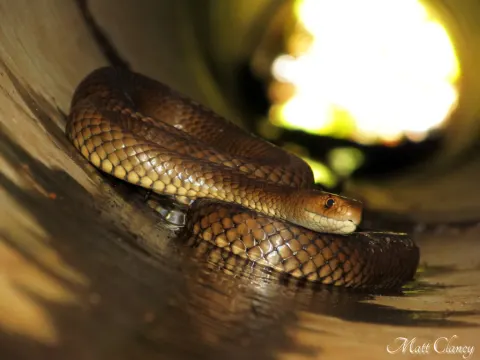
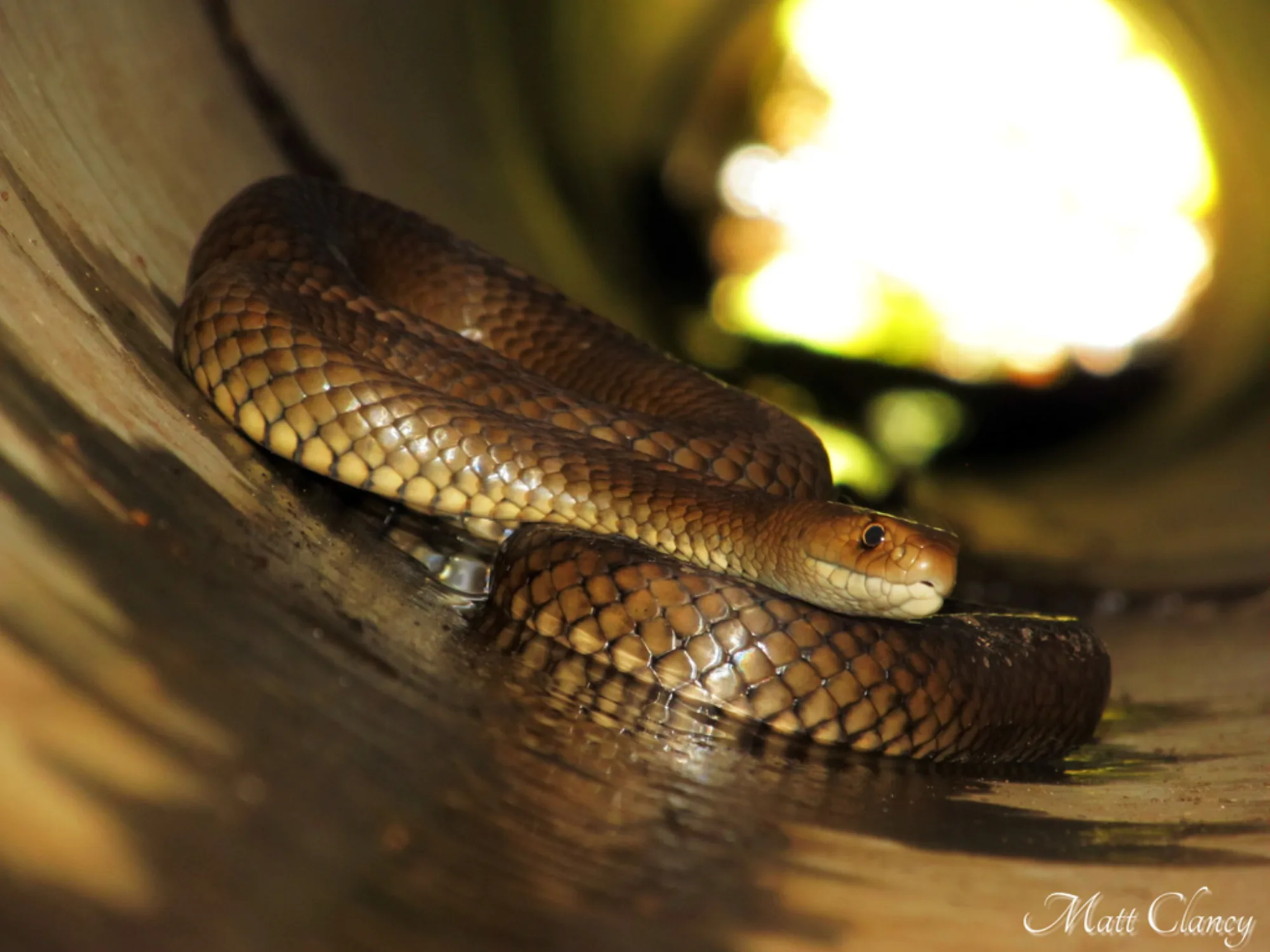
Slender and extremely venomous, the Eastern Brown Snake (Pseudonaja textilis) can grow to 2 m long. Adults vary in colour from pale brown to black, with a cream or pale yellow underside that often bears darker blotches. Young snakes generally have a black head, a lighter brown snout and a dark band behind the head; their bodies may be plain brown or patterned with black. Those darker markings fade as the snake grows.
Its range extends across eastern and central Australia and into southern New Guinea. It lives in habitats from coastal eucalypt forests and heath to grasslands, arid scrub and farmland, but favours open country. It also occurs on urban fringes and near houses and farms, where rodents provide food and buildings, rubbish and other cover offer shelter. Rocks, burrows and cracks in the ground also serve as hiding places.
Usually solitary and active by day, the snake is most active in spring, although it may emerge to bask on warm winter days. It searches for prey by sight, sometimes lifting its head to survey the surroundings, and usually finds animals in their shelters. House mice make up much of its diet, alongside other mammals, small birds, eggs and snakes; skinks are also eaten. When confronted, it may raise its body, flatten its neck or adopt an upright, S-shaped defensive posture. Females lay 10 to 35 eggs in sheltered places such as burrows or hollow logs. Cane toad toxins can harm the snake, although young snakes avoid eating the toads, and the king brown snake is a potential predator.
Written from the English Wikipedia article Eastern brown snake (CC BY-SA 4.0).
- Records
- 11,611
- Countries
- 1
- Atlas places
- 3
These are open occurrence records, so they show where people looked for and recorded the Eastern Brown Snake as much as where it lives. Cells are up to 25 km across, and every location is generalised to its cell.
Generalised encounter areas, not exact locations. Each shape is a grid cell coloured by how likely the species is there.
- Very likelyAustralia25 km zone · medium confidence · 11611 records · updated 80 days ago
Conservation status not assessed here yet, so every location is generalised to its grid cell.