Dugite
Pseudonaja affinis
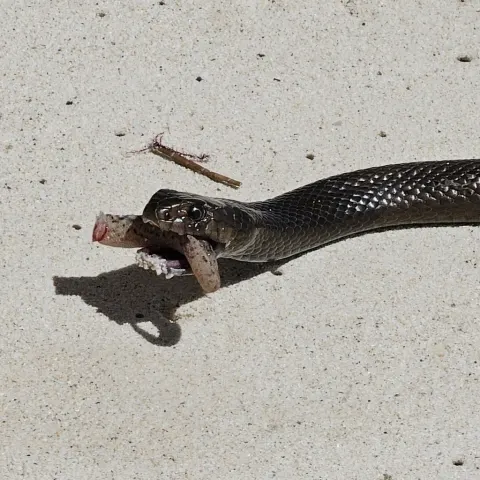
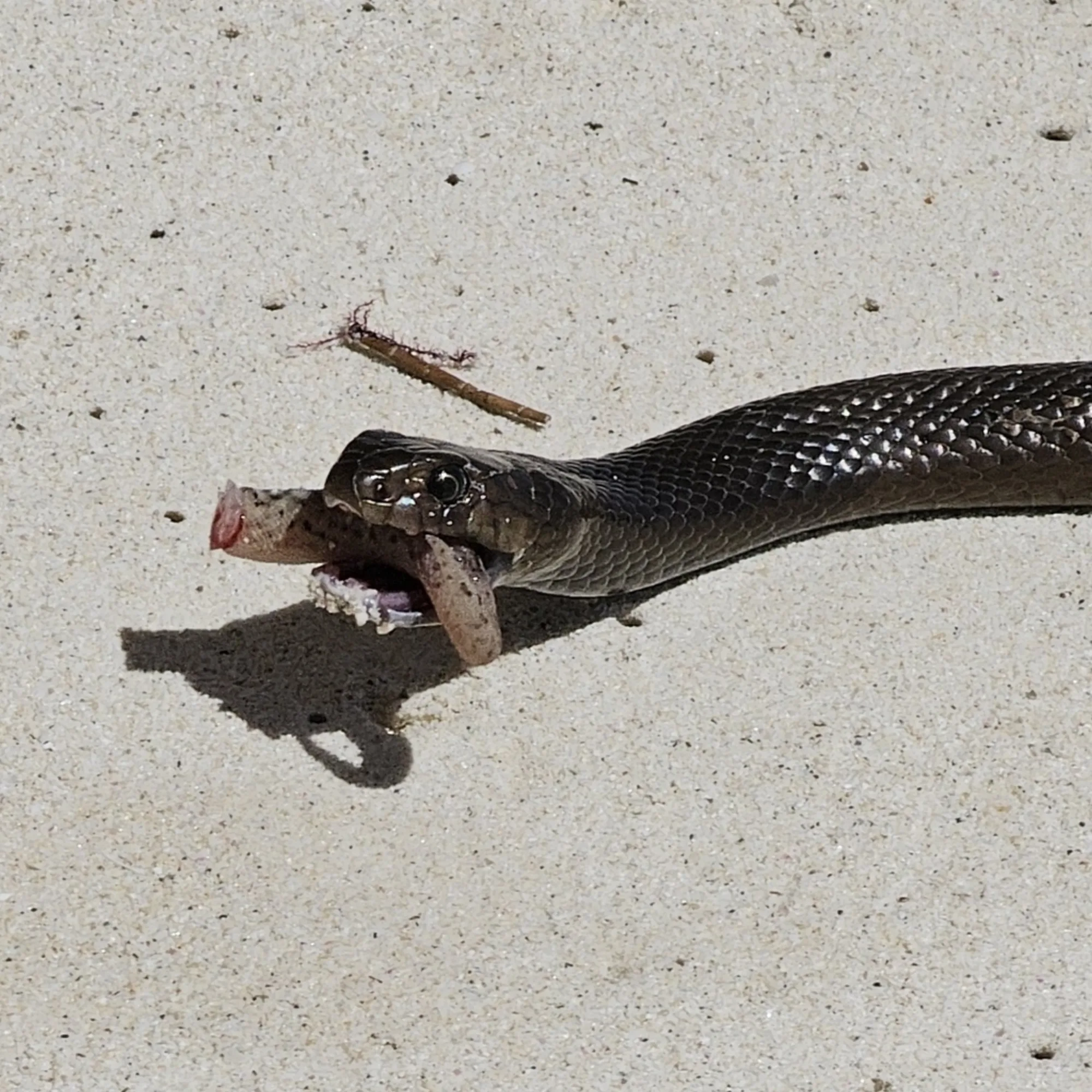
Long and slender, the Dugite is a highly venomous snake found in southern Western Australia and remote coastal parts of western South Australia. It usually reaches roughly 1.5 metres, though it can grow to 2 metres, including the tail. Its colour may be grey, green or brown, but varies too much between individuals to be a reliable guide. Scattered black scales may mark the body, and the scales have a semi-glossy appearance. Its small head, barely distinct from the neck, is a more useful feature.
Dugites occupy coastal dunes, heathlands, shrublands and woodlands, and can also be found in disturbed areas, including farmland, industrial sites and golf courses. Around Perth, they are among the snakes commonly found beside buildings. Near people, they shelter temporarily beneath materials such as concrete slabs and roofing tin; in natural habitats, they use rocks and abandoned termite mounds. They may also shelter beneath logs and burrow during winter. Active by day, they spend hot days moving mainly in the morning, with less activity in the afternoon. They eat lizards, other snakes, mice and rats, and generally retreat when disturbed, though a cornered snake will defend itself.
Breeding normally takes place between early September and late November. A female typically lays around 30 eggs, leaves them to incubate on their own, and they hatch after about 65 days. Under optimal conditions, a Dugite may lay two clutches in a season. The account gives no specific threats to the snake; its population has increased following the opening of natural habitats and the introduction of the house mouse, a main food source.
Written from the English Wikipedia article Dugite (CC BY-SA 4.0).
- Records
- 494
- Countries
- 1
No atlas park has a record of the Dugite in or around it yet.
These are open occurrence records, so they show where people looked for and recorded the Dugite as much as where it lives. Cells are up to 25 km across, and every location is generalised to its cell.
Generalised encounter areas, not exact locations. Each shape is a grid cell coloured by how likely the species is there.
- Very likelyAustralia25 km zone · medium confidence · 494 records · updated 80 days ago
Conservation status not assessed here yet, so every location is generalised to its grid cell.