Mariana Snailfish
Pseudoliparis swirei
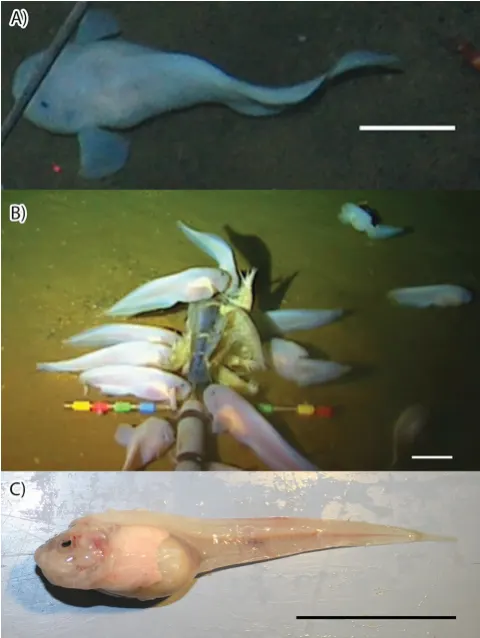
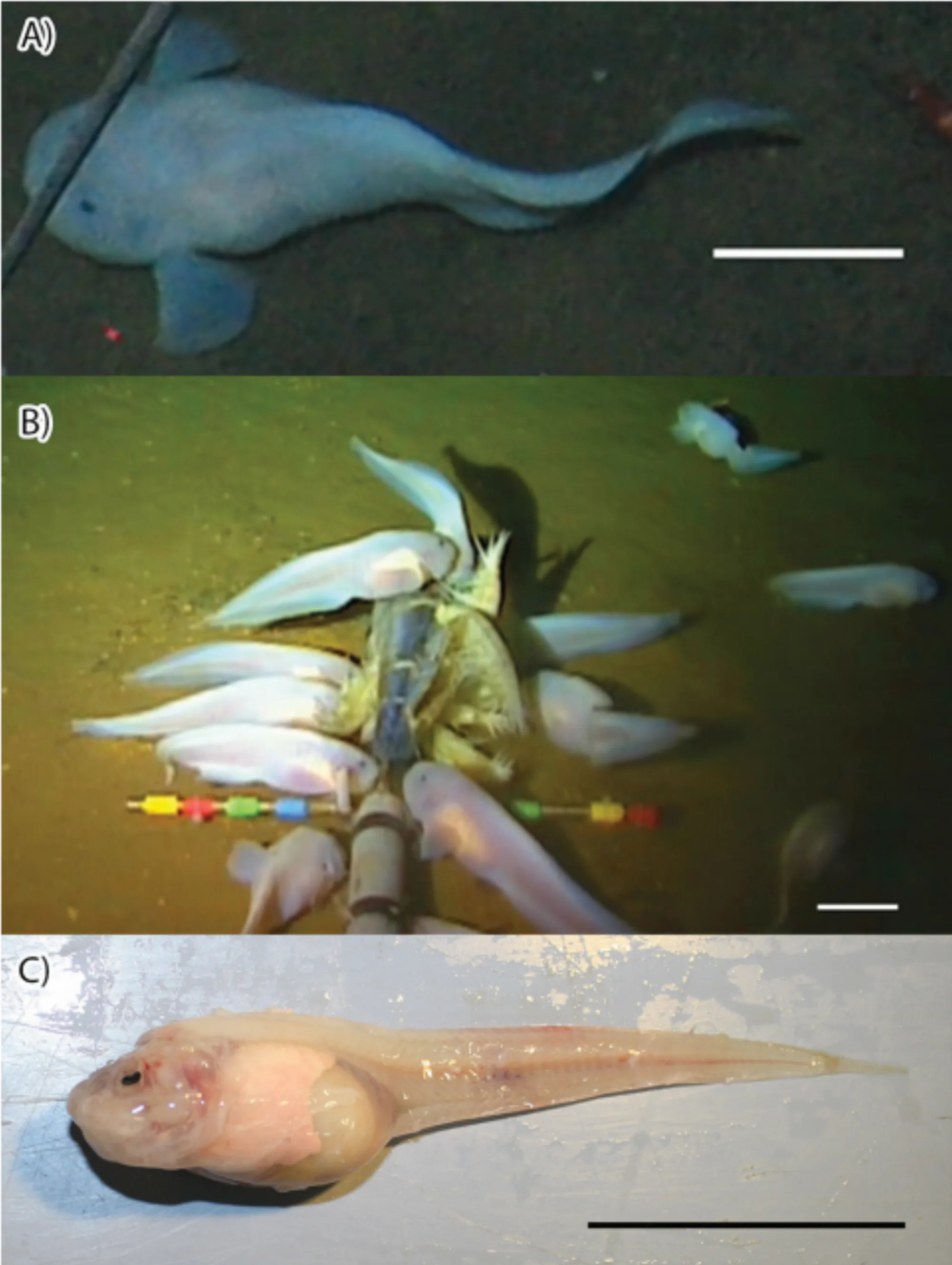
Deep in the Mariana Trench of the western Pacific Ocean, the Mariana Snailfish lives in darkness under high pressure. It has been recorded between 6,198 and 8,076 m, and one was captured at 7,966 m on the seafloor. Pale and shaped rather like a tadpole, it can reach 28.8 cm in standard length and weigh up to 160 g. Its skin is transparent and lacks pigment, and it seems to have very little sight, if any. Several adaptations help it live at these depths, including features that allow its proteins to function and its cell membranes to remain flexible.
The snailfish is abundant in its deep-sea habitat and appears to be the leading predator in some parts of the trench, where larger predators are scarce. It feeds on tiny crustaceans. Females produce relatively large eggs: a study found mature eggs up to 9.4 mm across, with as many as 23 in a female. These were interspersed with smaller, immature eggs, of which there were about 850, while eggs of intermediate size were rarely seen. There are indications that the larvae spend time away from the seabed, at shallower depths of less than 1,000 m.
Seeing one presents a considerable challenge: its known range lies thousands of metres down, and findings of hadal fish are limited. The first specimens were caught using deep-water traps designed to reduce damage during their ascent, with mackerel as bait. The first was caught on November 15, 2014, and another 35 were caught over the following 10 days. Another specimen was caught on January 29, 2017, during an expedition by the research ship Shinyo-maru.
Written from the English Wikipedia article Pseudoliparis swirei (CC BY-SA 4.0).
- Records
- 18
- Countries
- 1
No atlas park has a record of the Mariana Snailfish in or around it yet.
These are open occurrence records, so they show where people looked for and recorded the Mariana Snailfish as much as where it lives. Cells are up to 25 km across, and every location is generalised to its cell.
Generalised encounter areas, not exact locations. Each shape is a grid cell coloured by how likely the species is there.
- Very likelyGuam25 km zone · medium confidence · 18 records · updated 80 days ago
Conservation status not assessed here yet, so every location is generalised to its grid cell.