Bharal
Pseudois nayaur
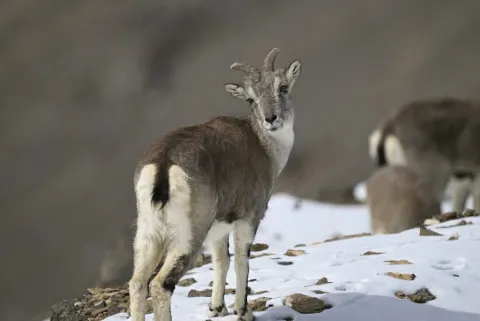
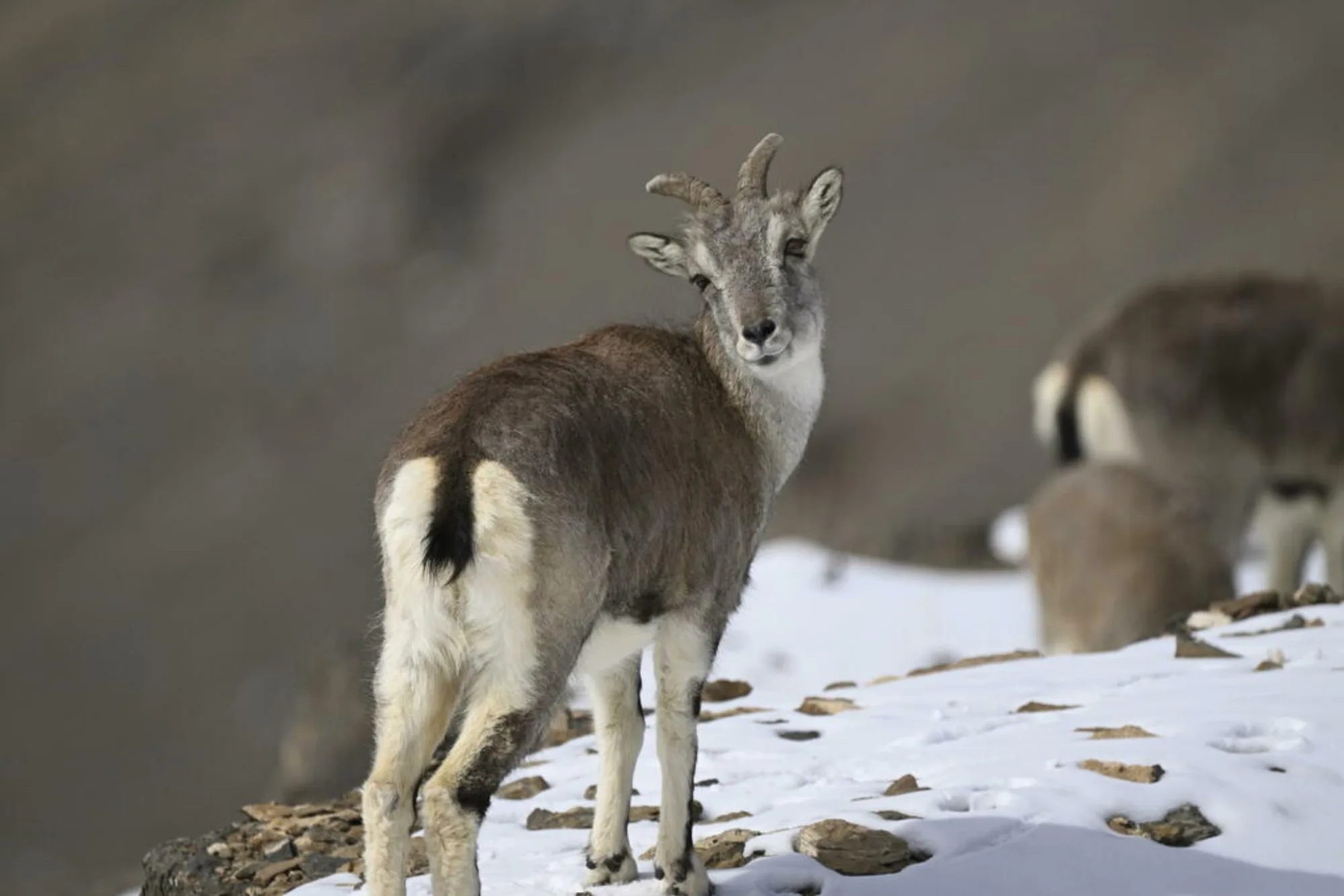
Known as the blue sheep, the Bharal is a medium-sized animal of the high Himalayas, with dense slate-grey fur that can have a bluish sheen. Its belly and the backs of its legs are white, contrasting with a black chest and black fronts to the legs. Both sexes carry horns, but those of males are larger and curve backwards, reaching up to 80 cm. Females have shorter, straighter horns that can reach 20 cm. Adults measure 115 to 165 cm in body length and weigh around 35 to 75 kg.
Bharal occur in Bhutan, China, India, Myanmar, Nepal and Pakistan, including on alpine meadows and rocky Himalayan slopes at 2,200 to 5,500 m. In China's Sichuan region, they also occupy grassy mountain slopes with ridges. A smaller form lives on dry, grassy slopes in the upper Yangtze gorge, while the Helanshan form occurs in mountain forests of the Helan range. Active throughout the day, Bharal alternate between feeding and resting on grassy slopes. When approached, they often stay still, relying on their colouring to blend into their surroundings. If noticed, they may dash towards steep cliffs and freeze against the rock. They mainly eat grass, turning to forbs and shrubs when grass is scarce. In winter, herds gather in valleys. The rut runs from late November to mid-January. Snow leopards favour Bharal as prey where their ranges overlap, and Himalayan wolves and leopards also hunt them. Poaching for meat and competition with livestock are threats, although the rugged mountain habitat limits their impact.
Written from the English Wikipedia article Bharal (CC BY-SA 4.0).
- Records
- 44
- Countries
- 3
- Atlas places
- 3
These are open occurrence records, so they show where people looked for and recorded the Bharal as much as where it lives. Cells are up to 25 km across, and every location is generalised to its cell.
Generalised encounter areas, not exact locations. Each shape is a grid cell coloured by how likely the species is there.
- Very likelyIndia25 km zone · medium confidence · 25 records · updated 80 days ago
- Very likelyChina25 km zone · medium confidence · 11 records · updated 80 days ago
- Very likelyNepal25 km zone · medium confidence · 8 records · updated 80 days ago
Conservation status not assessed here yet, so every location is generalised to its grid cell.