Common Ringtail
Pseudocheirus peregrinus
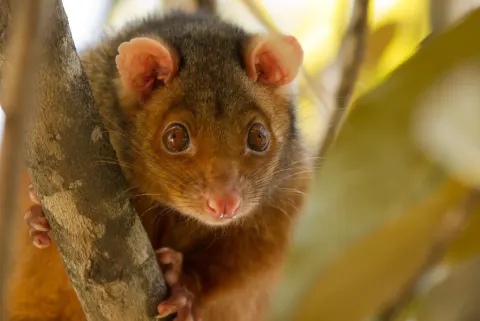
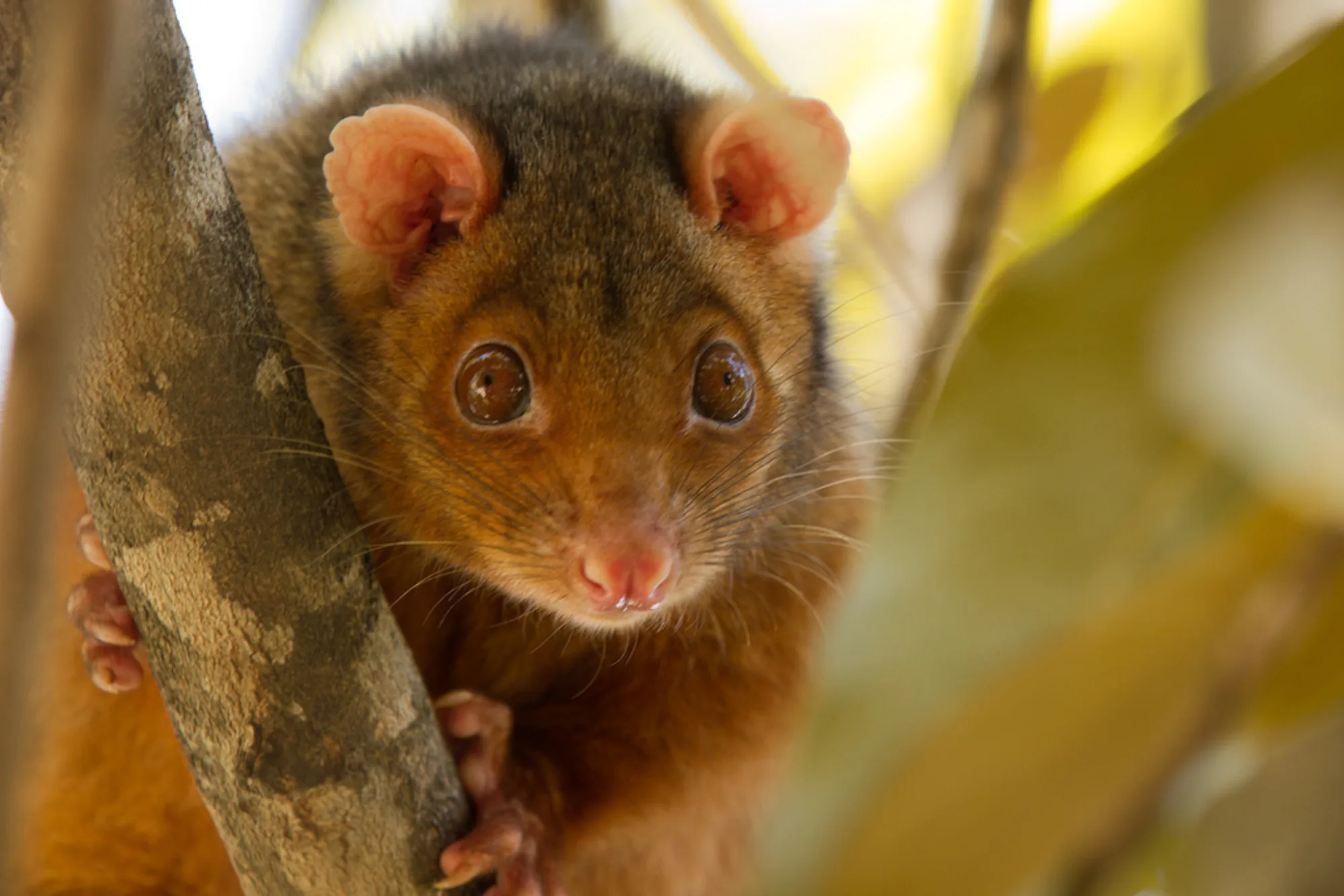
With grey or black fur, pale patches behind its eyes and a usually cream-coloured belly, the Common Ringtail is a small Australian marsupial. Its long, gripping tail has a distinctive white tip, and is roughly as long as its 30 to 35 cm body. Adults weigh between 550 and 1,100 g. It lives along Australia's east coast, in Tasmania and in part of southwestern Australia. It favours dense, brushy forest, especially eucalyptus forest, and is rare in drier environments.
Nocturnal and at home in the trees, the possum relies on its tail for support but sometimes comes down to the ground. Listen for soft, high-pitched, twittering calls. It eats leaves, flowers, fruit and sap from native and introduced plants, favouring young leaves when it forages. Some populations also eat cypress pine leaves, wattles, and plant gum or resins. During daytime rests, it eats material that has already passed through its digestive system, a process that helps it gain more protein and maintain its energy balance. Ringtail possums live in groups centred on communal nests, building them from branches or using tree hollows. A group may build several nests at different sites and will drive unfamiliar ringtails away from them.
Most young are born between May and July, and the average litter is two. The young leave their mother's pouch at 120 to 130 days and later use the communal nest. Land clearing destroys habitat, while introduced red foxes prey heavily on ringtails. In suburban areas, cars, snakes, cats and dogs also kill them.
Written from the English Wikipedia article Common ringtail possum (CC BY-SA 4.0).
- Records
- 118,123
- Countries
- 1
- Atlas places
- 3
These are open occurrence records, so they show where people looked for and recorded the Common Ringtail as much as where it lives. Cells are up to 25 km across, and every location is generalised to its cell.
Generalised encounter areas, not exact locations. Each shape is a grid cell coloured by how likely the species is there.
- Very likelyAustralia25 km zone · high confidence · 118123 records · updated 80 days ago
Conservation status not assessed here yet, so every location is generalised to its grid cell.