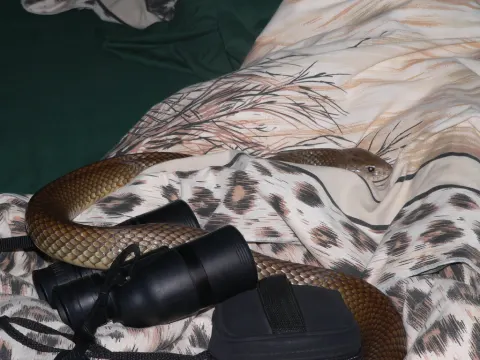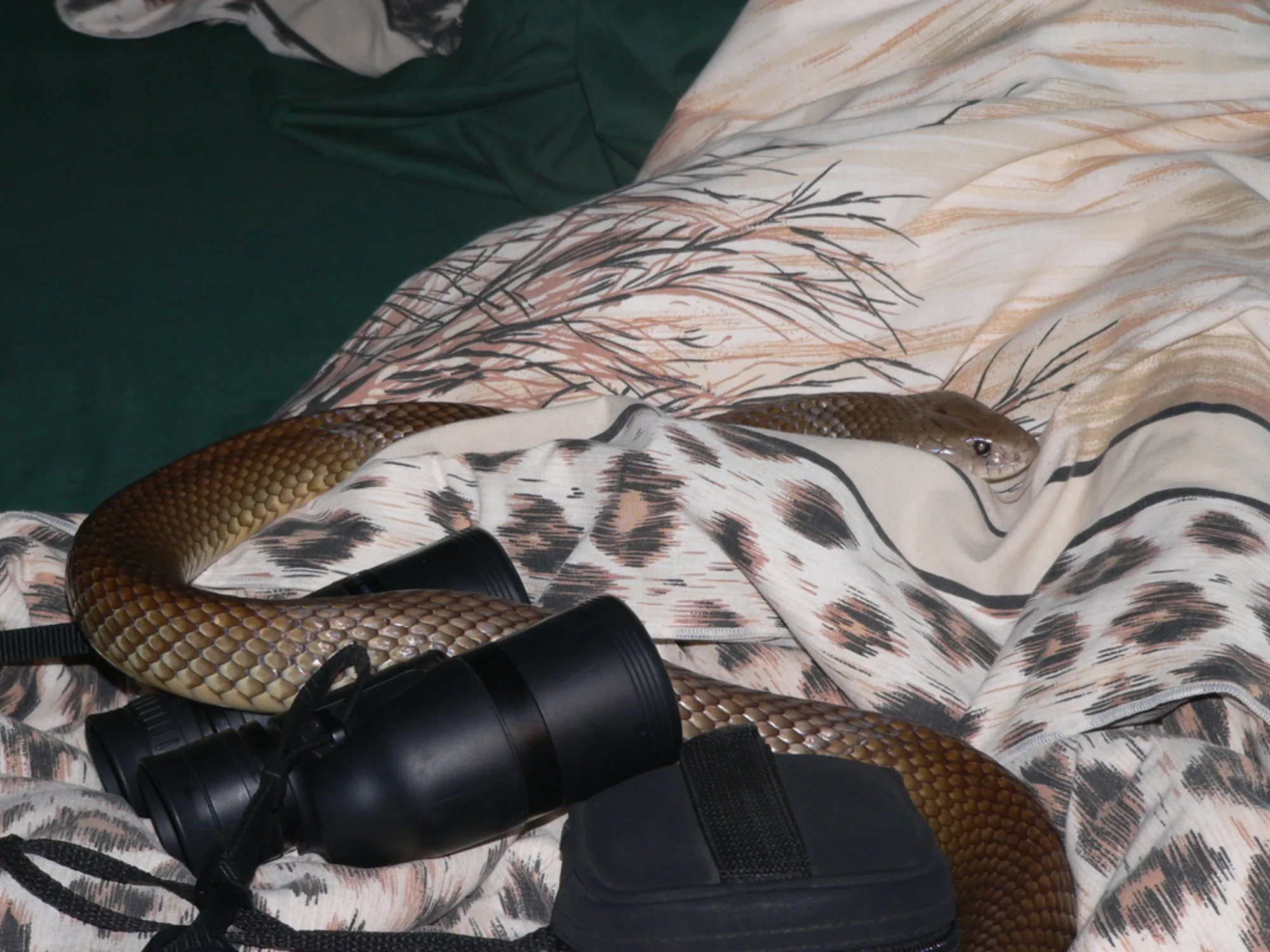
King Brown Or Mulga Snake
Pseudechis australis
Australia's largest terrestrial venomous snake, the King Brown Or Mulga Snake can reach 3.3 m in length and has a robust build. Its colour varies across its range: northern snakes are tan, while southern animals can be dark brown to blackish. Two-toned scales can give the upper body a patterned appearance, and the cream or white underside often has orange marks. Its head is slightly wider than its body, with prominent cheeks and small eyes.
The snake occurs in every Australian state except Victoria and Tasmania, although it has become rare or disappeared from parts of coastal Queensland. It inhabits woodlands, grasslands, scrub and sparsely vegetated deserts, and favours moister places such as watercourses in arid and semiarid areas. It is also seen around wheat fields, rubbish piles and empty buildings. Most active at dusk, it shelters in soil crevices, old animal burrows, or beneath rocks and logs; during warmer months, it emerges later after sunset. In cooler climates it is more active during daylight, while in hotter places it is more active after dark.
An opportunistic hunter, it eats frogs, lizards, other snakes, birds, small mammals and spiders, taking a greater proportion of frogs in wetter areas. It has also been reported eating roadkill and shed reptile skins, and sometimes eats its own kind. Females lay clutches of four to 19 eggs, with hatching occurring after roughly 70 to 100 days. Cane toads are a threat: the snakes are sensitive to their toxins and have died after eating them. Young snakes may be taken by birds of prey, while individuals can become trapped in mine shafts and wellbores.
Written from the English Wikipedia article King brown snake (CC BY-SA 4.0).
- Records
- 1,464
- Countries
- 1
- Atlas places
- 2
These are open occurrence records, so they show where people looked for and recorded the King Brown Or Mulga Snake as much as where it lives. Cells are up to 25 km across, and every location is generalised to its cell.
Generalised encounter areas, not exact locations. Each shape is a grid cell coloured by how likely the species is there.
- Very likelyAustralia25 km zone · medium confidence · 1464 records · updated 80 days ago
Conservation status not assessed here yet, so every location is generalised to its grid cell.