Pacific Chorus Frog
Pseudacris regilla
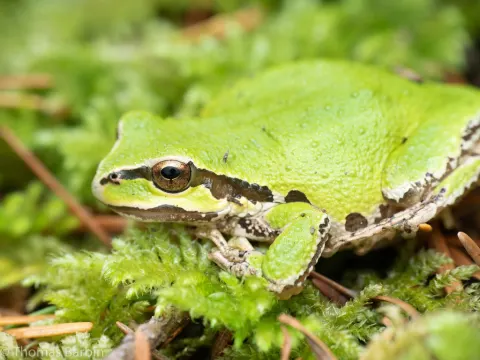
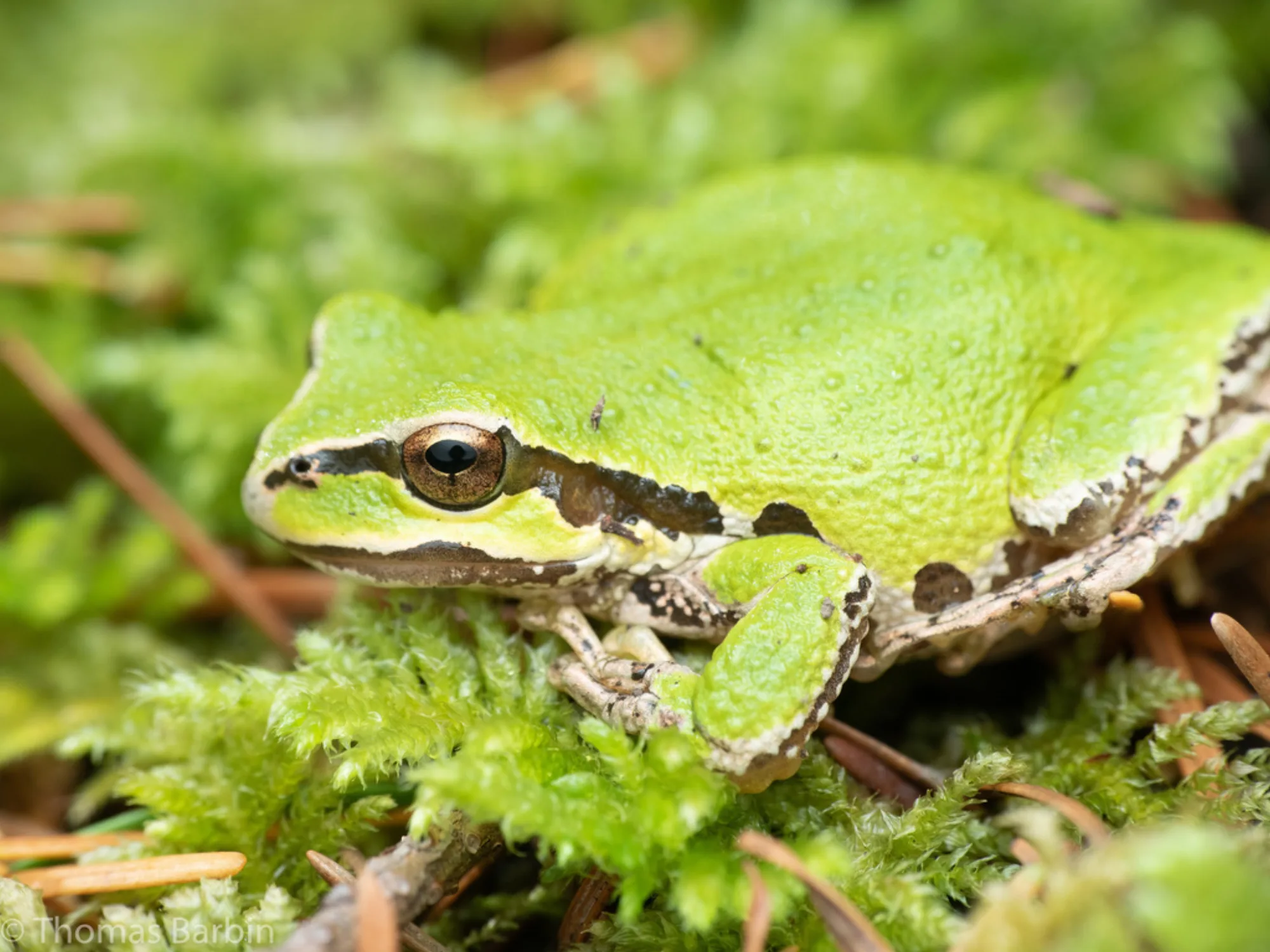
A dark stripe running from nose to shoulder, crossing the eye along the way, is a useful mark for recognising the Pacific Chorus Frog. Most have green or brown colouring above a light belly, with dark, sometimes spotty markings on their backs and sides. Their skin has small bumps, and their long legs give them a slender look. Some can shift between green and brown, while changes from lighter to darker shades can begin within hours.
Look for them across the Pacific Northwest, from northern California through Oregon and Washington to British Columbia and extreme southern Alaska. They also occur west of the Rockies in Idaho and Montana. Their varied habitat includes woodland, grassland, pasture, streamside areas and urban gardens with ponds. They live near ponds, streams and lakes, but can also be found farther from water. Mostly active at night, they sometimes move and call during the day, though they can be hard to spot among long grass, leaf litter, rocks and rotting logs. Their calls include a loud “ribbit” or “crek-ek”, and males also make a long dry-land call during much of the year.
Sticky toe pads help these frogs climb vegetation and other surfaces, where they wait to ambush spiders, beetles, flies, ants and other small prey. Breeding usually runs from December to May, with variation according to local conditions and altitude. Males gather at water and call together, drawing females towards them. Females lay clumps of eggs in shallow, calm pond water, usually among vegetation and leaf litter. Tadpoles feed on algae, diatoms and pollen. Snakes, raccoons, herons and egrets prey on the frogs, while rough-skinned newts and other amphibians may eat their eggs.
Written from the English Wikipedia article Pacific tree frog (CC BY-SA 4.0).
- Records
- 8,985
- Countries
- 3
- Atlas places
- 5
These are open occurrence records, so they show where people looked for and recorded the Pacific Chorus Frog as much as where it lives. Cells are up to 25 km across, and every location is generalised to its cell.
Generalised encounter areas, not exact locations. Each shape is a grid cell coloured by how likely the species is there.
- Very likelyUnited States25 km zone · high confidence · 7726 records · updated 80 days ago
- Very likelyCanada25 km zone · medium confidence · 1170 records · updated 80 days ago
- Very likelyMexico25 km zone · medium confidence · 89 records · updated 80 days ago
Conservation status not assessed here yet, so every location is generalised to its grid cell.