American Bushtit
Psaltriparus minimus
Small, sociable and long-tailed, the American Bushtit is a songbird that can be found from Vancouver south to Guatemala. Its range runs through the western United States, the Great Basin, California's lowlands and foothills, and the Mexican highlands. It usually lives in mixed open woodland with oaks and scrubby chaparral beneath them, but also visits gardens and parks.
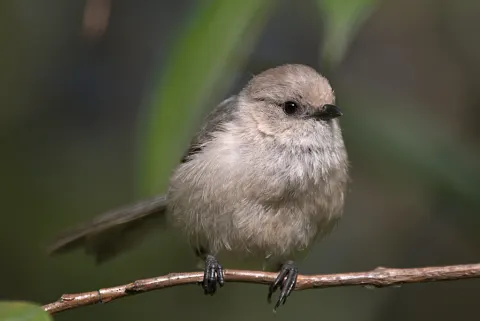
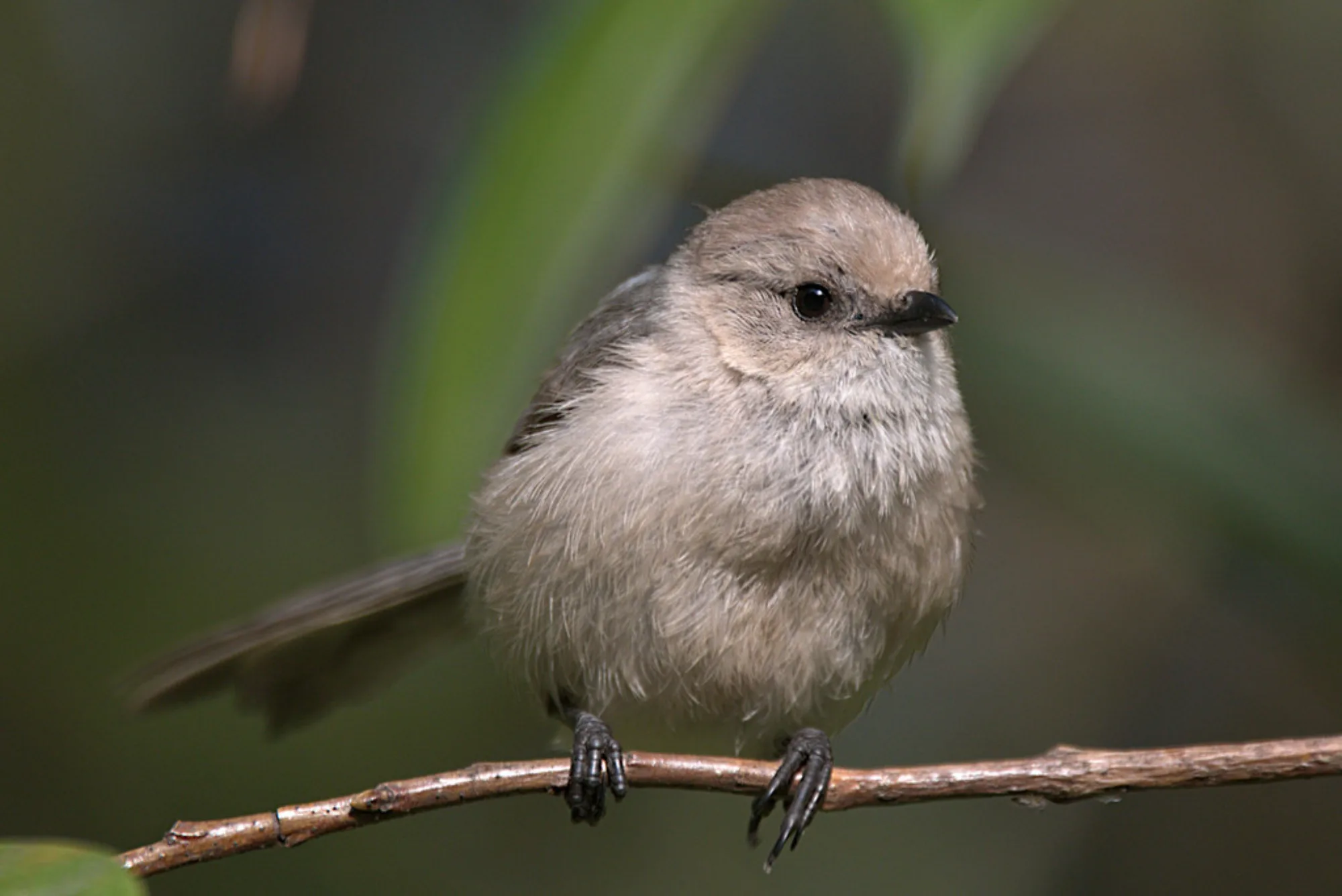
At 100 to 110 mm long and weighing 4.5 to 6 g, it is among North America's smallest passerines. Its plumage is mostly grey-brown, with a large head, short neck and small, stubby bill. Adult females have yellow eyes, while males have dark brown to black eyes. Coastal birds often show a brown crown, whereas inland birds have a brown mask across the face.
Active flocks of 10 to 40 birds forage for small insects and spiders, sometimes alongside chickadees and warblers. Their brief calls keep group members in contact as they feed. Both sexes build a hanging nest from spider webs and plant material, lining it with soft materials such as feathers and fur. Construction can take up to a month, and adults connected to the nest sleep inside while it is in use. Both parents incubate the eggs and feed the young, with help sometimes coming from older siblings or other adult males. Once the young are able to fly, they move out and spend the night on branches. Sharp-shinned hawks and other birds of prey hunt bushtits, while disturbance early in nesting can cause them to abandon an attempt.
Written from the English Wikipedia article American bushtit (CC BY-SA 4.0).
- Records
- 2,028,383
- Countries
- 4
- Atlas places
- 4
These are open occurrence records, so they show where people looked for and recorded the American Bushtit as much as where it lives. Cells are up to 25 km across, and every location is generalised to its cell.
Generalised encounter areas, not exact locations. Each shape is a grid cell coloured by how likely the species is there.
- Very likelyUnited States25 km zone · high confidence · 1881157 records · updated 80 days ago
- Very likelyCanada25 km zone · high confidence · 118398 records · updated 80 days ago
- Very likelyMexico25 km zone · high confidence · 24488 records · updated 80 days ago
- Very likelyGuatemala25 km zone · high confidence · 4340 records · updated 80 days ago
Conservation status not assessed here yet, so every location is generalised to its grid cell.