Dunnock
Prunella modularis
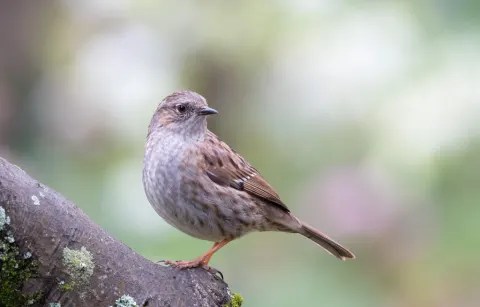
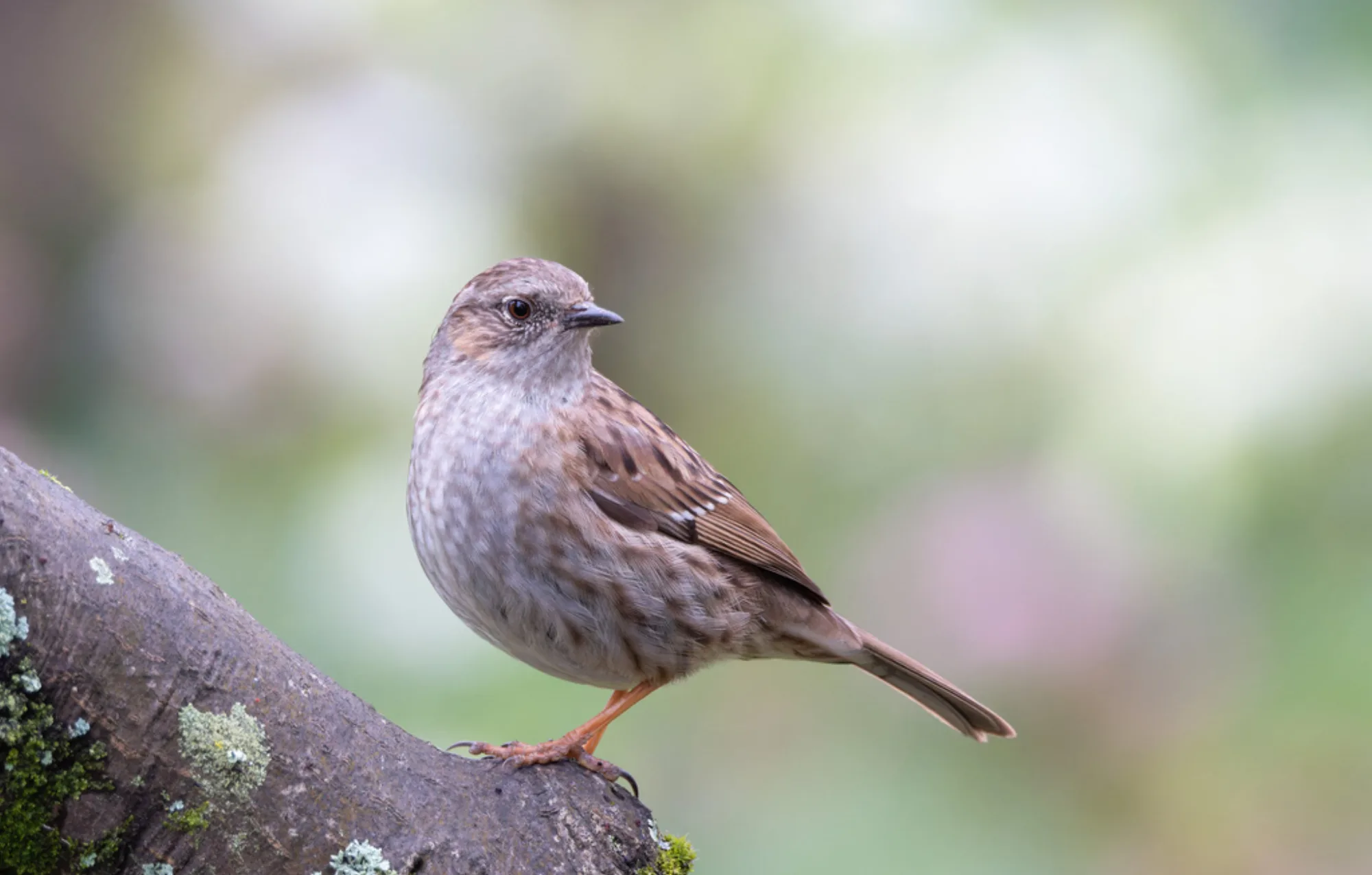
Small and easily overlooked, the Dunnock is a perching bird about the size of a robin, typically measuring 13 to 14.5 cm long. Its brown back has blackish streaks, its underside is brownish, and its bill is fine and pointed. Adults have dull grey heads, while young birds have browner heads and more conspicuous streaking. Watch for frequent flicks of the wings, especially during territorial disputes, or listen for a persistent, shrill tseep and a rapid, thin, tinkling song.
Dunnocks occur across temperate Europe and into Asian Russia, and their native range also reaches Lebanon, the Caucasus and northern Iran. Introduced to New Zealand in the 19th century, they are now widespread there and on some offshore islands. They favour woodland, shrubs, gardens and hedgerows, usually feeding on the ground. Their food often includes creatures that feed on decaying matter, as well as seeds, particularly in winter.
These birds defend territories and may confront others that come close to their nests. Males sometimes share a territory, while females usually occupy separate ranges; in some cases, several males cooperate to defend an area containing several females. A nest is built low in a bush or conifer, mostly from twigs and moss, with a soft lining that may include wool or feathers. A typical clutch contains three to five unspotted blue eggs. Nestlings may be fed by a female alone or by several adults, and two males and a female can often be seen bringing food to the same nest. Predation is a threat, and the bird's subdued colouring may help conceal it.
Written from the English Wikipedia article Dunnock (CC BY-SA 4.0).
- Records
- 1,168,957
- Countries
- 63
- Atlas places
- 1
These are open occurrence records, so they show where people looked for and recorded the Dunnock as much as where it lives. Cells are up to 25 km across, and every location is generalised to its cell.
Generalised encounter areas, not exact locations. Each shape is a grid cell coloured by how likely the species is there.
- Very likelyUnited Kingdom25 km zone · high confidence · 533231 records · updated 86 days ago
- Very likelyFinland25 km zone · high confidence · 141734 records · updated 86 days ago
- Very likelyBelgium25 km zone · high confidence · 137971 records · updated 86 days ago
- Very likelySweden25 km zone · high confidence · 119703 records · updated 86 days ago
- Very likelyFrance25 km zone · high confidence · 64408 records · updated 86 days ago
- Very likelyNorway25 km zone · high confidence · 41981 records · updated 86 days ago
- Very likelyNew Zealand25 km zone · high confidence · 34408 records · updated 86 days ago
- Very likelyNetherlands25 km zone · high confidence · 16653 records · updated 86 days ago
- Very likelyGermany25 km zone · high confidence · 11855 records · updated 86 days ago
- Very likelySpain25 km zone · high confidence · 11144 records · updated today
Conservation status not assessed here yet, so every location is generalised to its grid cell.