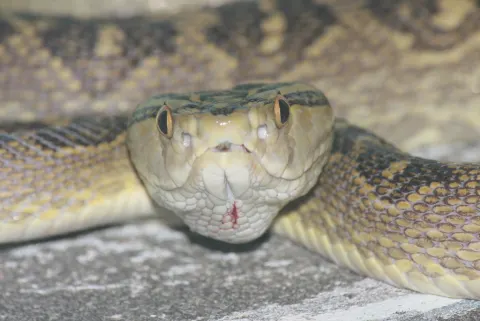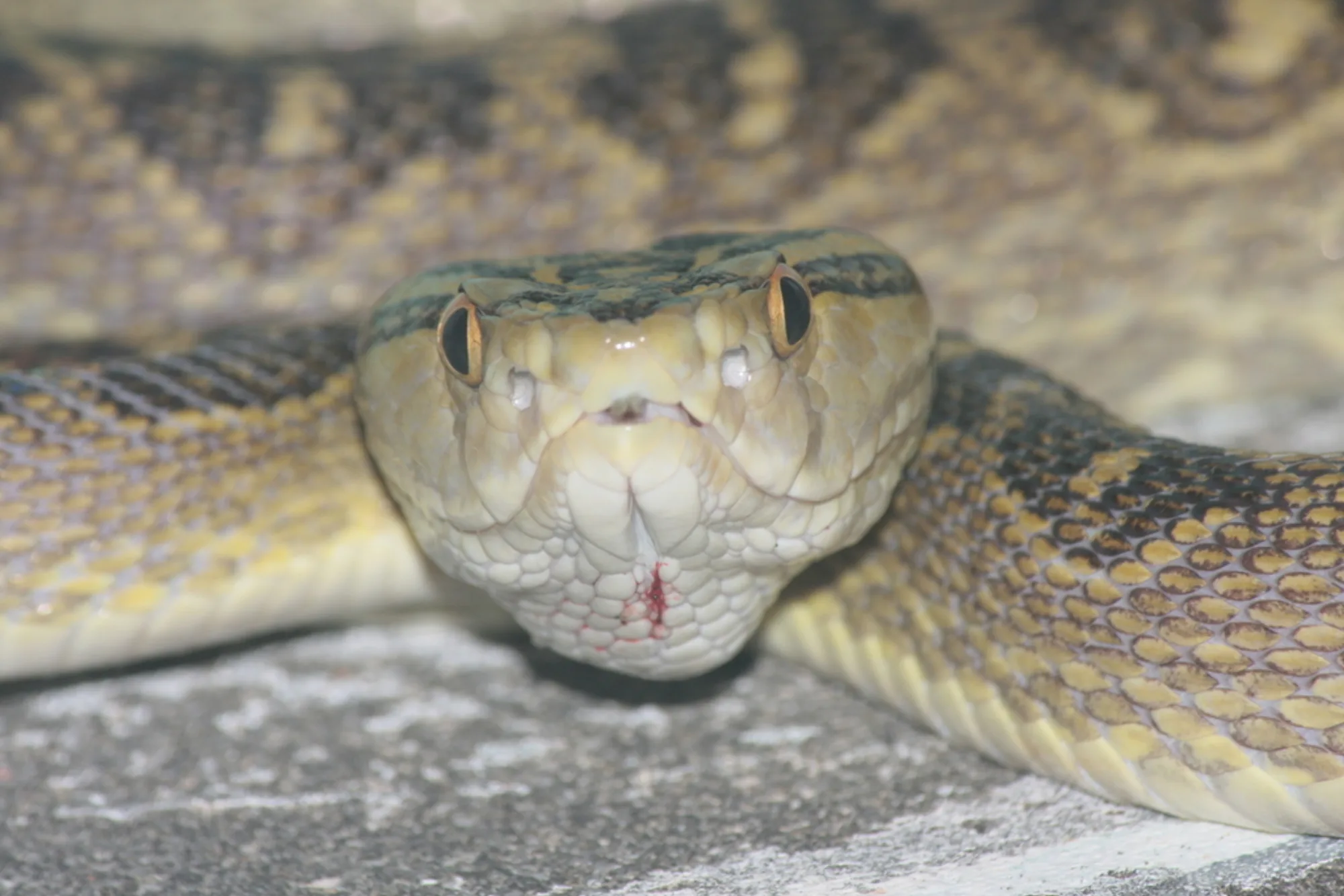
Habu
Protobothrops flavoviridis
A venomous pit viper native to Japan's Ryukyu Islands, the Habu has a slender body and a large head. Its light olive or brown colouring is patterned with long, dark green or brownish blotches edged in yellow. These markings sometimes contain yellow spots and often join into wavy stripes, while the belly is whitish with dark edges. Adults average 120 to 150 cm in total length, including the tail, and can reach 240 cm.
In the Ryukyu Islands, it occurs on Okinawa and the Amami Islands, and is common on larger volcanic islands but absent from smaller coral islands. Look for its habitat along the boundary between palm forest and cultivated fields; it also occurs among rock walls, old tombs and caves. The snake lives on the ground and is mostly active at night, sometimes entering homes and other buildings in search of rats and mice. It is bold and irritable, with a quick strike and a long reach, and its highly toxic venom can cause serious harm. Mating takes place in early spring, and females lay up to 18 eggs in mid-summer. After 5-6 weeks of incubation, the young emerge at 25 cm long and resemble the adults.
On Okinawa, the Habu is heavily collected, mainly for use in habushu, a liquor made with awamori. A small Indian mongoose was introduced there in 1910 to reduce Habu numbers, although the effects of that introduction have not been studied.
Written from the English Wikipedia article Protobothrops flavoviridis (CC BY-SA 4.0).
- Records
- 10
- Countries
- 1
No atlas park has a record of the Habu in or around it yet.
These are open occurrence records, so they show where people looked for and recorded the Habu as much as where it lives. Cells are up to 25 km across, and every location is generalised to its cell.
Generalised encounter areas, not exact locations. Each shape is a grid cell coloured by how likely the species is there.
- Very likelyJapan25 km zone · medium confidence · 10 records · updated 80 days ago
Conservation status not assessed here yet, so every location is generalised to its grid cell.